Facts
DRI officers intercepted a bus travelling from Gorakhpur to Delhi during the intervening night of 4–5 September 2020 and recovered 3,998.83 grams of gold valued at approximately ₹2.12 crore from Manoj Kumar Nishad and Rajan Kumar Sahani.
Source reference: p. 4The gold was seized on the belief that it was of foreign origin and smuggled into India.
Source reference: p. 4The appellants claimed that the gold had been domestically purchased by M/s Bajrang Bullion Traders, Gorakhpur, and was supported by vouchers, invoices, stock records and GST-related documents.
Source reference: pp. 4–5, 20–24The gold had no foreign markings and its purity was reported as 99.92%, 97.81%, 99.26% and 89.34%.
Source reference: pp. 5, 11The adjudicating authority ordered confiscation under Section 111 of the Customs Act, 1962, and imposed penalties under Section 112.
Source reference: no citationIn its earlier order dated 24 April 2025, the Tribunal had set aside the order, inter alia, on the ground that Section 138-B had not been complied with.
Source reference: pp. 2–4The Allahabad High Court quashed that order and directed the Tribunal to determine whether the appellants had actually requested cross-examination of the witnesses and thereafter decide the appeals afresh on merits.
Source reference: pp. 2–4During the de novo hearing, the appellants conceded that no specific request for cross-examination had been made before the adjudicating authority.
Source reference: p. 4Issues
Whether the appellants had requested cross-examination of the witnesses whose statements were relied upon, and whether non-compliance with Section 138-B of the Customs Act consequently violated natural justice?
Source reference: pp. 2–4Whether the seizure was supported by the “reasonable belief” required under Section 110 of the Customs Act so as to attract the burden-shifting presumption under Section 123?
Source reference: pp. 10–20Whether the Department established that the seized gold was smuggled and consequently liable to confiscation under Section 111, and whether penalties under Section 112 were sustainable?
Source reference: pp. 20–31Law Applied
Section 110 of the Customs Act, 1962 permits seizure only where the proper officer has a reasonable belief that the goods are liable to confiscation; such belief must be founded on objective and definite material existing at the time of seizure, and cannot be based merely on suspicion or conjecture.
Source reference: pp. 10–17Section 123 shifts the burden of proving that specified goods are not smuggled only when the statutory preconditions, including a valid seizure founded on reasonable belief, are satisfied.
Source reference: pp. 10–11, 19–20Sections 111 and 112 concern confiscation of improperly imported goods and penalties for acts rendering goods liable to confiscation.
Source reference: no citationSection 138-B requires statements sought to be relied upon to satisfy the statutory conditions for admissibility; where cross-examination is specifically requested, it must ordinarily be afforded, or reasons for its non-availability must be recorded.
Source reference: pp. 2–4The Tribunal relied upon Shantilal Mehta v. Union of India, Balanagu Naga Venkata Raghavendra v. CC, Vijayawada, Ahmed Mujjaba Khaleefa, and related authorities for the principles that reasonable belief must precede the seizure, that unmarked gold found away from a customs area does not by itself establish smuggling, and that the Department must prove the smuggled nature of the goods where Section 123 is not attracted.
Source reference: pp. 11–20Reasoning
The Tribunal first held that, since the appellants admitted that they had made no specific request for cross-examination, the procedural safeguard under Section 138-B could not be invoked to invalidate the adjudication; accordingly, the earlier finding of breach of natural justice was not sustainable.
Source reference: p. 4On merits, the Tribunal found that the gold was seized in an inland area, far from a customs station, bore no foreign markings, and had varying purity levels rather than uniform 99.99% purity.
Source reference: pp. 10–11The Department produced no reliable evidence identifying the foreign source, route of importation, persons involved in smuggling, or the manner in which the gold entered India.
Source reference: pp. 18–21The general statements relied upon by the Department did not provide material particulars of smuggling and were contradicted by the appellants’ documentary evidence.
Source reference: no citationThe Tribunal further found that the investigation into the domestic suppliers was incomplete: the Department did not verify the disputed signatures or conclusively disprove the purchase, melting, stock and sale records produced by the appellants.
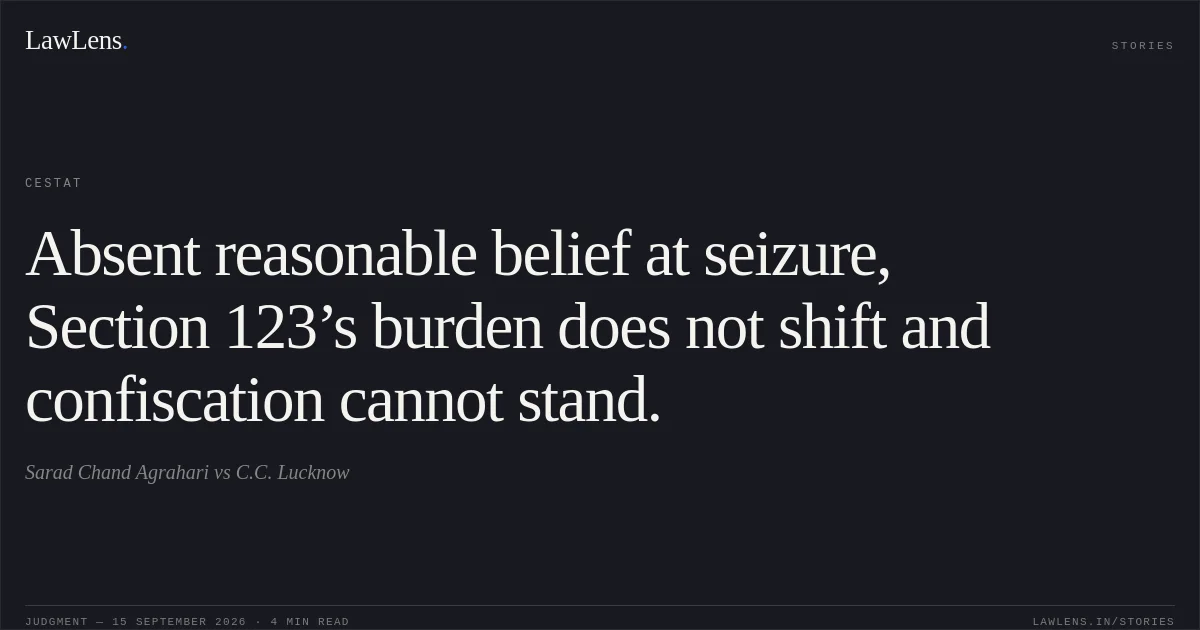
Source reference: pp. 19–25Since reasonable belief at the time of seizure was not established, Section 123 did not shift the burden to the appellants; in any event, the appellants had produced sufficient evidence indicating domestic procurement.
Source reference: pp. 19–31Consequently, the Department failed to establish that the gold was smuggled or liable to confiscation.
Source reference: no citationHolding
The Tribunal held that the appellants had not requested cross-examination and therefore could not challenge the adjudication solely on the basis of non-compliance with Section 138-B.
However, it held that the Department failed to establish the requisite reasonable belief under Section 110 and failed to prove that the gold was smuggled.
Source reference: pp. 19–31Section 123 was therefore inapplicable, and the gold was not liable to confiscation under Section 111.
Source reference: pp. 19–31As the confiscation failed, the penalties imposed under Section 112 also could not be sustained.
Source reference: no citationThe impugned adjudication order was set aside, all six appeals were allowed, and consequential relief was granted in accordance with law.
Source reference: p. 31Acts & Sections Cited
7 provisions across 1 statute referred to in this judgment. Each provision opens on LawLens.
Original Court PDF
Sarad Chand AgraharivsC.C. Lucknow
Click to open original judgment
Original judgment, available to read, download and summarize on LawLens.in