Facts
The Karnataka Public Service Commission (KPSC) issued a notification on 03.11.2011 for 362 Gazetted Probationer posts under the Karnataka Recruitment of Gazetted Probationers Rules, 1997
Source reference: para. 3.1The Respondent, an ex-serviceman, was selected as Assistant Commissioner of Commercial Taxes and joined duty on 09.05.2022
Source reference: para. 3.2–3.3However, another candidate (Sri Aiyappa M.A.), selected for the higher-preference post of Assistant Commissioner (KAS), failed to undergo medical examination or report for duty
Source reference: para. 3.3On 26.05.2022, the Respondent sought appointment to Aiyappa’s unfilled post, claiming he was the next eligible candidate in the merit list
Source reference: para. 3.4The Department of Personnel and Administrative Reforms (DPAR) rejected this on 27.06.2022, stating the 1997 Rules lack provisions for an additional select list
Source reference: para. 3.5The Karnataka State Administrative Tribunal (KSAT) upheld the DPAR’s decision
Source reference: para. 3.8but the High Court of Karnataka reversed it, directing the State to consider the Respondent
Source reference: para. 3.10Issues
1. Whether a vacancy arising from a selected candidate's failure to join or complete pre-appointment formalities can be claimed as a matter of right by the candidate next in merit under the 1997 Rules
Source reference: para. 52. Whether the absence of an express provision for a waiting or reserve list in the recruitment rules precludes the operation of a select list beyond the initial notified vacancies
Source reference: para. 8, 15Law Applied
The Court primarily applied Rule 4(3) and Rule 11 of the Karnataka Recruitment of Gazetted Probationers (Appointment by Competitive Examinations) Rules, 1997, which stipulate that lists must be equal to the number of available vacancies and do not provide for reserve or waiting lists
Source reference: para. 6–8It relied on the principle from Shankarsan Dash v. Union of India, which establishes that inclusion in a select list does not confer an indefeasible right to appointment
Source reference: para. 9It further cited Rakhi Ray v. High Court of Delhi and State of Orissa v. Rajkishore Nanda, holding that recruitment must strictly conform to the statutory scheme and notified vacancies
Source reference: para. 9Additionally, the Court noted the Karnataka Civil Services (Validation of Selection and Appointment of 2011 Batch Gazetted Probationers) Act, 2022, which attached finality to the 2011 selection list
Source reference: para. 18Reasoning
The Court reasoned that the 1997 Rules create a "structured and service-specific selection" against finite vacancies rather than an "open-ended reservoir of candidates"
Source reference: para. 7Rule 11(1) specifically mandates separate lists equal to the number of vacancies, and notably, the statutory framework contains no enabling provision for a waiting list or for moving downward to fill vacancies caused by non-joining
Source reference: para. 8, 12The Court observed that the High Court erred by conflating the factual existence of a vacancy with the legal authority to fill it; without an express rule, a vacancy resulting from a candidate's non-reporting must be treated as a fresh vacancy for subsequent recruitment
Source reference: para. 19–20Furthermore, since the recruitment involved multiple services based on candidate preferences, allowing post-facto adjustments would risk unsettling the finality of the entire preference-based allocation
Source reference: para. 13, 16The Court also found the Respondent's claim to be the "exclusive" next candidate factually uncertain and legally unsustainable under the 1997 Rules
Source reference: para. 14, 15Holding
The Supreme Court allowed the appeal and set aside the High Court’s judgment
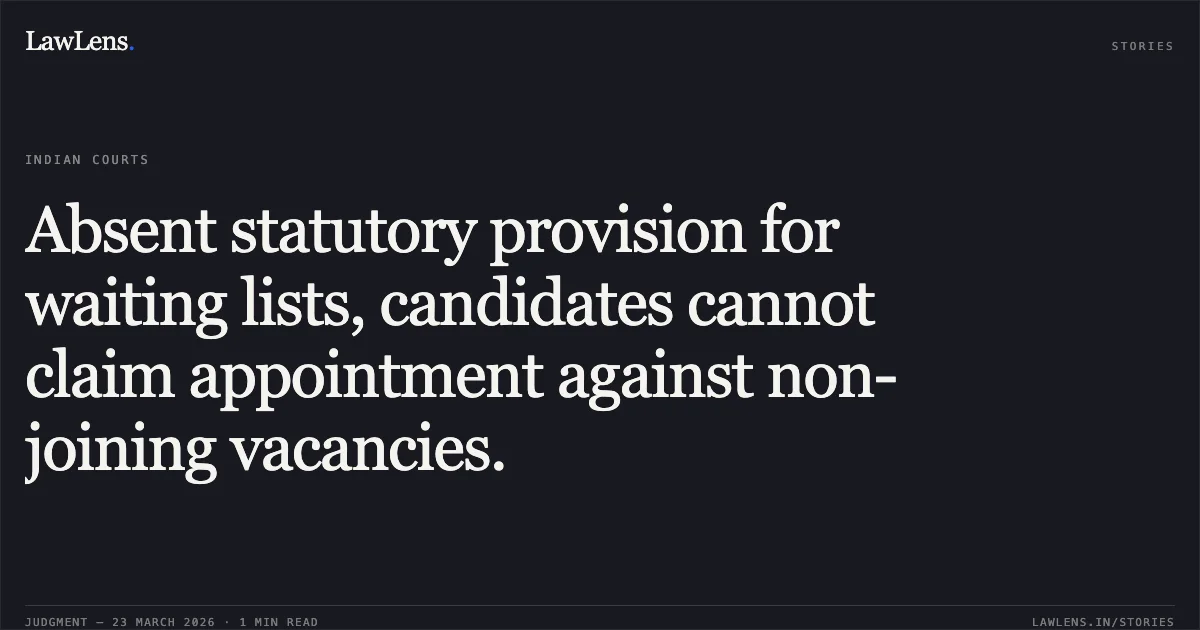
It held that under the 1997 Rules, a candidate has no enforceable right to be appointed against a vacancy arising from a selected candidate’s failure to report for duty in the absence of a provision for an additional or waiting list
Source reference: para. 20The Court reinstated the Tribunal's order and dismissed the Respondent's writ petition
Source reference: para. 22Acts & Sections Cited
2 provisions across 2 statutes referred to in this judgment. Each provision opens on LawLens.
Administrative Tribunals Act, 19851
KARNATAKA STATE CIVIL SERVICES (REGULATION OF TRANSFER OF MEDICAL OFFICERS AND OTHER STAFF) ACT, 20111
Original Court PDF
State Of KarnatakavsSanthosh Kumar C
Click to open original judgment
Original judgment, available to read, download and summarize on LawLens.in