Facts
The 28 Petitioners were originally employees of various Gram Panchayats and Municipal Councils that merged to form the Vasai-Virar City Municipal Corporation ("Municipal Corporation") on July 3, 2009
Source reference: para. 3Following the merger, the Petitioners continued their service in various posts (Safai Kamgar, Clerk, Peon) but were paid "lump sum" or minimum wages rather than the revised pay scales or the Seventh Pay Commission benefits granted to regular employees
Source reference: para. 2-4The Municipal Corporation resisted the claim, contending that the Petitioners were "backdoor entries" appointed without following due process (advertisements/tests) by the erstwhile Gram Panchayats and were thus ineligible for regularization or pay parity
Source reference: para. 7The State Government had previously rejected the Corporation's proposal for pay parity in January 2022 on similar grounds
Source reference: para. 8Issues
Whether the Petitioners are entitled to the regular pay scale and parity in wages with regular employees of the Municipal Corporation based on the principle of "equal pay for equal work"
Source reference: para. 2, 10Whether the nature of the Petitioners' initial appointment (alleged lack of due process) justifies the denial of pay parity for work performed after being absorbed into the Municipal Corporation
Source reference: para. 14Law Applied
The Court relied on the constitutional mandate of "equal pay for equal work" derived from Articles 14, 16, and 39(d) of the Constitution of India
Source reference: para. 11It applied the landmark precedent of Randhir Singh v. Union of India, which established that the principle of equal pay is a constitutional goal enforceable through Article 226
Source reference: para. 11Furthermore, it heavily relied on State of Punjab v. Jagjit Singh, which extended the right to the minimum of the regular pay scale to temporary, ad-hoc, and contractual employees performing duties similar to regular employees
Source reference: para. 12The Court also followed its own Division Bench ruling in Vinayak Kalu Jadhav & Ors. v. State of Maharashtra, which applied these principles specifically to Municipal Corporation employees
Source reference: para. 15Reasoning
The Court rejected the Municipal Corporation's defense that the Petitioners’ "backdoor entry" at the Gram Panchayat level precluded pay parity
Source reference: para. 14The Court reasoned that since the Petitioners had been serving the Municipal Corporation since 2009 and were discharging duties identical to regular employees—a fact not disputed by the Respondents—denying them equal wages constituted "exploitative enslavement" and a violation of human dignity
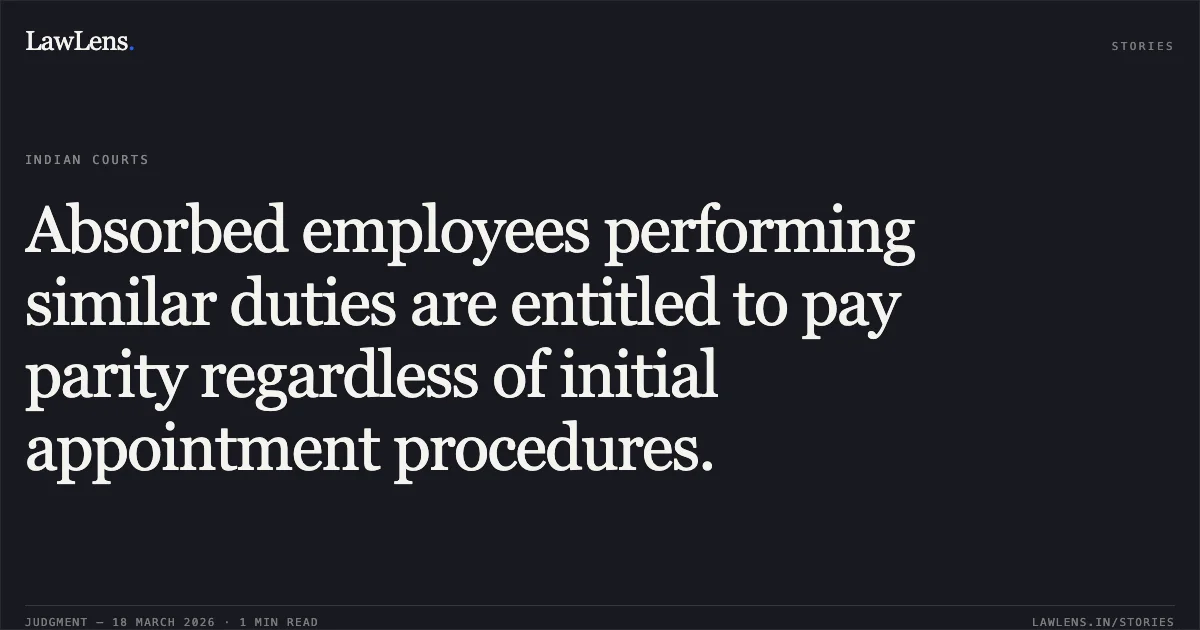
Source reference: para. 12, 14The Court clarified that the method of initial appointment is irrelevant to the claim of pay parity if the work performed is similar
Source reference: para. 14Applying the Jagjit Singh standard, the Court held that the Petitioners are vested with a clear and unambiguous right to claim wages at par with the minimum of the pay scale of regular employees holding the same posts
Source reference: para. 12-14Holding
The Court allowed the Writ Petition and made the Rule absolute
It held that the Petitioners are entitled to complete parity in pay scales and the benefits of the Seventh Pay Commission
Source reference: para. 16The Municipal Corporation was directed to calculate and pay all arrears of salaries and wages with interest at the rate of 8% per annum within four weeks
Source reference: para. 17The Court warned that any failure to comply would be treated as a breach of the order for appropriate further action
Source reference: para. 18Acts & Sections Cited
2 provisions across 1 statute referred to in this judgment. Each provision opens on LawLens.
Maharashtra Municipal Corporations Act.2
Original Court PDF
MR. GAJANAN NAMDEO OGE AND ORSvsVASAI-VIRAR CITY MUNICIPAL CORP. AND ORS
Click to open original judgment
Original judgment, available to read, download and summarize on LawLens.in


![Subsequent exoneration does not retrospectively invalidate a finalized promotion select list.. UNNIKRISHNAN M vs M/o Environment And Forests. CAT - ['Ernakulam']. LawLens](/stories/thumbnails/subsequent-exoneration-does-not-retrospectively-invalidate-a-finalized-promotion-select-li-ce80a0e84f2f4887857271e8b4341c42.webp)