Facts
The appellant was extradited from Portugal to India pursuant to the Union Government’s sovereign assurance that he would not be subjected to the death penalty or imprisonment exceeding 25 years. He was taken into Indian custody on 11 November 2005 and was subsequently convicted in two TADA cases. In the first case, he was sentenced to rigorous life imprisonment on 25 February 2015; in the second, he was sentenced to rigorous life imprisonment on 7 September 2017, with both sentences directed to run concurrently.
Source reference: paras. 4.1–4.4In its judgment dated 11 July 2022, the Supreme Court held that the appellant’s detention for sentence-computation purposes commenced on 12 October 2005, rejected his claim for set-off of custody undergone in Portugal, and directed that upon completion of 25 years the Central Government should consider action under Article 72 of the Constitution or Sections 432 and 433 of the CrPC in accordance with the sovereign assurance.
Source reference: para. 4.6–4.7; paras. 8–9The appellant thereafter sought habeas corpus and mandamus before the Bombay High Court, contending that he had completed 25 years by combining his custody, post-conviction incarceration and jail-earned remission of 3 years, 6 months and 2 days. The High Court dismissed the petition, holding that 25 years had not been completed and that the appellant’s computation impermissibly overlapped periods of custody.
Source reference: para. 4.8–4.9Issues
Whether the appellant had completed the stipulated period of 25 years by adopting a computation that treated the same period of incarceration simultaneously as undertrial custody and post-conviction custody.
Source reference: paras. 10–19Whether jail-earned remission could be added to the appellant’s period of actual incarceration so as to advance his release pursuant to the 25-year sovereign assurance.
Source reference: paras. 20–31Whether the sovereign assurance converted the appellant’s life sentences into a fixed-term sentence of 25 years or otherwise entitled him to release upon adding remission to his custody period.
Source reference: paras. 22–29Law Applied
The Court applied the Supreme Court’s earlier judgment dated 11 July 2022, which fixed 12 October 2005 as the commencement date for computing the appellant’s detention and required the Central Government, upon completion of 25 years, to consider action under Article 72 of the Constitution or Sections 432 and 433 of the CrPC in fulfilment of the sovereign assurance.
Source reference: paras. 8–9, 22Section 428 of the CrPC governs set-off of pre-conviction detention, but custody periods cannot be counted twice, particularly where concurrent sentences operate simultaneously.
Source reference: paras. 14–16The Court further relied on the principles of separation of powers: sentencing is a judicial function, while remission, commutation and release are executive powers exercised under constitutional or statutory authority.
Source reference: paras. 23–25The decisions in Swamy Shraddananda v. State of Karnataka, Union of India v. V. Sriharan @ Murugan and Yovehel v. State of Maharashtra were distinguished because they did not concern a sovereign extradition assurance coupled with life sentences and a stipulated maximum period of detention.
Source reference: paras. 21, 30–31Reasoning
The Court held that the appellant’s computation was legally impermissible because it calculated undertrial custody up to the later conviction of 7 September 2017 while calculating post-conviction custody from the earlier conviction of 25 February 2015. This resulted in the period between those dates being counted twice, contrary to the concurrent nature of the sentences.
Source reference: paras. 10–16The sovereign assurance guaranteed that the appellant would not be imprisoned beyond 25 years, but did not authorise an artificial or accelerated computation of custody.
Source reference: paras. 17–19Further, the earlier judgment had not altered the appellant’s life sentences or converted them into a fixed 25-year term; it merely required executive consideration of remission, commutation or release after completion of the stipulated period.
Source reference: paras. 22–26Consequently, jail-earned remission could not be notionally added to the period of incarceration to secure release before the completion of the relevant 25-year period. The State’s calculation also continued to treat the appellant as a life convict, for whom premature-release consideration was undertaken under the applicable prison rules.
Source reference: paras. 27–29Holding
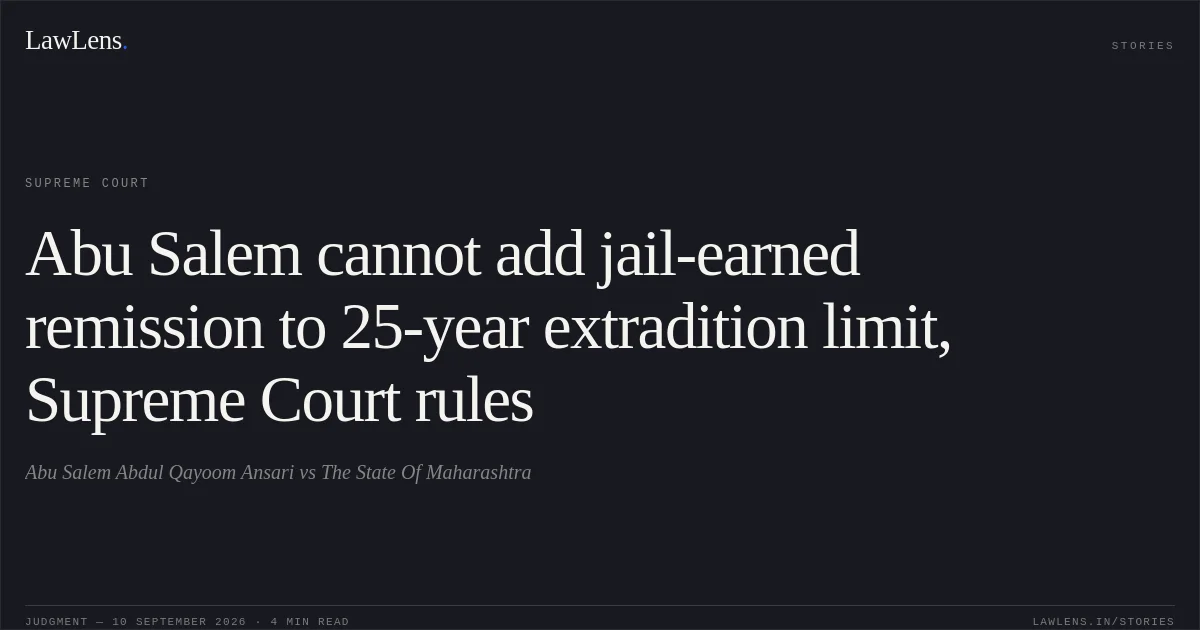
The Supreme Court answered the issues against the appellant. It held that he had not completed 25 years of sentence on the basis of the proposed computation, since the calculation involved impermissible double counting.
It further held that the sovereign assurance did not convert his life sentences into a fixed-term sentence of 25 years and that jail-earned remission could not be added to advance his release.
Source reference: paras. 25–30The Bombay High Court’s judgment dated 15 April 2026 was upheld, and the appeal was dismissed in limine. Pending applications were disposed of.
Source reference: paras. 32–34Acts & Sections Cited
3 provisions across 1 statute referred to in this judgment. Each provision opens on LawLens.
Code of Criminal Procedure, 19733
Original Court PDF
Abu Salem Abdul Qayoom AnsarivsThe State Of Maharashtra
Click to open original judgment
Original judgment, available to read, download and summarize on LawLens.in