Facts
The applicant, a legal advisor for a manpower firm, sought to quash an FIR filed under Sections 294(b) and 114 of the IPC and Sections 3(1)(r) and 3(1)(s) of the Atrocity Act.
Source reference: p. 2The de facto complainant alleged that while visiting a company office to discuss compensation for his son’s work injury, the applicant and others hurled caste-based abuses and forced him to leave the premises.
Source reference: p. 2The applicant contended the FIR was a malicious "arm-twisting tactic" to extort money, noting that the firm had already covered all medical expenses for the son's injury.
Source reference: p. 3During the pendency of the case, the original complainant passed away, and his heirs did not appear despite being served.
Source reference: p. 1-2Issues
1. Whether the alleged caste-based insults occurred within "public view" as required to attract Sections 3(1)(r) and 3(1)(s) of the Atrocity Act.
Source reference: p. 52. Whether the factory premises and private office area constitute a "public place" under Section 294(b) of the IPC.
Source reference: p. 83. Whether the FIR constitutes an abuse of the process of law deserving quashment under Section 482 of the CrPC.
Source reference: p. 9-10Law Applied
The Court applied Section 482 of the CrPC regarding the inherent powers of the High Court to prevent abuse of process.
Source reference: p. 2The Court relied on Swaran Singh v. State (2008), which distinguishes "public place" from "place within public view," noting that insults inside a building without public presence do not satisfy the Atrocity Act.
Source reference: p. 5-6The Court further applied Keshaw Mahto v. State of Bihar (2026), holding that mere knowledge of a person's caste is insufficient; there must be an intent to humiliate.
Source reference: p. 6-7For the IPC charges, Section 294(b) was applied, requiring "obscene acts or words" in or near a "public place".
Source reference: p. 8The Court followed the guidelines in State of Haryana v. Bhajan Lal (1992) for quashing proceedings.
Source reference: p. 9-11Reasoning
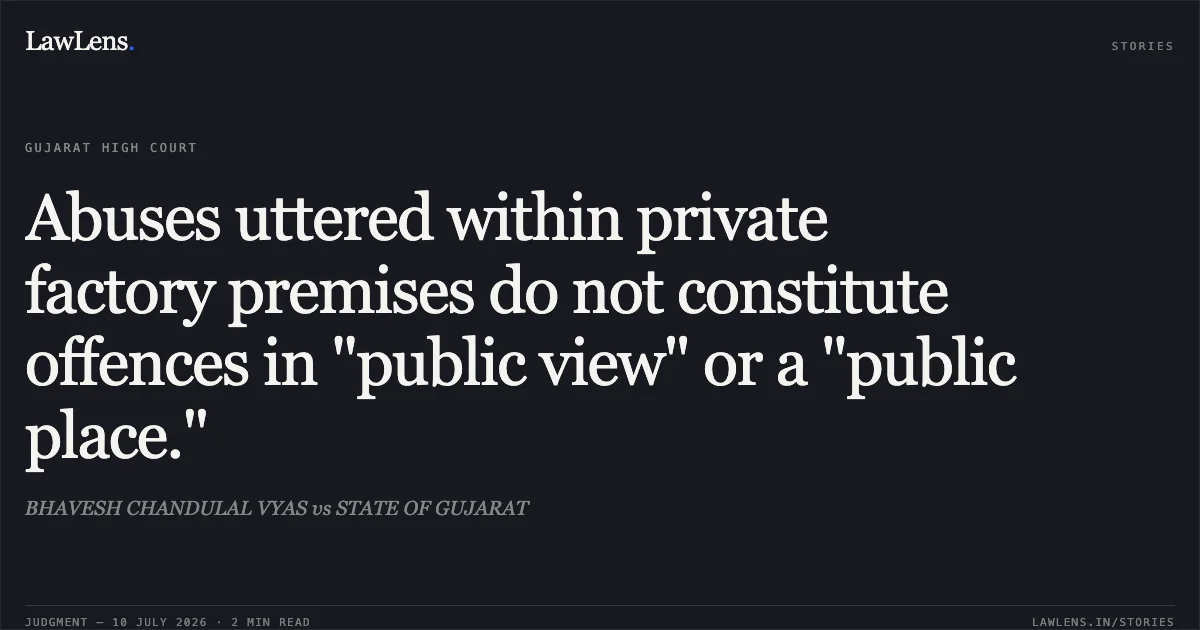
The Court found that the alleged incident occurred within the private precincts of a factory and outside a Managing Director's office, not in "public view".
Source reference: p. 7Investigation papers revealed that while the complainant was accompanied by friends, their statements did not corroborate the specific slurred words alleged in the FIR; one friend was even standing outside the building entirely.
Source reference: p. 7-8Because the utterances were not audible or visible to the general public, the fundamental ingredients of Sections 3(1)(r) and 3(1)(s) of the Atrocity Act were missing.
Source reference: p. 8Regarding the IPC, the Court reasoned that a private factory office does not constitute a "public place" under Section 294(b).
Source reference: p. 9The Court concluded that the allegations were inherently improbable and appeared to be maliciously instituted for vengeance.
Source reference: p. 11Holding
The Court held that the case fell under the Bhajan Lal categories (1), (3), (5), and (7) because the allegations, even if taken at face value, did not constitute a prima facie offence and were manifestly attended with mala fides.
The Court allowed the application and quashed the FIR (CR No. 11197006220377 of 2022) and all consequential proceedings against the applicant. Rule was made absolute.
Source reference: p. 11-12Acts & Sections Cited
6 provisions across 3 statutes referred to in this judgment. Each provision opens on LawLens.
Code of Criminal Procedure, 19733
Indian Penal Code, 18602
Scheduled Castes and the Scheduled Tribes (Prevention of Atrocities) Act, 19891
Original Court PDF
BHAVESH CHANDULAL VYASvsSTATE OF GUJARAT
Click to open original judgment
Original judgment, available to read, download and summarize on LawLens.in