Facts
The petitioner initially joined the National Institute of Rural Development (NIRD) as a contractual Research Associate on 12.11.1984 and was covered under the Central Provident Fund (CPF) Scheme. His services were regularised with effect from 07.11.1985. He was subsequently appointed as Assistant Director, Deputy Director, and Professor, and his services as Professor were regularised by Office Order No. 98 dated 04.05.2012. The order stipulated that regularisation would take effect from its date and that his service would continue to be governed by the existing CPF Scheme
Source reference: p.2; p.6The petitioner retired on 31.01.2017 and received his retiral benefits, including NIRD’s contribution to the CPF
Source reference: p.2–3Thereafter, he filed O.A. No. 45 of 2017 before the Central Administrative Tribunal (CAT), claiming that he should have been covered by the General Provident Fund-cum-Pension Scheme (GPF Scheme) under the NIRD Rules, 2011 and the NIRD Service Bye-laws
Source reference: p.3The CAT allowed the application on the basis of its earlier decision in favour of Mr. S.S.P. Sharma. However, in National Institute of Rural Development v. Shyam Sunder Prasad Sharma, Civil Appeal No. 542 of 2023, decided on 28.02.2023, this Court held that regularisation took effect only from 04.05.2012 and did not relate back to the date of initial appointment; consequently, the employee remained governed by the CPF Scheme
Source reference: p.3–4Relying on that decision, the High Court set aside the CAT’s order and dismissed the petitioner’s O.A. The petitioner challenged the High Court’s decision under Article 136 of the Constitution.
Source reference: p.4–5Issues
1. Whether the petitioner’s regularisation as Professor under Office Order No. 98 dated 04.05.2012 operated retrospectively from the date of his initial appointment or prospectively from the date of the regularisation order.
Source reference: p.5–62. Whether, despite having accepted the terms of regularisation and CPF retiral benefits, the petitioner was entitled to claim coverage under the GPF Scheme.
Source reference: p.6–73. Whether the decision in National Institute of Rural Development v. Shyam Sunder Prasad Sharma applied to the petitioner’s case.
Source reference: p.5–7Law Applied
The Court applied the NIRD Rules, 2011, particularly Rule 6, and NIRD Service Bye-law 52(a), read with Bye-laws 48 and 49, concerning the applicable provident fund and pension framework
Source reference: p.6It relied principally on National Institute of Rural Development v. Shyam Sunder Prasad Sharma, Civil Appeal No. 542 of 2023, decided on 28.02.2023, which held that where an order of regularisation expressly provides that regularisation takes effect from the date of the order and preserves coverage under the existing CPF Scheme, such regularisation cannot be given retrospective effect in the absence of a challenge to those conditions
Source reference: p.4–6The Court further applied the principle that an employee who accepts the terms of regularisation and retires after receiving benefits under a particular scheme cannot subsequently challenge those terms to claim a more advantageous scheme.
Source reference: p.6–7Reasoning
The Court found that the petitioner and Mr. S.S.P. Sharma were similarly situated: both were regularised as Professors by the identical Office Order dated 04.05.2012 and on the same terms
Source reference: p.6–7That order expressly made regularisation effective from the date of issuance and continued the existing CPF coverage. Since the petitioner had never challenged those conditions, his regularisation could not retrospectively relate back to his initial appointment.
Source reference: p.6The Court also noted that the petitioner raised the claim only after retirement and after accepting CPF benefits, including NIRD’s contribution
Source reference: p.2–3; p.6Consequently, the ratio of S.S.P. Sharma applied squarely, and the High Court correctly set aside the CAT’s order granting GPF coverage
Source reference: p.5–7Holding
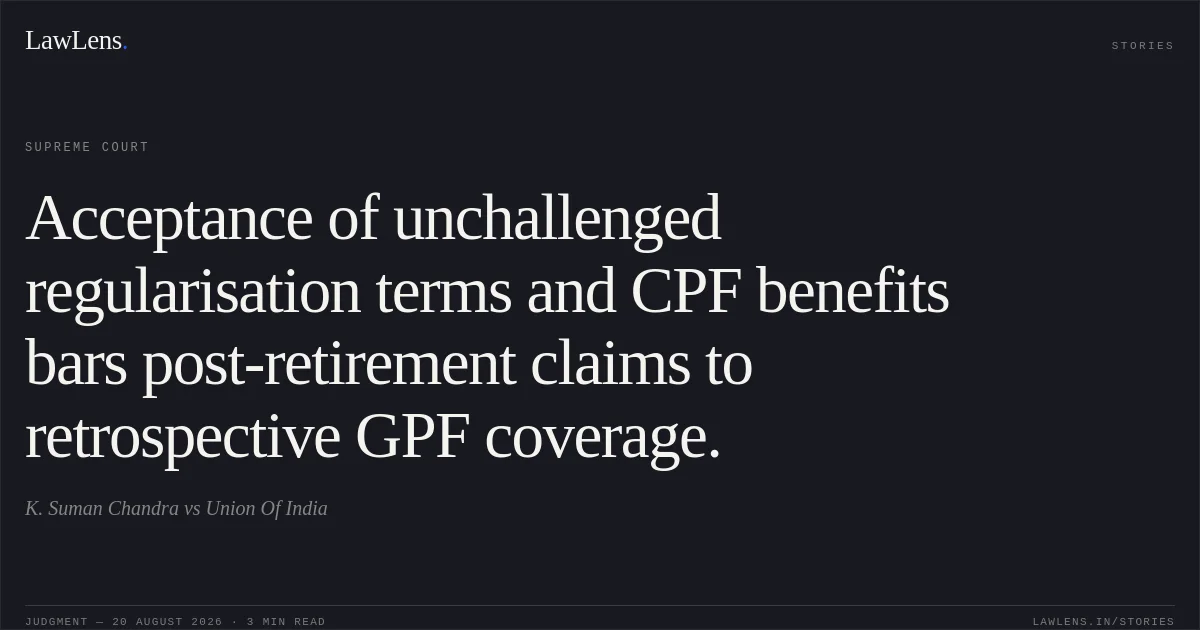
The Supreme Court held that the petitioner was governed by the CPF Scheme and was not entitled to retrospective coverage under the GPF Scheme.
The terms of his regularisation dated 04.05.2012 were binding, and the decision in S.S.P. Sharma applied to his case.
Source reference: p.7; para. 8–9Finding no ground to exercise jurisdiction under Article 136, the Court dismissed the Special Leave Petition
Source reference: p.7; para. 8–9Acts & Sections Cited
1 provisions across 1 statute referred to in this judgment. Linked provisions open on LawLens.
the Act (alias, unresolved)1
Original Court PDF
K. Suman ChandravsUnion Of India
Click to open original judgment
Original judgment, available to read, download and summarize on LawLens.in