Facts
The revisionist, Shavez Khan, filed an application under Section 156(3) of the Cr.P.C. alleging that on September 5, 2022, the opposite parties (a Tehsildar and two Lekhpals) harassed his father under the guise of illegal mining allegations and threw him into the Kosi River, where he drowned
Source reference: para. 5The Jurisdictional Magistrate rejected the application on May 4, 2024, citing a lack of prior sanction under Section 197 Cr.P.C. required to prosecute public servants
Source reference: para. 6In opposition, the State and private parties argued that the death was accidental (asphyxia due to drowning), and the revisionist’s family had already applied for and received ₹5 Lakhs in government compensation under an insurance scheme for "accidental death"
Source reference: para. 8-9The revisionist challenged the dismissal, arguing sanction is only required at the stage of taking cognizance, not for a Section 156(3) investigation
Source reference: para. 7Issues
1. Whether the requirement of prior sanction under Section 197 Cr.P.C. is a mandatory condition precedent for the filing of an application under Section 156(3) Cr.P.C. against public servants
Source reference: para. 72. Whether a revisionist can maintain a criminal complaint for homicidal death after having declared and accepted compensation for the same incident as an accidental death
Source reference: para. 12, 16Law Applied
The Court examined Section 197 of the Cr.P.C., which mandates prior sanction from the competent authority before a court takes cognizance of an offense committed by a public servant in the discharge of official duties
Source reference: para. 7It also referenced the precedent Anil Kumar v. M.K. Ayyappa, which discussed the necessity of sanction even at the Section 156(3) stage
Source reference: para. 6the Court applied the doctrine of election and the legal distinction between "accident" (unintentional/unplanned events) and "homicide" (intentional acts of killing), drawing from dictionary definitions and Wikipedia to establish that the two are mutually exclusive legal categories
Source reference: para. 13-15Reasoning
The Court noted that while the Jurisdictional Magistrate’s primary ground for rejection—the lack of Section 197 sanction—might not be technically "good in law" at the pre-cognizance stage, the revisionist’s conduct created a fatal contradiction
Source reference: para. 16The Court reasoned that "accidental death" and "homicidal death" are different facts and cannot be summarized in the same definition
Source reference: para. 12, 16Since the revisionist's family formally treated the death as "accidental" to claim a ₹5 Lakh government benefit, they were legally estopped from subsequently claiming that the same event was a "homicide" caused by the opposite parties
Source reference: para. 9, 16The Court found the story presented in the 156(3) application to be a "bundle of lies" designed to pressure public officials who had no enmity with the deceased
Source reference: para. 10Holding
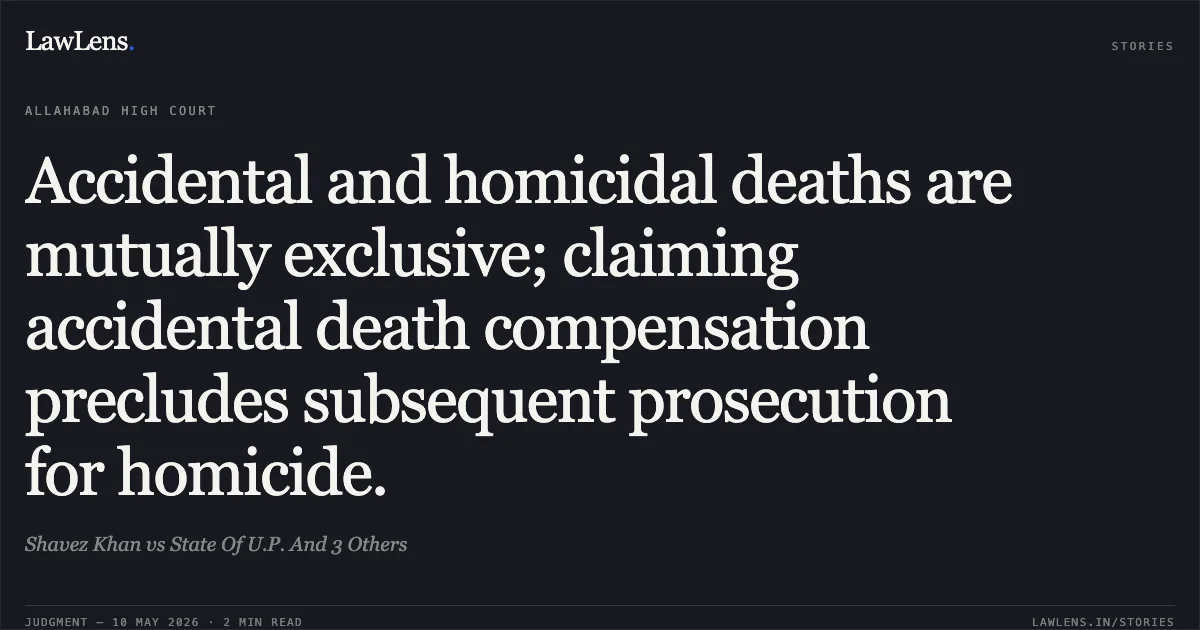
The Court held that having claimed compensation for an accidental death, the revisionist cannot maintain a prosecution for homicidal death for the same incident
While the Magistrate’s reasoning regarding sanction was legally flawed, the ultimate dismissal was justified as the story was not credible
Source reference: para. 16The High Court dismissed the criminal revision, affirming the rejection of the Section 156(3) application
Source reference: para. 17Acts & Sections Cited
2 provisions across 1 statute referred to in this judgment. Each provision opens on LawLens.
Code of Criminal Procedure, 19732
Original Court PDF
Shavez KhanvsState Of U.P. And 3 Others
Click to open original judgment
Original judgment, available to read, download and summarize on LawLens.in