Facts
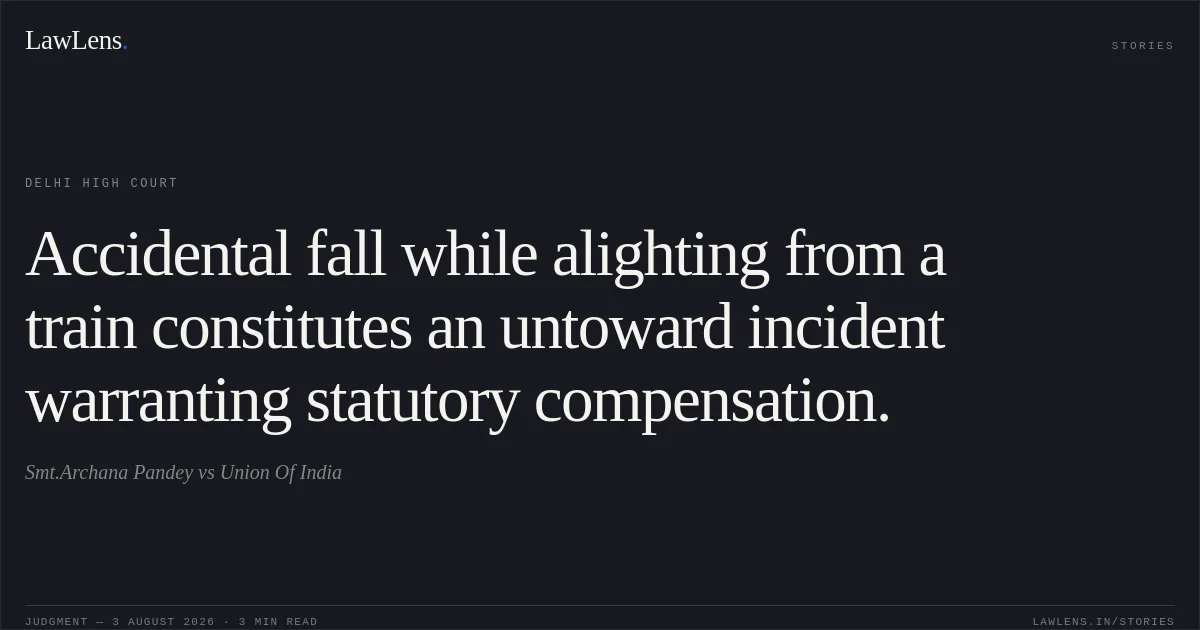
The appellants, who were the claimants before the Railway Claims Tribunal, were the family members of Bhanu Prakash Pandey and Vanshika, who died while travelling from Fatehgarh to Shahdara by Kalindi Express.
Source reference: p.1–2, paras 1–3The appellants’ case was that, while attempting to alight from the train, the deceased were compelled to use the off-side exit due to a blocked passage; when the train suddenly moved, they accidentally fell and sustained fatal injuries.
Source reference: p.2–3, paras 5, 11The Tribunal accepted that both deceased were bona fide passengers but dismissed the claims, holding that they had deboarded from the off-side, crossed the railway tracks, and were run over by another train.
Source reference: p.3, para. 4; p.4, para. 10The appellants challenged that decision under Section 23 of the Railway Claims Tribunal Act, 1987.
Source reference: p.1, para. 1Issues
Whether the deaths of the deceased constituted an “untoward incident” under Section 123(c) read with Section 124-A of the Railways Act, 1989.
Source reference: p.3–4, paras 9–10Whether the Tribunal was justified in concluding, on the basis of the Station Master’s memo and the nature of the post-mortem injuries, that the deceased had crossed the railway tracks and were run over, rather than having accidentally fallen from the train.
Source reference: p.4–6, paras 10, 14, 16–18Law Applied
The Court applied Sections 123(c) and 124-A of the Railways Act, 1989, under which accidental falling of a bona fide passenger while boarding or alighting from a train constitutes an “untoward incident” attracting the Railways’ strict liability, subject only to the statutory exceptions.
Source reference: p.5, paras 13, 15Relying on Union of India v. Prabhakaran Vijaya Kumar, (2008) 9 SCC 527, the Court held that the beneficial provisions of the Act must receive a liberal interpretation and that contributory negligence is not a defence to a claim under Section 124-A.
Source reference: p.5, para. 13; p.5–6, para. 15A claim can be denied on the grounds of a “self-inflicted injury” or “criminal act” only where the facts strictly satisfy those statutory exceptions, requiring more than speculative proof.
Source reference: p.5–6, para. 15The Court also relied on Rajpati v. Union of India, 2014 SCC OnLine Del 2540, for the principle that the mutilated or crushed condition of a body, by itself, does not conclusively establish that the deceased was run over while crossing the tracks.
Source reference: p.6, para. 17Reasoning
The Court found that the deceased’s status as bona fide passengers had already been established by the Tribunal and was not challenged by the Railways.
Source reference: p.3–4, para. 8The eyewitness, AW-2, supported the appellants’ account that the deceased attempted to alight from the platform side but were compelled to use the off-side exit and fell when the train moved; her testimony remained materially unimpeached in cross-examination.
Source reference: p.4–5, paras 11–12The Station Master’s memo merely recorded that a man and a woman had been run over near Platform No. 3 and did not state that they had crossed the tracks or acted deliberately.
Source reference: p.5, para. 14No independent eyewitness was produced by the Railways to establish track-crossing.
Source reference: no citationFurther, the post-mortem reports described the injuries but did not determine how they were caused, and no medical opinion ruled out accidental falling from a moving train.
Source reference: p.6, para. 16Accordingly, the Tribunal’s conclusion rested on an unsupported inference from the location of the bodies and the nature of the injuries, which could not displace the consistent and more probable account of accidental falling.
Source reference: p.6–7, paras 18–19Holding
The Court held that the deceased had most probably died after accidentally falling while attempting to alight from the train, and that the incident fell within the statutory definition of an “untoward incident” under the Railways Act, 1989.
The Tribunal’s judgment dated 17.05.2023 was set aside.
Source reference: p.7, para. 20The matter was remanded to the Tribunal to determine the compensation payable in accordance with law and direct its disbursement within two months of receiving the High Court’s order.
Source reference: p.7, para. 20The appeal was consequently allowed and disposed of, with the matter directed to be listed before the Tribunal on 19.08.2026.
Source reference: p.7, paras 20–22Original Court PDF
Smt.Archana PandeyvsUnion Of India
Click to open original judgment
Original judgment, available to read, download and summarize on LawLens.in