Facts
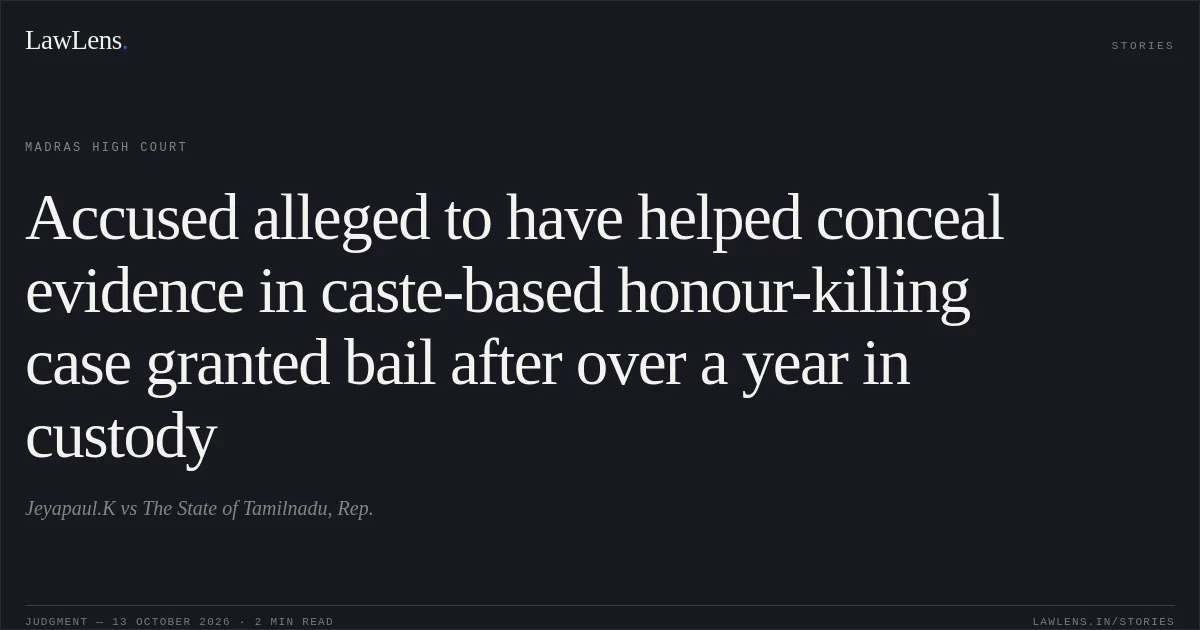
The appellant, arrayed as A-4 in S.C. No. 120 of 2025, was charged under provisions of the Bharatiya Nyaya Sanhita, 2023, and the Scheduled Castes and Scheduled Tribes (Prevention of Atrocities) Act, 1989, in connection with the alleged honour killing of Kavin Selva Ganesh.
Source reference: p. 1–3, 5–6The prosecution alleged that the appellant aided A-1 in moving safely after the occurrence and in destroying evidence at the appellant’s quarry; the appellant disputed having a specific overt act and relied, among other things, on the quashing of proceedings against A-2 and A-3.
Source reference: p. 1–3, 5–6Arrested on 13 August 2025, he remained in custody while the trial court rejected his bail application on 21 January 2026.
Source reference: p. 1–3, 5–6He appealed under Section 14-A(2) of the SC/ST Act.
Source reference: p. 1–3, 5–6Issues
1. Whether the appellant should be released on bail pending trial, having regard to the alleged role, period of custody, and likely duration of the trial.
Source reference: p. 5–62. Whether the quashing of proceedings against A-2 and A-3, alongside the allegations remaining against the appellant, supported granting bail subject to conditions.
Source reference: p. 6Law Applied
The appeal was brought under Section 14-A(2) of the SC/ST Act, which provides for an appeal against an order granting or refusing bail in a case involving offences under that Act.
Source reference: p. 1The charged provisions identified in the judgment include Sections 296(b), 103(1), 49 and 238 of the Bharatiya Nyaya Sanhita, 2023, and Sections 3(1)(r), 3(1)(s) and 3(2)(v) of the SC/ST Act.
Source reference: p. 1, 5The Court assessed bail by reference to the allegations against the appellant, his period in custody, the anticipated time for trial, and the status of the co-accused; it cited no precedent or further statutory test.
Source reference: p. 6Reasoning
The Court did not accept that the appellant was wholly unconnected to the case: it noted that the earlier decision declining to quash the proceedings against him found material warranting trial, including allegations of intimidation and aiding the screening of evidence after the occurrence.
Source reference: p. 5–6However, the alleged role was subsequent to the crime, the appellant had been in custody since 13 August 2025, and the prosecution relied on 70 witnesses and 37 documents, making an early trial unlikely.
Source reference: p. 6The Court also considered that proceedings against A-2 and A-3 had been quashed.
Source reference: p. 6Weighing those circumstances against the gravity of the allegations, it concluded that bail could be granted subject to stringent conditions.
Source reference: p. 6Holding
The High Court allowed the appeal, set aside the trial court’s order refusing bail, and directed the appellant’s release on a bond of ₹20,000 with two sureties, one being a blood relative.
Conditions included providing identity and address documents, filing an undertaking, not entering the occurrence village or contacting the victim or de facto complainant, and reporting to the trial court twice daily.
Source reference: p. 6–7The order also permits an application for cancellation of bail upon breach of its conditions.
Source reference: p. 6–7Acts & Sections Cited
8 provisions across 2 statutes referred to in this judgment. Each provision opens on LawLens.
Bharatiya Nyaya Sanhita, 20236
Scheduled Castes and the Scheduled Tribes (Prevention of Atrocities) Act, 19892
Original Court PDF
Jeyapaul.KvsThe State of Tamilnadu, Rep.
Click to open original judgment
Original judgment, available to read, download and summarize on LawLens.in