Facts
The respondent filed a complaint under Section 138 of the Negotiable Instruments Act alleging that the petitioner failed to repay a loan of Rs. 6,00,000/- after a cheque (No. 081760) was dishonored due to insufficient funds
Source reference: p.1During the trial, the petitioner was granted permission under Section 315 Cr.P.C. to testify as a defence witness, but failed to appear on the scheduled dates due to the demise of his father-in-law and his counsel’s family medical emergency
Source reference: p.2Consequently, the Trial Court closed the right to lead defence evidence on 19.11.2025 and dismissed a subsequent application for recall on 12.12.2025
Source reference: p.2The Revisional Court affirmed this closure on 19.02.2026
Source reference: p.2The petitioner challenged these orders before the High Court under Section 528 of BNSS/Section 482 of Cr.P.C.
Source reference: p.1Issues
1. Whether the Trial Court and Revisional Court erred in closing the petitioner's opportunity to lead defence evidence despite the explanation of unavoidable circumstances
Source reference: p.2-32. Whether the denial of an opportunity to examine oneself as a defence witness under Section 315 of Cr.P.C. causes terminal prejudice to the accused
Source reference: p.3Law Applied
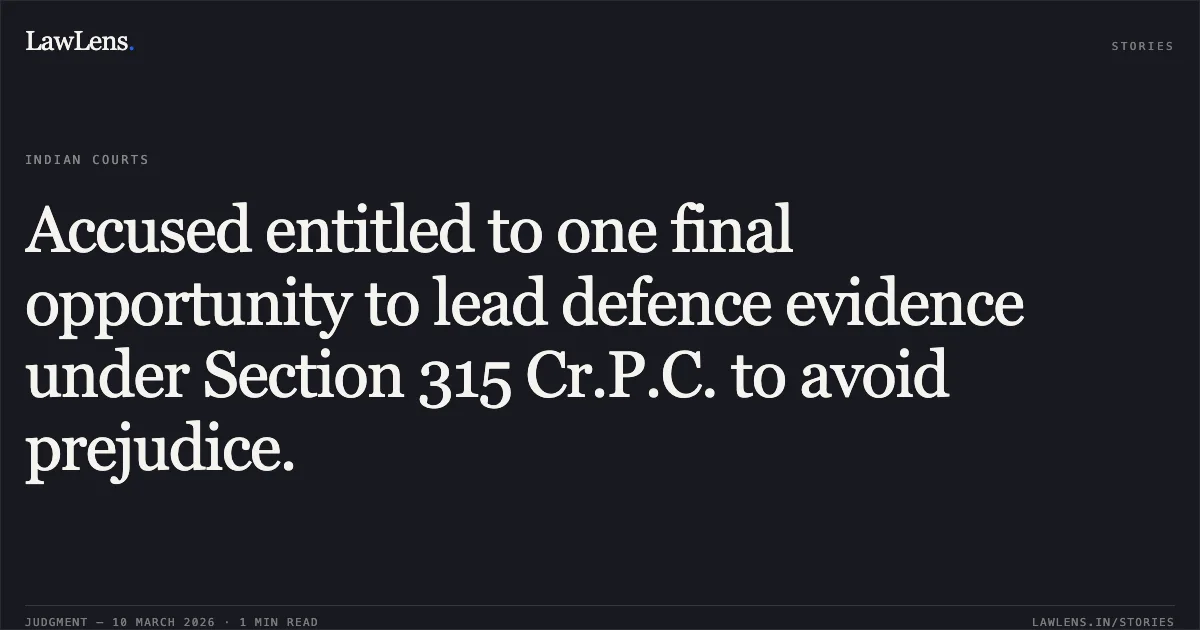
The Court primarily applied Section 315 of the Code of Criminal Procedure (Cr.P.C.), which permits an accused person to be a competent witness for the defence
Source reference: p.2-3It also considered Section 528 of the Bharatiya Nagarik Suraksha Sanhita (BNSS) / Section 482 of the Cr.P.C. regarding the High Court's inherent powers to prevent abuse of process and secure the ends of justice
Source reference: p.1The Court relied on the legal principle that the right to lead defence evidence is a fundamental component of a fair trial and that a party should not suffer for the unavoidable circumstances of their counsel
Source reference: p.2-3Reasoning
The Court observed that while the petitioner had been granted permission to testify, the failure to record evidence was supported by "genuine difficulties," specifically a bereavement in the family and the illness of the counsel’s spouse
Source reference: p.2The High Court reasoned that the right to lead defence evidence is an "important right" and its denial would cause significant prejudice to the accused's case
Source reference: p.3While acknowledging the need to prevent unnecessary delays in trial proceedings, the Court determined that the interest of justice outweighed the procedural lapse
Source reference: p.3It concluded that a single, final opportunity should be provided to ensure the petitioner is not condemned unheard, provided it is treated as a "last indulgence" to prevent further stalling of the Case No. 1228/2017
Source reference: p.3-4Holding
The High Court allowed the petition in part, setting aside the orders dated 19.02.2026 and 12.12.2025 to the limited extent of granting the petitioner one last opportunity to examine himself as a witness under Section 315 Cr.P.C.
The Court ordered the petitioner to appear on the next fixed date to complete the evidence, explicitly stating that no further adjournments would be permitted for this purpose
Source reference: p.4The petition was disposed of with directions to the Trial Court to proceed in accordance with the law thereafter
Source reference: p.4Acts & Sections Cited
5 provisions across 3 statutes referred to in this judgment. Each provision opens on LawLens.
Bharatiya Nagarik Suraksha Sanhita, 20231
Code of Criminal Procedure, 19733
Negotiable Instruments Act, 18811
Original Court PDF
Prakashchandra Shivhare v. Rajkumar Sharma, MCRC No. 9956 of 2026 (Neutral Citation: 2026:MPHC-GWL:8184)
Click to open original judgment
Original judgment, available to read, download and summarize on LawLens.in