Facts
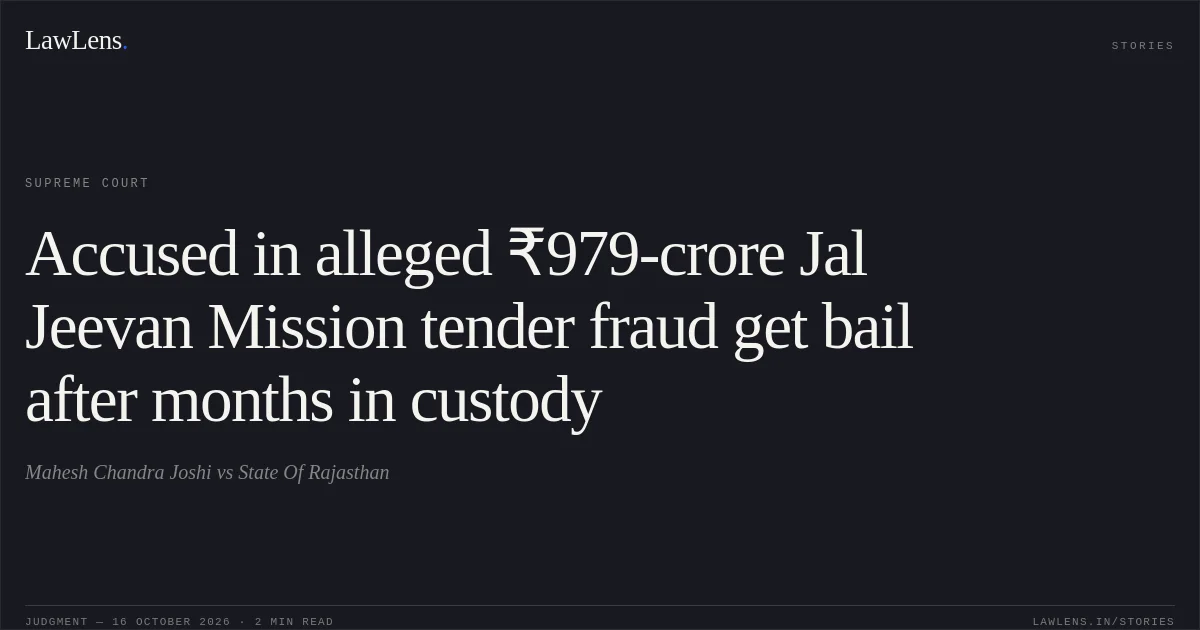
The appeals arose from FIR No. 245/2024, registered over alleged irregularities in PHED tenders under the Jal Jeevan Mission.
Source reference: pp. 1–3, paras 2, 4–5The prosecution alleged that two firms used forged IRCON certificates to secure work orders in 104 tenders worth an aggregate of Rs. 979.45 crore, with the involvement of public servants and private individuals.
Source reference: pp. 1–3, paras 2, 4–5The FIR invoked provisions of the Prevention of Corruption Act, 1988 and the Indian Penal Code.
Source reference: p. 1, n. 1The Rajasthan High Court rejected both appellants’ applications for regular bail.
Source reference: p. 2, para 3By the time of the appeals, investigation against the appellants was complete and chargesheets had been filed; both had also been granted bail in connected proceedings arising from the same factual allegations.
Source reference: pp. 4–6, para 10(a)–(b)Charges had not been framed, and the case involved 22 accused, 124 prosecution witnesses, and 192 documents spanning more than 20,000 pages.
Source reference: p. 6, para 10(c)Issues
1. Whether the appellants should be released on regular bail notwithstanding the gravity of the alleged corruption and fraud
Source reference: pp. 3–4, paras 8–92. Whether the appellants’ completed investigation, period of custody, connected bail orders, and the likely duration of trial made continued pre-trial detention unwarranted
Source reference: pp. 4–7, paras 10–11Law Applied
Article 21 of the Constitution protects an undertrial’s right to personal liberty and a speedy trial; prolonged pre-trial detention must not become punishment without trial.
Source reference: p. 6, para 10(c)The seriousness of allegations is relevant to bail, but gravity alone cannot eclipse other considerations or justify indefinite detention.
Source reference: p. 4, para 9The Court also relied on the general bail principle that detention may be unnecessary where investigation is complete, evidence is secured, and risks to the prosecution can be addressed through conditions.
Source reference: pp. 4–7, paras 10–11The appellants’ arguments concerning successive FIRs, double jeopardy, Section 17A of the Prevention of Corruption Act, and the legality of arrest were expressly left open for determination by the appropriate forum.
Source reference: p. 3, para 8Reasoning
The Court recognised the seriousness of the allegations but found that the prosecution’s case depended predominantly on documentary and electronic evidence already seized, making further custodial interrogation or recovery unnecessary and substantially reducing the risk of evidence-tampering.
Source reference: pp. 4–5, para 10(a)It considered the appellants’ periods in custody, their bail in connected proceedings involving the same underlying allegations, and the absence of any demonstrated misuse of liberty by Joshi after his earlier release.
Source reference: pp. 5–6, para 10(b)The case’s scale, the fact that charges had not been framed, and the likely length of trial strengthened the concern that continued detention could become punishment before trial.
Source reference: p. 6, para 10(c)Bail granted to certain co-accused also formed part of the overall assessment.
Source reference: p. 7, para 10(d)The Court concluded that any legitimate prosecution concerns could be addressed by appropriate bail conditions.
Source reference: p. 7, para 11Holding
The Court allowed both appeals, set aside the High Court’s order insofar as it concerned the appellants, and directed their release on bail in the subject FIR, unless required in another case.
Bail was subject to conditions including surrender of passports, cooperation with further investigation, non-interference with witnesses or evidence, and regular appearance before the trial court; breach could result in cancellation of bail.
Source reference: pp. 7–8, paras 13–14The Court left all merits-related observations and the appellants’ other legal contentions open.
Source reference: pp. 3, 8, paras 8, 15Acts & Sections Cited
10 provisions across 2 statutes referred to in this judgment. Each provision opens on LawLens.
Prevention of Corruption Act, 19885
Indian Penal Code, 18605
Original Court PDF
Mahesh Chandra JoshivsState Of Rajasthan
Click to open original judgment
Original judgment, available to read, download and summarize on LawLens.in