Facts
The petitioners, former office-bearers of a welfare society, were accused in FIR No. 84/2022 of cheating and manipulating the society’s constitution to conceal financial irregularities
Source reference: para. 1-2During the investigation, the police did not arrest the petitioners, and the High Court had granted them interim protection until the filing of the charge-sheet
Source reference: para. 3, 8Upon filing the charge-sheet, the Chief Judicial Magistrate (CJM), Jodhpur, issued bailable warrants against the petitioners on February 19, 2026, observing that their entitlement to bail would be considered only upon their physical appearance/custody
Source reference: para. 1, 9The petitioners challenged this order under Section 528 of the BNSS (formerly Section 482 CrPC), arguing that custody is not mandatory for filing a charge-sheet when they have cooperated with the investigation
Source reference: para. 4Issues
1. Whether the Trial Court was justified in issuing bailable warrants at the first instance after a charge-sheet was filed without the accused being arrested during the investigation
Source reference: para. 9, 142. Whether the term "custody" under Section 170 CrPC (now relevant provisions under BNSS) mandates the physical arrest and production of the accused at the time of filing the charge-sheet
Source reference: para. 10, 17Law Applied
The Court applied Section 170 of the CrPC and the principles governing the issuance of process.
Source reference: para. 4, 10It relied on Siddharth v. State of Uttar Pradesh (2022) 1 SCC 676, which held that Section 170 does not impose an obligation to arrest every accused at the time of filing a charge-sheet if they are not a flight risk
Source reference: para. 10It further applied Satender Kumar Antil v. CBI (2022) 10 SCC 51, clarifying that the court can secure presence under Section 88 CrPC by taking bonds without requiring a bail application or remand
Source reference: para. 11-12Lastly, it cited Inder Mohan Goswami v. State of Uttaranchal AIR 2008 SC 251, which mandates that warrants should not be issued mechanically if summons suffice
Source reference: para. 13Reasoning
The Court reasoned that since the offences were not heinous and the investigation was primarily based on documentary evidence, there was no justification for the Trial Court to issue bailable warrants
Source reference: para. 15The Court noted that the Investigating Agency itself did not find arrest necessary during the probe, and the petitioners had a history of cooperation
Source reference: para. 8, 15It emphasized that "custody" in the context of filing a charge-sheet connotes the mere physical presentation of the accused before the court, not necessarily police or judicial remand
Source reference: para. 10, 17The Court found the Trial Court’s insistence on considering bail only after appearance—implying potential custody—contrary to the mandate in Satender Kumar Antil, which suggests that presence can be secured via bonds under Section 88 without a formal bail application in such circumstances
Source reference: para. 11, 16-17Holding
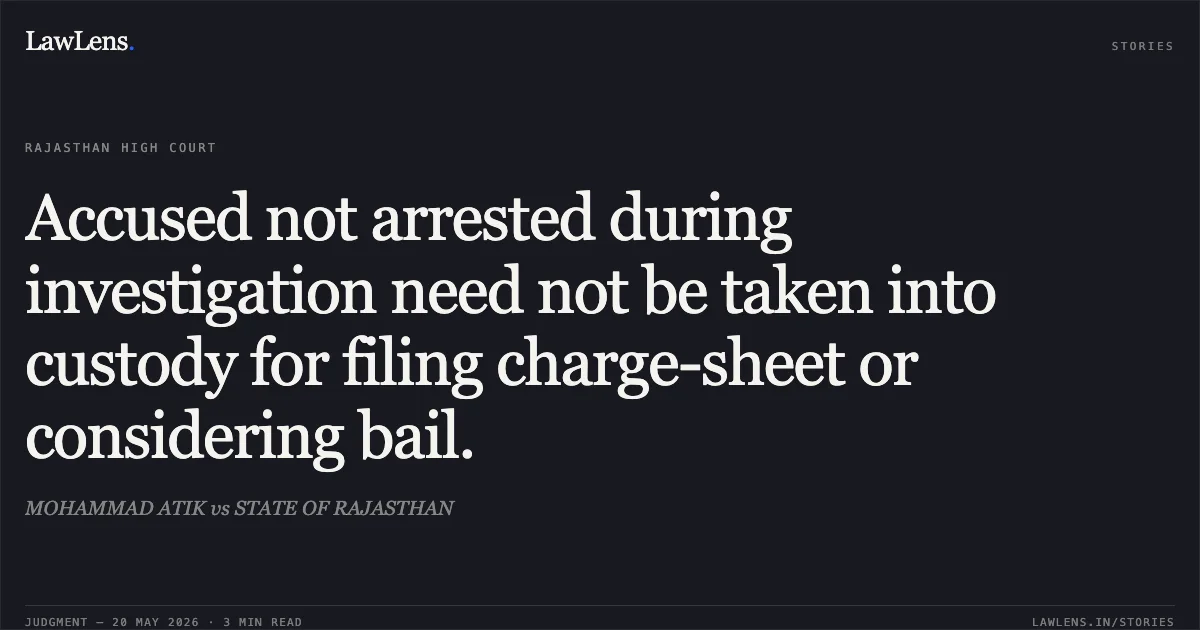
The Court held that where arrest was not required during investigation, the Trial Court should not insist on custody for the formal consideration of bail bonds
The Court allowed the petition and quashed the order dated February 19, 2026, to the extent of the issuance of bailable warrants. The High Court directed the petitioners to appear before the Trial Court on the next date and ordered the Trial Court to accept their personal/surety bonds for securing their presence during the trial without taking them into custody
Source reference: para. 19Acts & Sections Cited
5 provisions across 2 statutes referred to in this judgment. Each provision opens on LawLens.
Bharatiya Nagarik Suraksha Sanhita, 20231
Code of Criminal Procedure, 19734
Original Court PDF
MOHAMMAD ATIKvsSTATE OF RAJASTHAN
Click to open original judgment
Original judgment, available to read, download and summarize on LawLens.in


![Subsequent exoneration does not retrospectively invalidate a finalized promotion select list.. UNNIKRISHNAN M vs M/o Environment And Forests. CAT - ['Ernakulam']. LawLens](/stories/thumbnails/subsequent-exoneration-does-not-retrospectively-invalidate-a-finalized-promotion-select-li-ce80a0e84f2f4887857271e8b4341c42.webp)