Facts
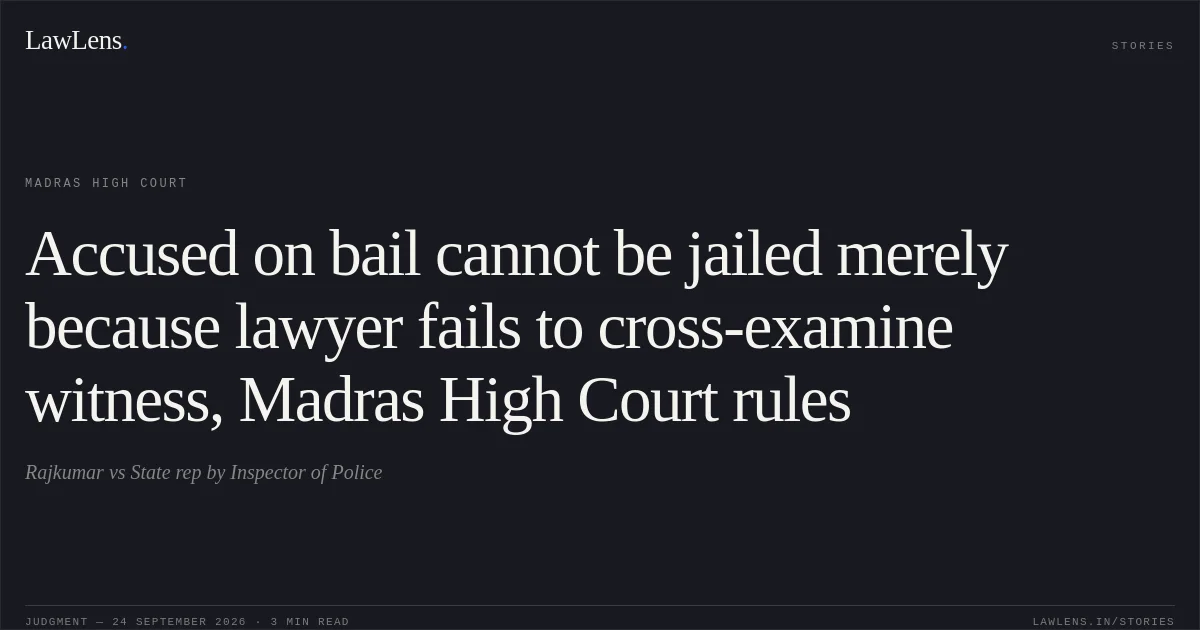
The petitioner/A1 and the other accused in C.C. No. 319 of 2024, pending before the II Additional Special Court for Trial of Cases under the NDPS Act, Chennai, had previously been released on bail and had complied with their bail conditions.
Source reference: p.2, para. 2On 2 September 2026, PW1 was examined in chief. Although counsel for A1, A2, A3 and A5 were allegedly instructed to cross-examine PW1, they did not do so; counsel for A4 cross-examined PW1 in part and sought time for continuation.
Source reference: p.2, para. 2; p.4, para. 5The Special Judge consequently remanded A1, A2, A3 and A5 under Section 309 Cr.P.C., stating that they were “not ready to conduct the case”.
Source reference: p.4, para. 5The petitioner challenged the remand order by criminal revision.
Source reference: no citationThe High Court called for a report from the Special Judge, who sought to justify the remand by relying on Explanation 1 to Section 309 Cr.P.C.
Source reference: p.2, para. 3; p.4, para. 6–7Issues
1. Whether the trial court could remand accused persons who were already on bail under Section 309 Cr.P.C. merely because their counsel failed or declined to cross-examine a prosecution witness.
Source reference: pp.4–6, paras. 6–92. Whether the trial court could cancel the petitioner’s bail through an order of remand without following the statutory requirements under Sections 437(5) or 439(2) Cr.P.C.
Source reference: p.5, para. 8–93. Whether, in the absence of counsel being ready to cross-examine a witness, the proper course was to invoke proviso (c) to Section 309(2) Cr.P.C. rather than remand the accused.
Source reference: p.6, paras. 10–11Law Applied
Section 309(2) Cr.P.C. permits remand only where the accused is already in custody; it does not authorise the remand or cancellation of bail of an accused who is on bail.
Source reference: p.5, para. 9Cancellation of bail must be undertaken under Sections 437(5) or 439(2) Cr.P.C., upon satisfaction of the applicable legal conditions.
Source reference: p.5, para. 9Under proviso (c) to Section 309(2) Cr.P.C., where a party or pleader is absent or is not ready to examine or cross-examine a witness, the court may record the witness’s statement and pass appropriate orders, including dispensing with the examination-in-chief or cross-examination; remand of the accused is not the prescribed response.
Source reference: p.6, para. 10The Court relied on Raghubir Singh v. State of Bihar, (1986) 4 SCC 481, which held that Section 309(2) does not empower a court to cancel bail by remanding an accused already on bail.
Source reference: p.5, para. 9The Court noted that the principle had been followed by the Madras High Court in Noorudeen @ Rafi @ Ismail v. State, Criminal Appeal No. 226 of 2022, order dated 10 February 2022.
Source reference: p.6, para. 9Reasoning
The High Court found that the impugned order was prompted solely by the failure of counsel for A1, A2, A3 and A5 to cross-examine PW1, and that the accused had been remanded despite being on bail.
Source reference: p.4, paras. 5–6Even assuming Section 309 Cr.P.C. was applicable, the Special Judge had not recorded the necessary finding that further evidence was likely to be obtained by remanding the accused, as contemplated by Explanation 1 to that provision.
Source reference: p.4, para. 7; p.5, para. 8More fundamentally, the remand effectively cancelled the existing bail, which could not lawfully be done through Section 309(2) and without recourse to Sections 437(5) or 439(2) Cr.P.C.
Source reference: p.5, para. 8–9The appropriate procedural course, when counsel was not ready to cross-examine a present witness, was to proceed under proviso (c) to Section 309(2), including by dispensing with the cross-examination, and not to place the accused in custody.
Source reference: p.6, paras. 10–11The Special Judge’s subsequent justification was therefore inconsistent with the impugned order and contrary to the procedure established by law.
Source reference: p.6, para. 11Holding
The High Court held that the remand order dated 2 September 2026 was legally unsustainable.
Section 309 Cr.P.C. could not be used to remand the petitioner and the other accused who were already on bail, nor could it be used indirectly to cancel their bail for failure of counsel to cross-examine PW1.
Source reference: p.5, para. 8–9The remand order was set aside, and the petitioner/A1 and the other accused remanded on that date were directed to be released forthwith, their sureties having already been executed. The criminal revision petition was accordingly allowed.
Source reference: p.7, para. 12Acts & Sections Cited
6 provisions across 2 statutes referred to in this judgment. Each provision opens on LawLens.
Bharatiya Nagarik Suraksha Sanhita, 20232
Code of Criminal Procedure, 19734
Original Court PDF
RajkumarvsState rep by Inspector of Police
Click to open original judgment
Original judgment, available to read, download and summarize on LawLens.in