Facts
The petitioner, Accused No. 6 in a pending sessions trial, had been granted regular bail on 7 July 2022; that order had not been cancelled or set aside.
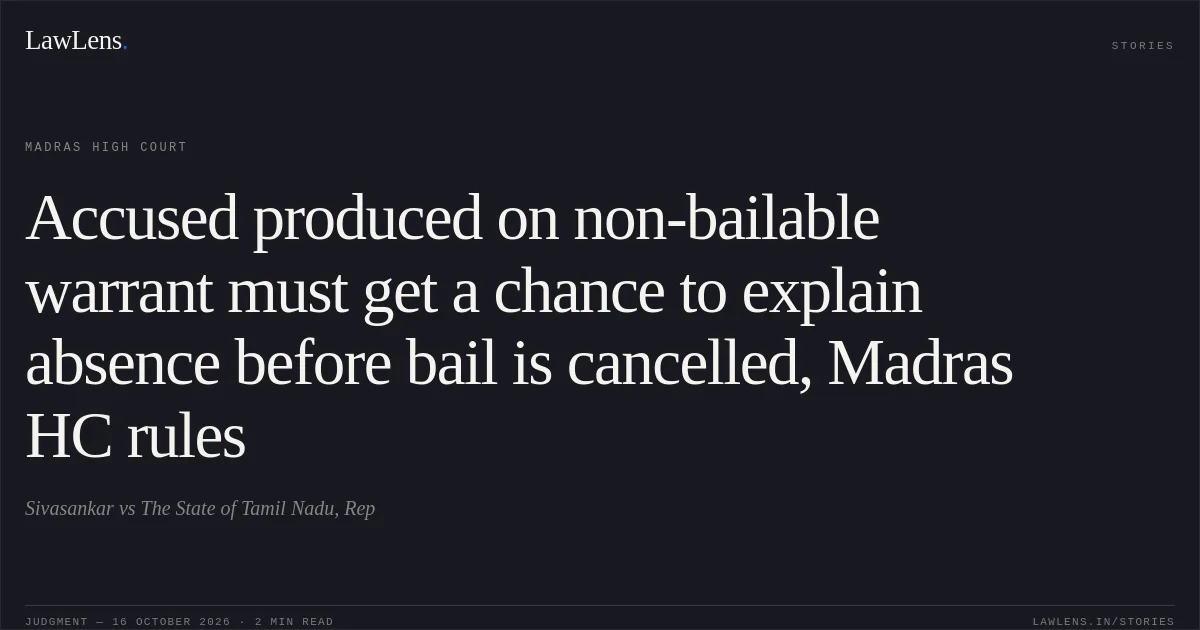
Source reference: paras. 1–9, pp. 1–4After he failed to appear, the trial court issued a non-bailable warrant on 3 August 2024. On his production following arrest on 19 May 2026, the trial court remanded him to judicial custody. His subsequent bail applications were dismissed. He challenged the remand order, contending that his bail remained in force and that he had not been given an opportunity to explain his absence.
Source reference: paras. 1–9, pp. 1–4Issues
Whether the trial court could remand the petitioner to custody under Section 167(2) Cr.P.C. when he was produced pursuant to a non-bailable warrant during trial.
Source reference: paras. 14–17, pp. 6–7Whether the trial court could remand him without first giving him an opportunity to explain his non-appearance and recording a finding that his bail bond stood forfeited.
Source reference: paras. 20–23, pp. 9–13Law Applied
The Court held that remand following production on a non-bailable warrant issued during trial is governed by Section 309(2) Cr.P.C., not Section 167(2), which concerns remand in the context of investigation.
Source reference: paras. 14–16, pp. 6–7; State through CBI v. Dawood Ibrahim Kaskar, (2000) 10 SCC 438, para. 11, p. 8Under Sections 89 and 70(2) Cr.P.C. (corresponding to Sections 92 and 72(2) BNSS), an accused who fails to appear may be secured by warrant and, upon production, must be allowed to explain the absence. If the explanation is unsatisfactory, the court must record reasons and find that the bond is forfeited; upon that finding, the bond and bail stand cancelled under Section 446-A Cr.P.C. The court may then release the accused on a fresh bond under the provision’s proviso or remand him under Section 309(2) Cr.P.C.
Source reference: para. 21(a)–(h), p. 12; para. 22, p. 13The Court relied on Prabakaran v. State, (2010) 1 CTC 585, and Pillappan v. State, (2018) 3 CTC 156, concerning forfeiture, cancellation of the bond, and the required opportunity and finding.
Source reference: paras. 19–20, pp. 8–11Reasoning
The petitioner had been produced in execution of a trial-stage non-bailable warrant, but the trial court’s order treated the matter as a remand under Section 167(2) Cr.P.C. and did not address the distinct requirements applicable under Section 309(2).
Source reference: paras. 14–17, pp. 6–7The court had neither afforded the petitioner an opportunity to explain his absence nor recorded reasons or a finding of bond forfeiture. The remand was therefore mechanical and legally defective. Given that the petitioner had already spent more than 180 days in custody, merely setting aside the order and sending the matter back would not serve the ends of justice.
Source reference: para. 23, p. 13Holding
The High Court set aside the remand order dated 19 May 2026 and allowed the petition.
It directed that the petitioner be released on bail, subject to appearing before the trial court daily at 10:30 a.m. until further orders and furnishing such bond and sureties as the trial court may fix.
Source reference: para. 23(a)–(c), p. 13Acts & Sections Cited
17 provisions across 4 statutes referred to in this judgment. Each provision opens on LawLens.
Bharatiya Nagarik Suraksha Sanhita, 20233
Indian Penal Code, 18605
Scheduled Castes and the Scheduled Tribes (Prevention of Atrocities) Act, 19891
Code of Criminal Procedure, 19738
Original Court PDF
SivasankarvsThe State of Tamil Nadu, Rep
Click to open original judgment
Original judgment, available to read, download and summarize on LawLens.in