Facts
The petitioner, a widow and partially paralyzed individual, filed eviction petitions against three tenants under Section 14(1)(e) of the Delhi Rent Control Act (DRCA), 1958, claiming bona fide requirement for herself and her daughters.
Source reference: p. 2-3The property history involves a devolution from the original owner (Smt. Raj Kumari Verma) to her son (Ashok Kumar Verma), who then bequeathed it via Will to the petitioner’s husband (Anil Gupta) in 2005.
Source reference: p. 2Following Ashok's death in 2021, Anil Gupta became the owner and subsequently executed a registered Gift Deed in favor of his wife, the petitioner, on 18.07.2022.
Source reference: p. 2The eviction petitions were filed on 06.12.2022.
Source reference: p. 4The Rent Controller (ARC) dismissed the petitions as non-maintainable, holding they were barred by Section 14(6) of the DRCA, which prohibits eviction filings within five years of acquiring property by "transfer".
Source reference: p. 5Issues
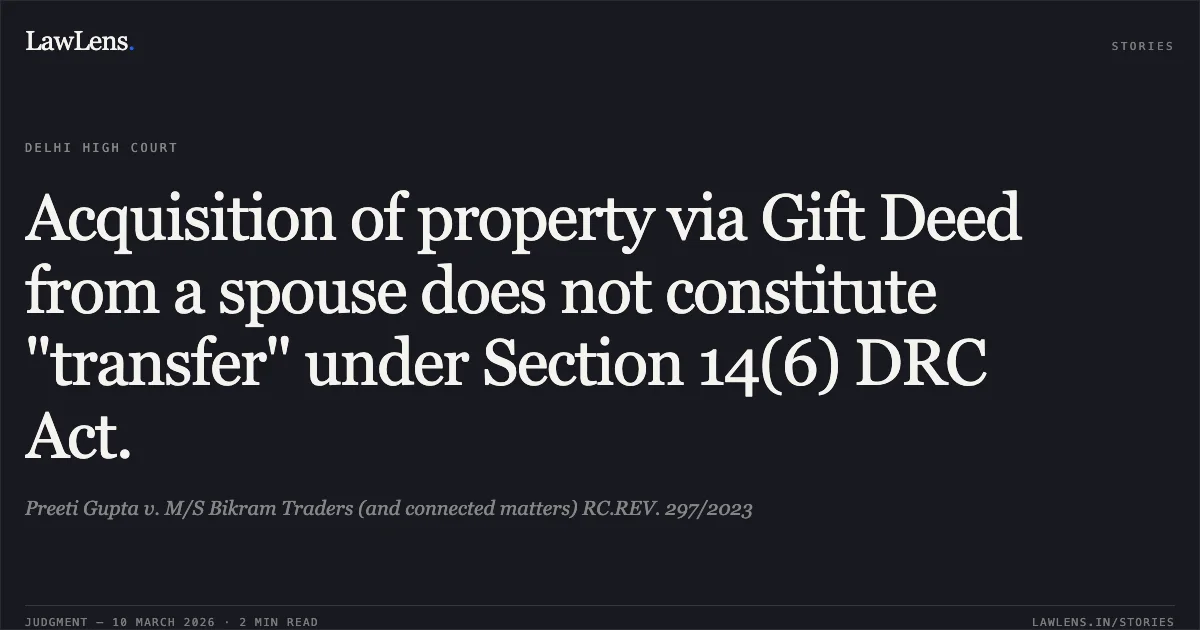
Whether the acquisition of property by a wife from her husband via a Gift Deed constitutes a "transfer" under Section 14(6) of the DRCA so as to trigger the five-year statutory bar on filing eviction petitions.
Source reference: p. 3, 6Law Applied
The court primarily interpreted Section 14(6) of the Delhi Rent Control Act, 1958, which restricts landlords who acquire premises by "transfer" from seeking eviction for five years.
Source reference: p. 7It relied on the Supreme Court precedent in V.N. Sarin v. Major Ajit Kumar Poplai, which established that the object of Section 14(6) is to prevent "strangers" or "outsiders" from using transfers as a device to evict tenants, and does not apply where the claimant had a prior interest or title (such as through partition).
Source reference: p. 7-9It further considered Dr. R.C. Sakhuja v. R.P. Kholi, which clarified that devolution by succession (testamentary or non-testamentary) is not a "transfer" within this section.
Source reference: p. 12-13Reasoning
The Court reasoned that Section 14(6) is intended to curb the "mischief" of landlords transferring property to third parties specifically to circumvent eviction restrictions.
Source reference: p. 8In the present case, the petitioner is not a "rank outsider" or a "stranger" to the property.
Source reference: p. 9, 14As the wife and a Class I legal heir of the previous owner (Anil Gupta), she possessed a vested legal interest in the property even prior to the Gift Deed.
Source reference: p. 15The Court observed that had the husband died intestate, the petitioner would have inherited the property by operation of law, which is exempt from the five-year bar.
Source reference: p. 15Therefore, a Gift Deed executed between family members (husband to wife) under these circumstances does not qualify as a "transfer" in the restrictive sense contemplated by the legislature, as it does not involve the introduction of a stranger to the landlord-tenant relationship.
Source reference: p. 14-15Holding
The Court held that the bar under Section 14(6) of the DRCA is not attracted when property is gifted by a husband to a wife who is also a legal heir.
The High Court set aside the impugned orders dated 27.03.2023, restored the eviction petitions, and remanded the matter to the ARC for fresh adjudication on merits.
Source reference: p. 15The petitions were allowed with directions for immediate compliance.
Source reference: p. 15-16Acts & Sections Cited
1 provisions across 1 statute referred to in this judgment. Each provision opens on LawLens.
delhi rent control act, 19581
Original Court PDF
Preeti Gupta v. M/S Bikram Traders (and connected matters) RC.REV. 297/2023
Click to open original judgment
Original judgment, available to read, download and summarize on LawLens.in


