Facts
The petitioners, police personnel, challenged the State Human Rights Commission’s order directing the State to pay ₹1,00,000 to Angusamy’s son, Raja, and to recover portions of that amount from the petitioners.
Source reference: paras. 2–6, 10–12; pp. 4–10The complaint alleged that the police, motivated by a dispute over payment for paint and a refusal to supply paint free of cost, falsely implicated Raja in a prohibition case and physically assaulted and stripped him at the police station.
Source reference: paras. 2–6, 10–12; pp. 4–10The complainant and two other witnesses gave evidence before the Commission; the police personnel filed counters and examined a defence witness.
Source reference: paras. 2–6, 10–12; pp. 4–10The High Court called for and examined the Commission’s records.
Source reference: paras. 2–6, 10–12; pp. 4–10Issues
Whether the material before the Commission sufficiently established that Raja was physically assaulted while in police custody.
Source reference: paras. 7–10; pp. 6–8Whether the alleged police motive and false implication of Raja were established so as to support a finding of human-rights violation and an award of compensation.
Source reference: paras. 10–12; pp. 8–10Law Applied
The Court exercised its jurisdiction under Article 226 of the Constitution to review the Commission’s order.
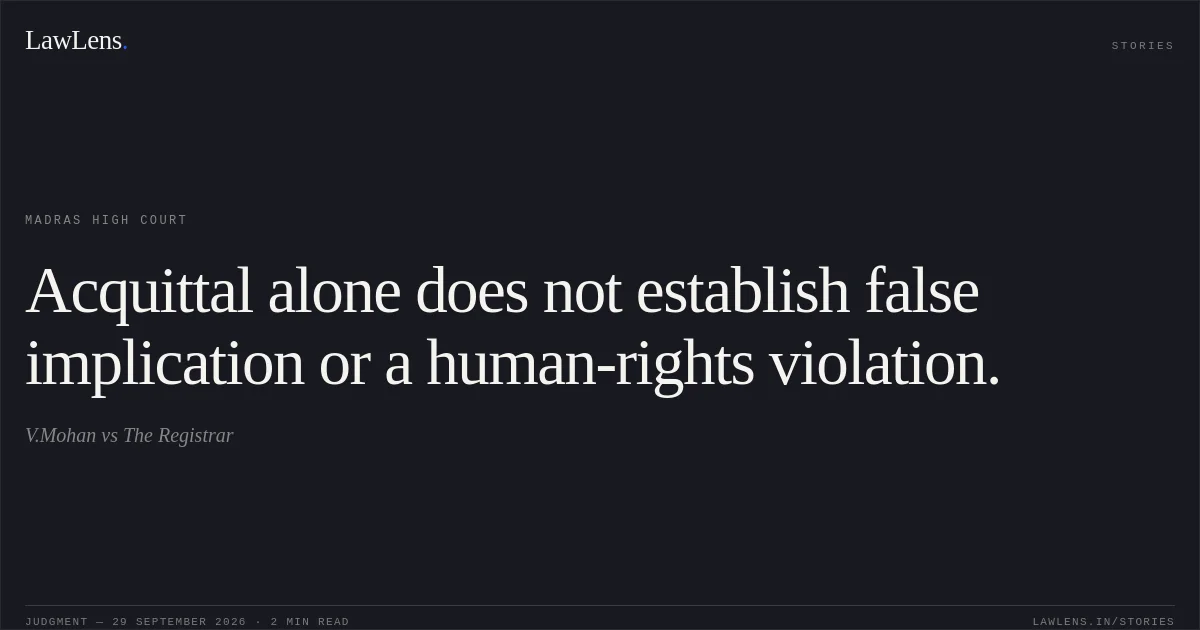
Source reference: paras. 11–12; pp. 9–10It applied the principle that a finding of human-rights violation and consequential compensation must be supported by acceptable material; an acquittal in a criminal case, by itself, does not establish that the case was falsely foisted, and false implication must be independently proved.
Source reference: paras. 11–12; pp. 9–10The petitioners referred to Section 65B of the Evidence Act in challenging the photographs and CCTV footage, but the Court’s decision rested on the insufficiency of the evidence on record.
Source reference: para. 7; p. 6Reasoning
The Court found no document or other material establishing physical injury to Raja.
Source reference: paras. 10–12; pp. 8–10The photographs showed him at the hardware store, but, without scientific evidence confirming their date and time, they did not prove the alleged assault or its circumstances.
Source reference: paras. 10–12; pp. 8–10The oral evidence was not supported by bills or other documents substantiating the alleged paint dispute or the claimed unpaid amount.
Source reference: paras. 10–12; pp. 8–10Further, the alleged acquittal judgment was not produced before the Commission, and acquittal alone could not establish false implication.
Source reference: paras. 10–12; pp. 8–10The Court therefore held that the evidence did not support the Commission’s finding of a human-rights violation.
Source reference: paras. 10–12; pp. 8–10Holding
The Court held that the Commission’s finding of a human-rights violation was unsupported by acceptable material and set aside its order dated 28 March 2023.
All three writ petitions were allowed; there was no order as to costs, and the connected miscellaneous petitions were closed.
Source reference: paras. 12–13; p. 10Acts & Sections Cited
2 provisions across 2 statutes referred to in this judgment. Linked provisions open on LawLens.
Tamil Nadu Prohibition Act, 19371
Indian Evidence Act, 18721
Original Court PDF
V.MohanvsThe Registrar
Click to open original judgment
Original judgment, available to read, download and summarize on LawLens.in