Facts
The petitioner applied for recruitment as a Grade II Police Constable on 2 April 2019 and completed the selection process. In his verification roll, submitted on 10 September 2019, he stated that he had no criminal antecedents.
Source reference: pp. 2–4The respondents rejected his candidature by order dated 23 March 2020, citing unsatisfactory character and antecedents.
Source reference: pp. 2–4The petitioner maintained that he was not named in the FIR registered on 19 April 2019 and did not know of the case when he completed the verification roll; his bail application was reportedly returned because he was not shown as an accused, and he was implicated by a later statement dated 16 December 2020.
Source reference: pp. 2–4, 6He was subsequently tried in S.C. No. 2 of 2021 and acquitted after the complainant turned hostile.
Source reference: pp. 2–4, 6He sought certiorari to quash the rejection and a direction for consideration of his appointment.
Source reference: p. 1Issues
Whether the petitioner’s failure to disclose the criminal case in his verification roll amounted to suppression, given his claim that he was unaware of the case and was not named in the FIR.
Source reference: pp. 3–5, 7Whether the petitioner’s involvement in the criminal case, followed by an acquittal based on the complainant turning hostile, rendered him unsuitable for appointment as a Grade II Police Constable.
Source reference: pp. 5–6, 8–9, 17–19Whether the Court, in exercising judicial review under Article 226, could interfere with the appointing authority’s assessment of the petitioner’s suitability.
Source reference: pp. 8–10, 13, 19Law Applied
The Court relied on Rule 14(2)(b) and Explanation (1)(2) of the Special Rules for the Tamil Nadu Police Subordinate Services, 1978, under which involvement in a criminal case disqualifies a candidate; it also treated an acquittal based on the complainant turning hostile as insufficient to establish eligibility.
Source reference: pp. 5–6It applied Manikandan v. Chairman, Tamil Nadu Uniformed Services Recruitment Board (2008) 2 CTC 97 and J. Alex Ponseelan v. Director General of Police (2014) 2 CTC 337 on the validity of the police-service rules.
Source reference: p. 7Relying also on Avtar Singh v. Union of India, Union Territory, Chandigarh Administration v. Pradeep Kumar, Commissioner of Police v. Raj Kumar, Satish Chandra Yadav v. Union of India, and State of Madhya Pradesh v. Bhupendra Yadav, the Court stated that truthful disclosure or acquittal does not automatically confer a right to appointment, and that the employer may assess antecedents and suitability; judicial review of that assessment is limited, including to grounds such as mala fides, bias, unfair procedure, or illegality.
Source reference: pp. 7–10It considered Ravindra Kumar v. State of U.P. for the proposition that suppression alone does not justify an automatic or arbitrary rejection, but distinguished the present case as involving more than suppression.
Source reference: pp. 11–12, 18Reasoning
The Court accepted, to some extent, the petitioner’s argument that his answers in the verification roll could not be treated as suppression if he was unaware of the case.
Source reference: p. 5, para. 7It nevertheless considered the petitioner’s involvement to be established: the case had proceeded against him, he was acquitted after the complainant turned hostile, and the applicable rule did not treat that acquittal as sufficient to make him eligible.
Source reference: pp. 6, 10–11, paras. 9, 17The Court therefore treated the case as turning not only on what the petitioner knew when completing the verification roll, but also on the respondents’ subsequent assessment of his antecedents and suitability.
Source reference: no citationIn light of the governing rules and the limited scope of judicial review, it declined to reassess the appointing authority’s suitability determination.
Source reference: pp. 11–12, 19Holding
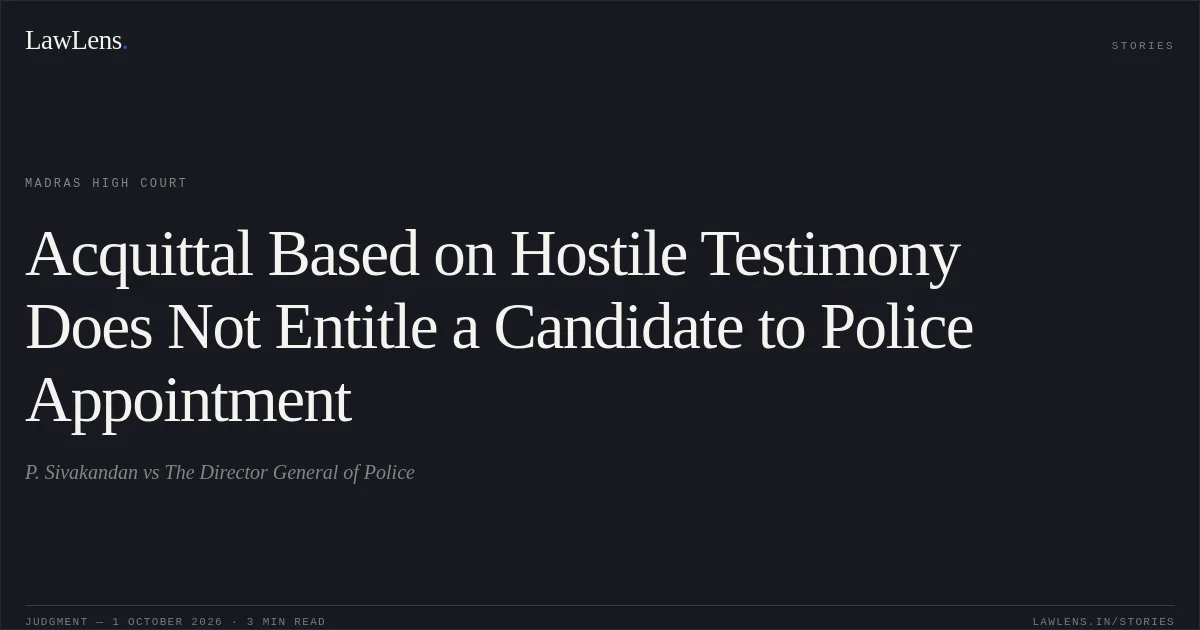
The Court held that the petitioner’s acquittal, based on the complainant turning hostile, did not entitle him to appointment and found no ground to interfere with the respondents’ assessment of his suitability.
The writ petition was dismissed, the connected miscellaneous petition was closed, and no costs were awarded.
Source reference: p. 12, para. 20Original Court PDF
P. SivakandanvsThe Director General of Police
Click to open original judgment
Original judgment, available to read, download and summarize on LawLens.in