Facts
The Petitioner’s father, a Delhi Police employee, died in 2013, and the Petitioner was subsequently approved for compassionate appointment as Head Constable (Ministerial) in 2014, subject to verification
Source reference: p. 2During verification, it was revealed that the Petitioner had been involved in FIR No. 138/2009 involving charges of house trespass, rioting, and grievous hurt
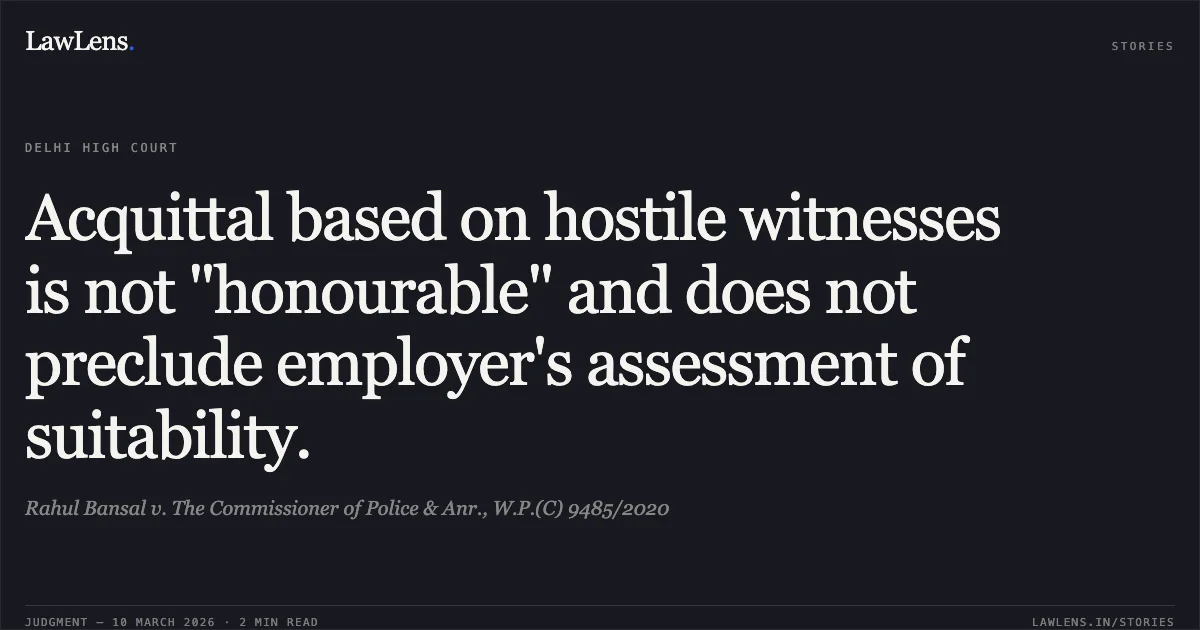
Source reference: p. 2, 10Although the Petitioner disclosed this in his attestation form, he was acquitted in 2011 because prosecution witnesses turned hostile
Source reference: p. 2The Respondent’s Screening Committee deemed the Petitioner unsuitable for a disciplined force, leading to the cancellation of his candidature on March 14, 2016
Source reference: p. 3The Petitioner challenged this before the Central Administrative Tribunal (CAT), which dismissed his plea on March 18, 2020, upholding the employer's right to assess suitability
Source reference: p. 3Issues
1. Whether the Respondents were justified in rejecting the Petitioner’s appointment for a disciplined force based on his criminal antecedents despite his truthful disclosure and subsequent acquittal
Source reference: p. 2 / para. 32. Whether an acquittal resulting from witnesses turning hostile constitutes an "honourable acquittal" that mandates appointment
Source reference: p. 6 / para. 18-193. Whether the Petitioner maintains a vested right to compassionate appointment a decade after the death of the breadwinner
Source reference: p. 12 / para. 27-28Law Applied
The Court relied on *Commissioner of Police v. Mehar Singh*, establishing that a Screening Committee may reject candidates if an acquittal is technical (e.g., witnesses turning hostile) rather than honourable
Source reference: p. 6It further applied *Avtar Singh v. UOI*, which held that truthful disclosure does not create an indefeasible right to appointment, and employers retain discretion to assess suitability for sensitive services
Source reference: p. 9-10Regarding compassionate appointment, the Court applied *Tinku v. State of Haryana*, noting it is an exception to meet immediate financial crises and not a vested right or alternative mode of recruitment
Source reference: p. 12Reasoning
The Court reasoned that for recruitment into a disciplined force like the Delhi Police, a stringent standard of "impeccable character" is required
Source reference: p. 6The Court noted that the Petitioner’s acquittal was not on merits but occurred because victims from his own village turned hostile despite Medico-Legal Certificates (MLCs) confirming grievous injuries to women
Source reference: p. 10-11Consequently, the Screening Committee’s decision was neither mechanical nor mala fide but based on a reasoned assessment of the "propensity" of the candidate to affect law and order
Source reference: p. 7, 11Furthermore, the Court observed that the 13-year delay since the father’s death in 2013 attenuated the "immediate succour" justification for compassionate appointment, suggesting the family had successfully navigated the financial crisis in the interim
Source reference: p. 13Holding
The Court answered the issues in the negative, holding that the employer's right to assess suitability is paramount in disciplined forces and is not eclipsed by a technical acquittal
The Court affirmed that the Screening Committee acted within its legal bounds and found no procedural infirmity in the Tribunal’s judgment
Source reference: p. 11The Writ Petition was dismissed, and the cancellation of the Petitioner’s candidature was upheld
Source reference: p. 14Original Court PDF
Rahul Bansal v. The Commissioner of Police & Anr., W.P.(C) 9485/2020
Click to open original judgment
Original judgment, available to read, download and summarize on LawLens.in