Facts
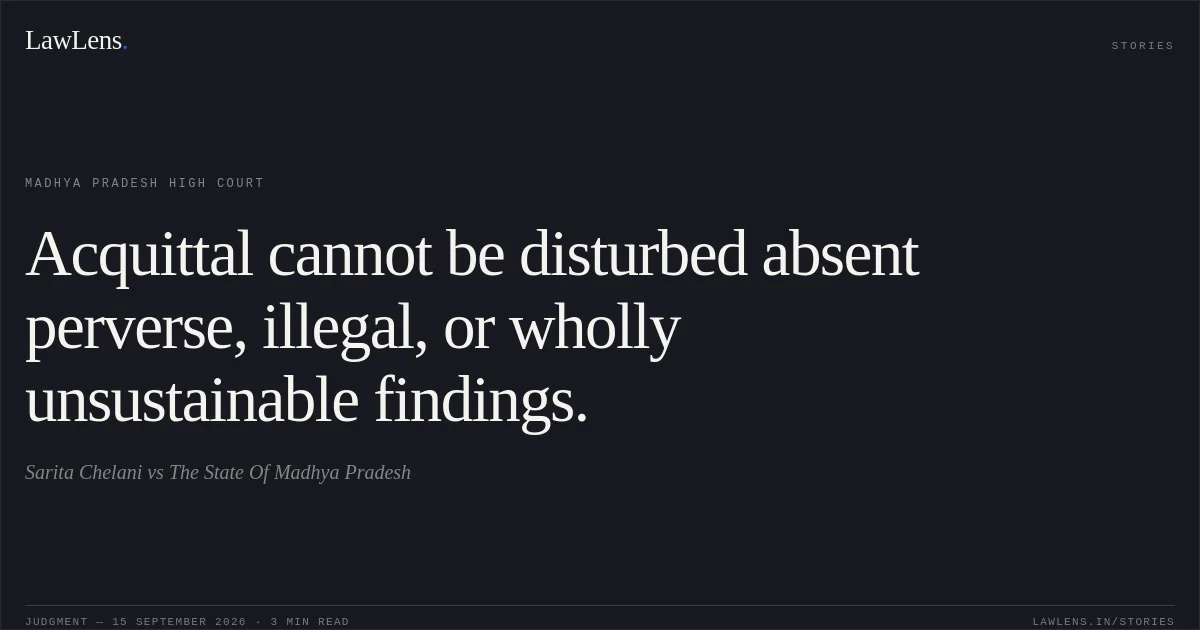
The petitioner challenged the judgment dated 14 October 2017 passed by the Judicial Magistrate First Class, Katni, in Criminal Complaint Case No. 1453/2011, whereby respondents Nos. 2–5 were acquitted of offences under Sections 323, 452, 458, 294, 324, 506-II read with Section 34 of the Indian Penal Code (IPC).
Source reference: p.1The petitioner alleged that the respondents had assaulted her and threatened to kill her family members.
Source reference: p.1The alleged incident occurred on 20 March 2007. The petitioner later submitted an application to the National Chairperson of the Women’s Commission on 30 April 2007; however, the alleged earlier written complaint was not produced or proved.
Source reference: p.2The respondents argued that the delay was unexplained, no medical-legal certificate was produced, the witnesses’ names were absent from the complaint, and the complaint was motivated by prior enmity arising from a counter-case lodged by respondent No. 2 against the complainant’s husband.
Source reference: p.1The Trial Court had found material omissions and contradictions in the prosecution evidence and granted the respondents the benefit of doubt.
Source reference: p.2Issues
Whether the Trial Court’s acquittal of respondents Nos. 2–5 for offences under Sections 323, 452, 458, 294, 324, 506-II and 34 IPC was perverse, illegal, or contrary to the evidence so as to warrant appellate interference?
Source reference: pp.2–4Whether the delay in lodging the complaint, absence of medical evidence, omissions in the complaint, and contradictions in the prosecution testimony created reasonable doubt regarding the respondents’ guilt?
Source reference: p.2Whether the High Court, while examining a challenge to an acquittal under Section 378(IV) of the Code of Criminal Procedure, should disturb the Trial Court’s view where another reasonable view is possible?
Source reference: pp.3–4Law Applied
The Court considered the petition under Section 378(IV) of the Code of Criminal Procedure, concerning appellate scrutiny of an order of acquittal.
Source reference: p.1The alleged substantive offences were under Sections 323, 452, 458, 294, 324, 506-II and 34 IPC.
Source reference: p.1Relying on Ramesh Babulal Doshi v. State of Gujarat, (1996) 9 SCC 225, the Court held that an acquittal should not be disturbed unless the Trial Court’s findings are palpably wrong, manifestly erroneous, or demonstrably unsustainable.
Source reference: p.3Under Ajit Savant Majagvai v. State of Karnataka, (1997) 7 SCC 110, although the appellate court may reappraise the evidence, it must consider the reasons supporting acquittal, preserve the strengthened presumption of innocence, and adopt the view favourable to the accused where two reasonable views are possible.
Source reference: p.3The Court further relied on Nikhil Chandra Mondal v. State of West Bengal, (2023) 6 SCC 605, which reiterates that interference is impermissible unless the acquittal is perverse, illegal, or impossible, and that an acquitted accused benefits from a double presumption of innocence.
Source reference: p.4Reasoning
The High Court found that the alleged incident occurred on 20 March 2007, whereas the application to the Women’s Commission was made only on 30 April 2007, and the purported earlier complaint was neither produced nor proved.
Source reference: p.2The prosecution also lacked medical-legal evidence, and the Trial Court had identified material omissions and contradictions in the testimony of the complainant and other witnesses.
Source reference: pp.1–2The existence of a counter-case involving the complainant’s husband furnished an additional circumstance supporting the respondents’ contention that the complaint might have been motivated by prior enmity.
Source reference: p.2Applying the restrictive standard governing appeals against acquittal, the High Court held that the Trial Court’s assessment was a reasonably possible view based on the evidence and did not disclose perversity, illegality, or manifest error.
Source reference: pp.2–4Holding
The High Court answered the issues against the petitioner.
It held that the Trial Court had properly appreciated the evidence and had rightly extended the benefit of reasonable doubt to respondents Nos. 2–5.
Source reference: p.4Since no perversity or illegality was established in the acquittal judgment, the High Court declined to interfere with it and dismissed the petition.
Source reference: p.4Acts & Sections Cited
8 provisions across 2 statutes referred to in this judgment. Each provision opens on LawLens.
Code of Criminal Procedure, 19731
Indian Penal Code, 18607
Original Court PDF
Sarita ChelanivsThe State Of Madhya Pradesh
Click to open original judgment
Original judgment, available to read, download and summarize on LawLens.in