Facts
The complainant, Kantaben, a member of a Scheduled Caste and a construction labourer, alleged that on 12 April 2009, Aminbhai quarrelled with her daughter and niece at the outskirts of the village and slapped Mansukhbhai when he intervened. It was further alleged that Aminbhai, accompanied by the other accused and armed with sticks, an axe and a farsi, came near the complainant’s house, assaulted her and her family members, and caused a bleeding head injury to Lalitaben.
Source reference: pp. 2, 8–9The injured persons were taken first to Limbdi Government Hospital and thereafter to T.B. Hospital, Surendranagar.
Source reference: p. 2An FIR, C.R. No. II-3021/2009, was registered at Panshina Police Station for offences under Sections 147, 148, 323, 403, 427, 504 and 506(2) read with Section 149 of the Indian Penal Code, Section 3(1)(x) of the Scheduled Castes and Scheduled Tribes (Prevention of Atrocities) Act, 1989, and Section 135 of the Bombay Police Act.
Source reference: pp. 1–3After investigation and trial in Special Atrocity Case No. 39 of 2009, the Trial Court acquitted all the accused on 17 March 2012. The State preferred the present appeal under Section 378(1) and (3) of the Code of Criminal Procedure, 1973.
Source reference: p. 1Issues
1. Whether the Trial Court committed an error of law or fact in acquitting the accused?
Source reference: p. 7, para. 72. Whether the Trial Court improperly appreciated the oral and documentary evidence led by the prosecution?
Source reference: p. 7, para. 73. Whether the impugned judgment of acquittal was illegal, perverse or otherwise warranted appellate interference?
Source reference: p. 7, para. 74. Whether the prosecution proved the essential ingredients of the offences under the IPC, Section 3(1)(x) of the SC/ST Act and Section 135 of the Bombay Police Act beyond reasonable doubt?
Source reference: pp. 11–12, 17, paras. 13–20Law Applied
The Court applied Section 378(1) and (3) CrPC governing appeals against acquittal, along with the principle that although an appellate court may fully review and re-appreciate the evidence, an acquittal carries a strengthened or “double” presumption of innocence; where two reasonable views are possible, the acquittal should not be disturbed.
Source reference: pp. 18–21, paras. 22–25The Court considered Sections 147, 148, 323, 403, 427, 504 and 506(2) read with Section 149 IPC, Section 3(1)(x) of the SC/ST Act, and Section 135 of the Bombay Police Act.
Source reference: pp. 1, 5It held that an offence under the SC/ST Act requires proof of its statutory ingredients, including caste-based insult or humiliation and, where applicable, the requirement that the abuse occur in a place within public view; mere proof that the complainant belongs to a Scheduled Caste is insufficient.
Source reference: pp. 13–17, paras. 17–20In this regard, the Court relied on Shajan Skaria v. State of Kerala, 2024 AIR SC 4557, concerning the necessity of a caste-based intention, and Sohanvir @ Sohanvir Dhama v. State of U.P., 2025 (4) Crimes 375, Karuppudayar v. State, 2025 AIR SC 705, and related authorities on the “public view” requirement.
Source reference: pp. 13–17, paras. 17–20The appellate principles in Chandrappa v. State of Karnataka, (2007) 4 SCC 415, as reaffirmed in Rajesh Prasad v. State of Bihar, (2022) 3 SCC 471, Babu Sahebagouda Rudragoudar v. State of Karnataka, (2024) 8 SCC 149, and Ramesh v. State of Karnataka, (2024) 9 SCC 169, were also applied.
Source reference: pp. 18–21, paras. 22–25Reasoning
The Court found that the prosecution evidence did not establish the charges beyond reasonable doubt.
Source reference: no citationAlthough the complainant and several injured or eyewitness witnesses supported the occurrence, the medical evidence showed only simple injuries, which were also consistent with a fall or pushing during a scuffle; the doctors further stated that the injured persons had not named the assailants in their medical histories.
Source reference: pp. 9–10, paras. 10–11Specific roles were principally attributed to Accused Nos. 1 to 4, while no clear role was assigned to Accused Nos. 5 to 9, and some names allegedly given to the doctor did not correspond with the accused before the Court.
Source reference: p. 11, para. 12The material witnesses were related to the complainant, and the record disclosed possible prior political rivalry and enmity.
Source reference: p. 11, para. 12The Investigating Officers admitted that the witnesses had not stated during investigation that the accused had committed the offence under Section 3(1)(x) of the SC/ST Act; consequently, the essential caste-based ingredients were not proved.
Source reference: p. 11, para. 13The alleged weapons were not reliably recovered from the accused, and the panch witnesses did not support the recovery panchnama.
Source reference: p. 12, para. 14Applying the heightened appellate restraint applicable to an acquittal, the Court held that the Trial Court’s view was reasonable, supported by the evidence, and neither perverse nor legally unsustainable.
Source reference: pp. 18–21, paras. 22–27Holding
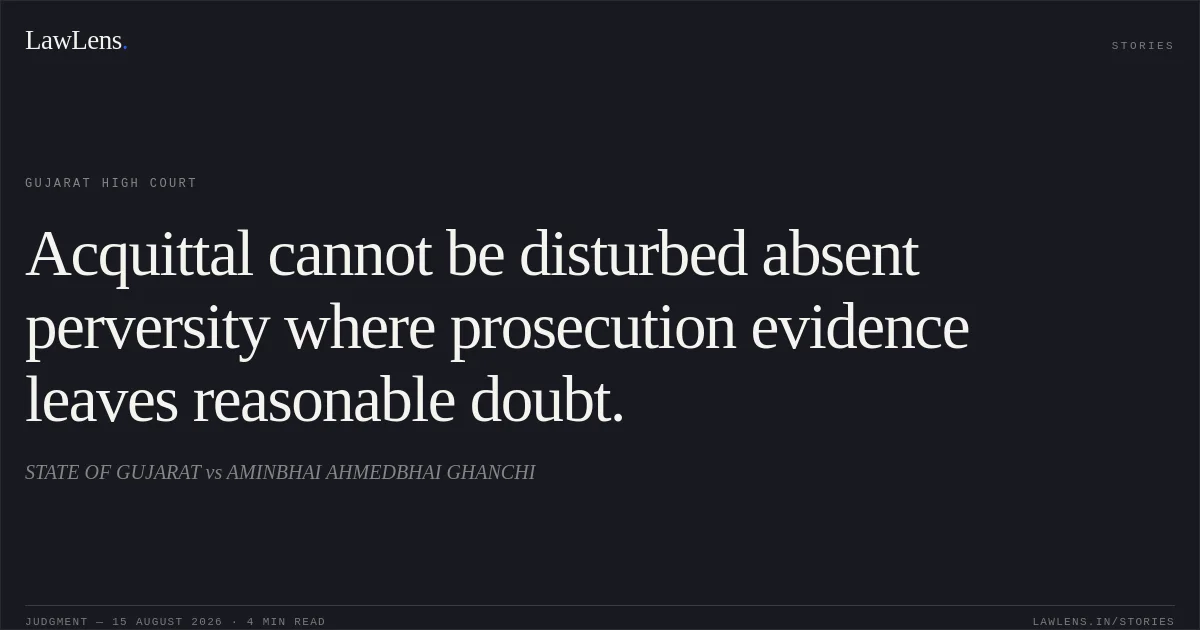
The High Court answered the issues against the State and held that the prosecution failed to prove the accused’s involvement in the alleged offences beyond reasonable doubt, including the essential ingredients of Section 3(1)(x) of the SC/ST Act.
Finding no illegality, perversity or manifest error in the Trial Court’s judgment, the Court dismissed the State’s appeal and confirmed the order of acquittal dated 17 March 2012.
Source reference: p. 22, para. 28The bail bonds were cancelled, and the record and proceedings were directed to be returned to the Trial Court.
Source reference: p. 22, para. 28Acts & Sections Cited
17 provisions across 4 statutes referred to in this judgment. Each provision opens on LawLens.
Code of Criminal Procedure, 19735
Indian Penal Code, 1860
Scheduled Castes and the Scheduled Tribes (Prevention of Atrocities) Act, 19892
Protection of Civil Rights Act, 19551
Original Court PDF
STATE OF GUJARATvsAMINBHAI AHMEDBHAI GHANCHI
Click to open original judgment
Original judgment, available to read, download and summarize on LawLens.in