Facts
The deceased, Balvantsinh Chauhan, and the accused—his close relatives—were involved in disputes concerning ancestral agricultural land and residential property.
Source reference: p.2The prosecution alleged that the accused continuously harassed, abused, humiliated and threatened the deceased, including an alleged threat on 19 May 2018 to vacate the property or face death. On 20 May 2018, the deceased consumed poisonous “selfos” tablets, informed his wife that the accused’s conduct had led him to take the step, and subsequently died during treatment.
Source reference: p.2The appellant, wife of the deceased, lodged the complaint, following which the accused were prosecuted under Sections 306, 504, 506(2) and 114 of the Indian Penal Code (“IPC”).
Source reference: p.2After examining 13 witnesses and producing 15 documentary exhibits, the trial court acquitted the accused in Sessions Case No. 31 of 2019 by judgment dated 28 February 2026.
Source reference: p.3The complainant accordingly preferred an appeal against acquittal under Section 413 of the Bharatiya Nagarik Suraksha Sanhita (“BNSS”).
Source reference: p.1The evidence also disclosed that the deceased was facing departmental proceedings in his employment, a pending prohibition case, and civil and criminal proceedings involving the accused.
Source reference: pp.5–6Issues
Whether the prosecution proved beyond reasonable doubt that the accused abetted the deceased’s suicide so as to attract Section 306 read with Section 107 IPC.
Source reference: pp.6–7, 12–13Whether the evidence established the offences under Sections 504, 506(2) and 114 IPC against the accused.
Source reference: pp.6–7, 12Whether the trial court’s acquittal was so erroneous, perverse or manifestly illegal as to warrant interference in an appeal against acquittal.
Source reference: pp.8–11, 16–21Law Applied
The Court applied Section 306 IPC, which penalises abetment of suicide, read with Section 107 IPC, which defines abetment; the prosecution must establish a clear, proximate and intentional act of instigation or abetment connected with the suicide, as explained in Gangula Mohan Reddy v. State of Andhra Pradesh, (2010) 1 SCC 750.
Source reference: pp.6–7The alleged offences under Sections 504, 506(2) and 114 IPC also required proof beyond reasonable doubt of intentional insult, criminal intimidation and common liability, respectively.
Source reference: p.7In an appeal against acquittal under Section 413 BNSS, the appellate court has full power to reappreciate the evidence, but must recognise the double presumption of innocence in favour of the accused; where two reasonable views are possible, the acquittal should not be disturbed.
Source reference: pp.8–11These principles were drawn from Chandrappa v. State of Karnataka, (2007) 4 SCC 415; Rajesh Prasad v. State of Bihar, (2022) 3 SCC 471; Babu Sahebagouda Rudragoudar v. State of Karnataka, (2024) 8 SCC 149; and Ramesh v. State of Karnataka, (2024) 9 SCC 169.
Source reference: pp.8–11Reasoning
The Court found that the prosecution had not produced credible evidence establishing a specific, proximate or intentional act by the accused that instigated or facilitated the deceased’s suicide, as required under Sections 107 and 306 IPC.
Source reference: pp.6–7, 20–21The existence of property disputes, prior civil and criminal proceedings, departmental proceedings against the deceased and a pending prohibition case supplied alternative circumstances relevant to the deceased’s mental condition, but did not independently prove abetment by the accused.
Source reference: pp.5–6The Court agreed with the trial court that the evidence did not reliably connect the accused with the alleged offences under Sections 306, 504, 506(2) or 114 IPC.
Source reference: pp.6–7, 20Since the trial court’s view was a reasonable one based on the evidence, and there was no manifest illegality, perversity or compelling ground for reversal, the appellate presumption in favour of the acquitted accused remained operative.
Source reference: pp.8–11, 16–18Holding
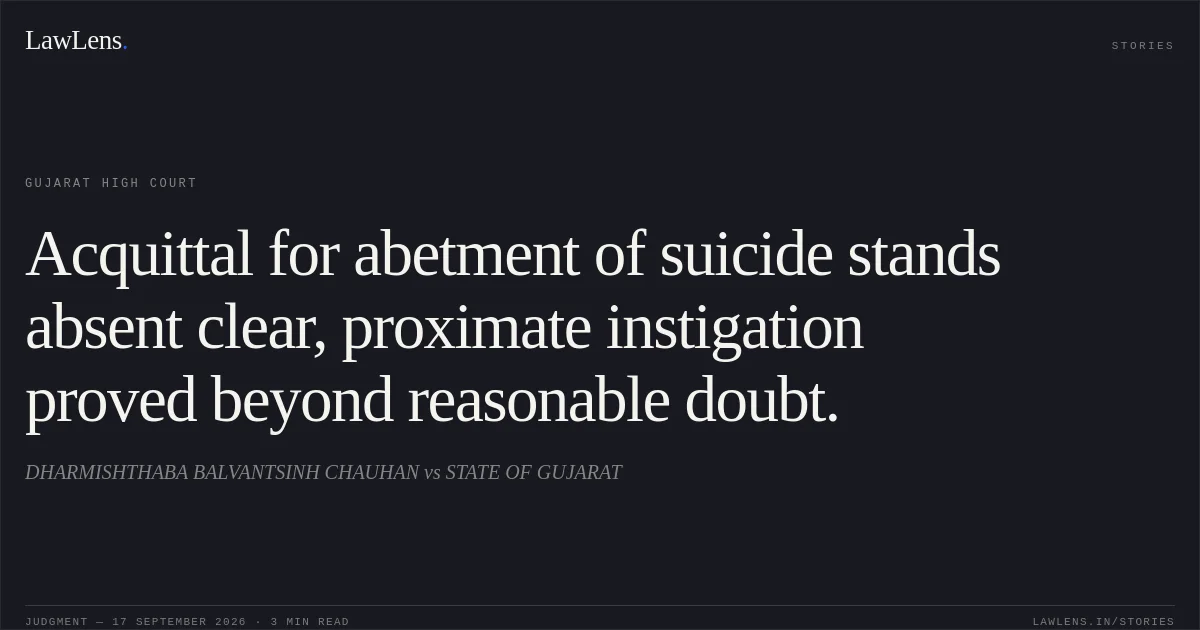
The Court answered the issues against the appellant, holding that the prosecution failed to prove abetment of suicide or the other charged offences beyond reasonable doubt.
It held that the trial court had committed no error of fact or law in acquitting the accused and that the acquittal did not warrant appellate interference.
Source reference: pp.20–21The appeal was dismissed, the judgment and order of acquittal dated 28 February 2026 were confirmed, any bail bonds were cancelled, and the record and proceedings were directed to be returned to the trial court.
Source reference: p.12Acts & Sections Cited
7 provisions across 3 statutes referred to in this judgment. Each provision opens on LawLens.
Bharatiya Nagarik Suraksha Sanhita, 20231
Indian Penal Code, 18605
Code of Criminal Procedure, 19731
Original Court PDF
DHARMISHTHABA BALVANTSINH CHAUHANvsSTATE OF GUJARAT
Click to open original judgment
Original judgment, available to read, download and summarize on LawLens.in