Facts
On 22 June 2006, a GEB/P.G.V.C.L. checking squad allegedly inspected the respondent’s flour mill at Village Gorakhadi, Taluka Jamjodhpur, and found an unauthorised three-phase direct connection from a low-tension electricity line, allegedly used to operate the mill.
Source reference: pp.1–3, paras. 1–2.4The squad prepared an inspection report, allegedly seized approximately 15 metres of cable, and issued a supplementary assessment bill.
Source reference: pp.1–3, paras. 1–2.4A complaint was thereafter lodged, and C.R. No. II-195 of 2006 was registered for an offence under Section 135 of the Electricity Act, 2003.
Source reference: pp.1–3, paras. 1–2.4Following investigation, a charge-sheet was filed and the matter was committed to the Special Court, Khambhalia, where it was registered as Special (GEB) Case No. 65 of 2010.
Source reference: pp.1–3, paras. 1–2.4The Trial Court acquitted the respondent on 22 September 2012.
Source reference: p.2, para. 2.5The State preferred the present appeal against acquittal.
Source reference: p.2, para. 2.5The prosecution examined six witnesses and produced documentary evidence, but the evidence disclosed that the complainant had not personally inspected the premises, no authorisation under Section 151 was produced, the alleged seized cable was not produced before the Investigating Officer or the Court, no proper seizure or recovery panchnama was prepared, and the respondent’s ownership or occupation of the premises was not satisfactorily established.
Source reference: pp.8–13, paras. 10–18Issues
1. Whether the Trial Court committed an error of fact or law in acquitting the respondent of the offence punishable under Section 135 of the Electricity Act, 2003.
Source reference: p.7, para. 62. Whether the prosecution established the respondent’s connection with the premises and proved the essential ingredients of theft of electricity beyond reasonable doubt.
Source reference: pp.12–14, paras. 18–203. Whether the complaint and prosecution were legally maintainable in the absence of proof of the complainant’s authorisation under Section 151 of the Electricity Act, 2003.
Source reference: pp.8–11, paras. 11–164. Whether the Trial Court’s findings were illegal, perverse, or unsupported by the evidence so as to justify interference in an appeal against acquittal.
Source reference: pp.17–20, paras. 27–30Law Applied
The Court applied Section 135 of the Electricity Act, 2003, which criminalises dishonest tapping, making or using unauthorised connections, and unauthorised abstraction, consumption or use of electricity; where artificial or unauthorised means are proved, dishonesty may be presumed under the statutory proviso.
Source reference: pp.12–14, para. 19Section 151 was applied as requiring cognizance upon a written complaint by the Appropriate Government, Appropriate Commission, an authorised officer, or other specified competent person; the Court held that proof of the complainant’s authorisation was essential.
Source reference: pp.8–11, paras. 11–16The Court also considered the procedural requirements relating to inspection, search and seizure under Section 135(2)–(4), including preparation of a seizure list and compliance, as far as applicable, with the Code of Criminal Procedure.
Source reference: pp.13–14, para. 19In an appeal against acquittal, the appellate court has full power to reappreciate the evidence, but must account for the accused’s double presumption of innocence; where two reasonable views are possible, the acquittal should not be disturbed.
Source reference: pp.17–20, paras. 27–30These principles were drawn from Chandrappa v. State of Karnataka, reaffirmed in Rajesh Prasad v. State of Bihar, Babu Sahebagouda Rudragoudar v. State of Karnataka, and Ramesh v. State of Karnataka.
Source reference: pp.17–20, paras. 27–30Reasoning
The Court found that the prosecution evidence did not reliably establish the statutory ingredients of Section 135.
Source reference: pp.8–20, paras. 10–32The complainant had not personally visited or inspected the premises and failed to produce any authorisation under Section 151.
Source reference: pp.8–9, paras. 10–12The evidence of the checking-squad member was inconsistent regarding the colour of the cable, and he admitted that no proper panchnama was prepared, panch signatures were not obtained, and the alleged muddamal was not handed over to the Investigating Officer.
Source reference: pp.9–10, paras. 12–13The Investigating Officer likewise admitted that he did not prepare a spot panchnama, collect or produce the seized cable, investigate the delay in lodging the complaint, or record further statements.
Source reference: p.10, para. 14The prosecution also failed to prove that the respondent was the owner or actual occupier of the premises; the record indicated that he was a tenant, but no rent agreement or receipt was produced.
Source reference: p.12, para. 18The photographs were not duly proved because the photographer and supporting bill were not produced.
Source reference: pp.14–15, para. 21In view of these cumulative deficiencies, the Trial Court’s conclusion that the prosecution had failed to prove guilt beyond reasonable doubt was a possible and reasonable view, not a perverse or manifestly illegal one.
Source reference: pp.14–20, paras. 20–32Holding
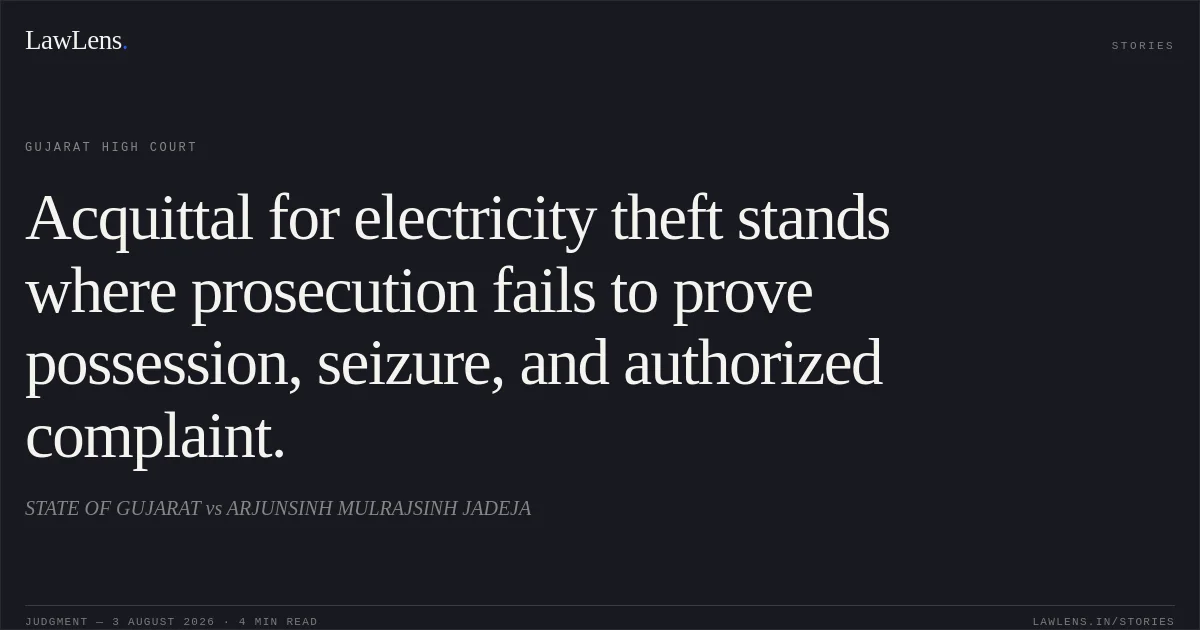
The High Court held that the prosecution failed to prove beyond reasonable doubt that the respondent had dishonestly abstracted or used electricity through an unauthorised connection, and also failed to establish the complainant’s statutory authorisation and the respondent’s connection with the inspected premises.
Finding no illegality or perversity in the Trial Court’s acquittal and applying the restrictive principles governing appeals against acquittal, the Court dismissed the State’s appeal and confirmed the judgment and order dated 22 September 2012.
Source reference: p.21, para. 33The respondent’s bail bond was cancelled, and the record and proceedings were directed to be returned to the Trial Court.
Source reference: p.21, para. 33Acts & Sections Cited
11 provisions across 2 statutes referred to in this judgment. Each provision opens on LawLens.
Code of Criminal Procedure, 19732
Original Court PDF
STATE OF GUJARATvsARJUNSINH MULRAJSINH JADEJA
Click to open original judgment
Original judgment, available to read, download and summarize on LawLens.in