01Facts
The petitioner joined the respondent Bank as an Agricultural Officer (Scale I) in May 1981, was promoted to Scale IV, and served as Chief Manager at Erode in 2009–2010.
p. 2A charge memo containing ten charges was issued: nine related to loan accounts and one to alleged irregularities in his savings bank account.
p. 2He replied on 25.09.2010, and an Enquiry Officer was appointed on 04.10.2010.
pp. 2–3On 07.01.2011, on a criminal complaint lodged by the Bank, he was arrested and remanded, and he was suspended on 08.01.2011.
p. 3His request to defer the enquiry until the criminal trial concluded was rejected, and he participated under reservation of rights, with documents produced, witnesses examined and cross-examined.
p. 3The Enquiry Officer submitted his report on 11.07.2012, finding some charges proved and others not.
p. 3The Disciplinary Authority imposed dismissal under Regulation 4(j) on 28.09.2012.
p. 3The Appellate Authority dismissed the appeal on 30.01.2013 and the Reviewing Authority dismissed the review on 08.07.2013.
p. 4The petitioner superannuated in April 2014 during the pendency of the writ.
p. 4In the criminal case (C.C. No. 3/2012, CBI Cases, Coimbatore), he was acquitted of Prevention of Corruption Act charges; the acquittal was upheld in Crl.A. No. 179 of 2019 batch (Madurai Bench).
p. 6The Bank contended that the charges are serious, the punishment proportionate, and that the criminal charges (under the PC Act, Sections 120-B and 420 IPC) differ from the disciplinary charges.
pp. 4–5 · pp. 7–802Issues
i.1. Whether the petitioner's acquittal in the criminal case requires the quashing of the disciplinary proceedings and dismissal order, as the charges are the same.
p. 6 · ¶ 13 · ¶ 14ii.2. Whether the disciplinary enquiry was vitiated by denial of natural justice or by being conducted hastily without awaiting the criminal trial.
p. 6 · ¶ 15iii.3. Whether the findings and penalty of dismissal warrant interference under Article 226 of the Constitution, including on the ground that the punishment is disproportionate.
p. 7 · ¶ 15 · ¶ 1803Law Applied
Regulations 3(1) and 3(3) of the Indian Overseas Bank Officer Employees' (Conduct) Regulations require integrity, honesty and diligence and acting in accordance with best judgment, and Regulation 24 makes breach a misconduct; the penalty was imposed under Regulation 4(j) of the Discipline and Appeal Regulations.
p. 6 · pp. 37–38 · p. 38 · p. 3Disciplinary and criminal proceedings operate on different platforms and on different evidence, so an acquittal does not bind the disciplinary authority.
¶ 14 · ¶ 18From Airports Authority of India v. Pradip Kumar Banerjee, 2025 INSC 149, disciplinary proof rests on preponderance of probabilities, not proof beyond reasonable doubt, and a reasoned finding on enquiry evidence suffices.
¶ 15 · pp. 39–40From Union of India v. Sardar Bahadur (quoted therein), the High Court does not sit as an appellate court over an enquiry's findings and reviews only whether relevant material supports them.
pp. 40–41From Boloram Bordoloi v. Lakhimi Gaolia Bank (quoted therein), a disciplinary authority accepting the enquiry findings need not give detailed reasons.
¶ 15 · p. 39From Chairman & MD, United Commercial Bank v. P.C. Kakkar (2003 INSC 76), bank officers must maintain higher standards of honesty and integrity, and absence of loss is no defence to a breach of discipline.
¶ 17 · pp. 41–42Provisions in the judgment · 1 · Linked ones open on LawLens
Indian Penal Code, 1860 Section 420
04Reasoning
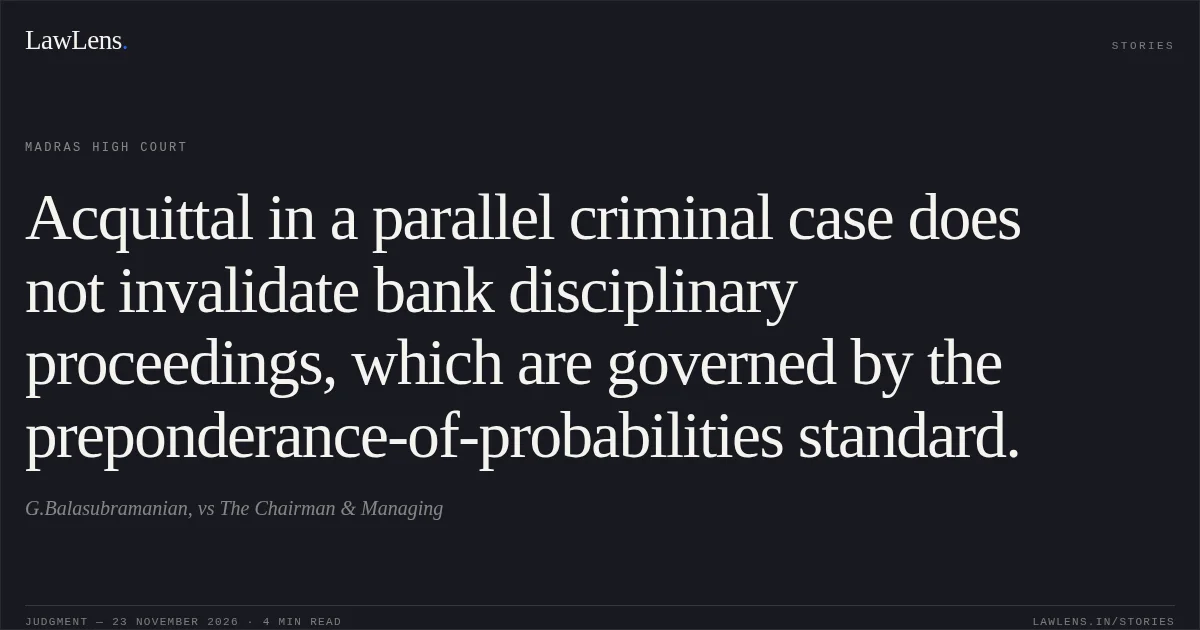
The criminal charges (PC Act and cheating) and the disciplinary charges (breach of Regulations 3(1), 3(3) and 24 through specific loan irregularities and the SB account transactions) are distinct, so the acquittal could not automatically quash the disciplinary order.
¶ 14 · ¶ 18Applying Pradip Kumar Banerjee, the Court treated the disciplinary inquiry's lower standard as the correct yardstick, so the acquittal's higher threshold did not bind the Bank.
¶ 15On natural justice, the petitioner had documents marked, evidence recorded, cross-examination permitted, a reasoned Enquiry Report, a further explanation considered, and an appeal and review heard, so there was "no lacuna" in the procedure; the refusal to defer the enquiry was thus not a ground for interference.
¶ 15Because the enquiry was procedurally sound, the Court confined its review to whether the penalty was proportionate to the charges.
¶ 15On proportionality, the Court relied on the petitioner's senior position handling public money and the higher standard required of bank officers, and held that the charges, which alleged breach of norms causing financial loss, justified dismissal.
¶ 16–17 · ¶ 18The Court's reasoning on proportionality is brief; it does not separately examine the petitioner's argument that six of the nine accounts involved no loss, and the "no loss" objection is addressed only through the Kakkar principle that loss is not an element of the misconduct.
p. 7 · ¶ 10 · ¶ 1705Holding
The acquittal in the criminal case does not affect the disciplinary proceedings, the enquiry was fairly conducted, and the financial loss to the Bank justified dismissal, so no ground for interference under Article 226 was made out.
¶ 18The writ petition is dismissed without costs, and the prayers to quash the orders dated 28.09.2012, 30.01.2013 and 08.07.2013, and for back wages up to April 2014 and terminal benefits thereafter, stand rejected.
p. 43 · ¶ 17Original Court PDF
G.Balasubramanian,vsThe Chairman & Managing
Click to open original judgment
Original judgment, available to read, download and summarize on LawLens.in