Facts
On 20 January 2019, police intercepted a coal-laden truck allegedly being transported without valid documents and registered Poraiyahat P.S. Case No. 07 of 2019 against the petitioner and others under Sections 414 and 120B IPC read with Sections 4 and 21 of the Mines and Minerals (Development and Regulation) Act, 1957.
Source reference: para. 2–4On the basis of this scheduled offence, the Directorate of Enforcement registered ECIR/RNZO/08/2023 under the Prevention of Money Laundering Act, 2002 (PMLA).
Source reference: para. 6During a search of the petitioner’s premises on 21 November 2025, the ED seized ₹85 lakh in cash, 134 property deeds and loose documents, and filed Original Application No. 381 of 2025 before the Adjudicating Authority for retention of the seized assets.
Source reference: para. 7–10The petitioner was acquitted in the predicate criminal case on 10 February 2026 on the ground that the prosecution failed to prove the charges beyond reasonable doubt.
Source reference: para. 12–14He thereafter sought quashing of the ECIR and cessation of all PMLA proceedings, relying on the acquittal.
Source reference: no citationThe ED opposed the writ petition, contending that the acquittal was subject to appellate remedies, that the seized assets raised independent factual issues, and that the petitioner had an efficacious statutory remedy before the Adjudicating Authority, the Appellate Tribunal and the High Court.
Source reference: para. 30–48Issues
Whether an ECIR is amenable to quashing under Article 226 of the Constitution merely because the petitioner was acquitted by the court of first instance in the scheduled offence?
Source reference: para. 81(i)Whether investigation or enquiry under the PMLA loses force solely on account of the petitioner’s acquittal in the predicate offence, particularly in view of Section 66(2) of the PMLA?
Source reference: para. 81(ii)Whether the High Court could direct release of the seized or attached properties under Article 226 by bypassing the statutory remedies under the PMLA?
Source reference: para. 81(iii)Whether the petitioner, having already invoked the jurisdiction of the Adjudicating Authority, could simultaneously pursue parallel proceedings before the High Court?
Source reference: para. 81(iv)Whether information and material gathered during the PMLA enquiry and shared under Section 66(2) could be quashed at the threshold?
Source reference: para. 81(v)Law Applied
The Court applied Sections 2(1)(u), 3, 5, 17, 20, 25, 26, 42 and 66(2) of the PMLA.
Source reference: no citation“Proceeds of crime” under Section 2(1)(u) must be property derived or obtained, directly or indirectly, from criminal activity relating to a scheduled offence, and such proceeds are the foundational ingredient of the offence under Section 3.
Source reference: para. 51–54, 59–60Relying on Vijay Madanlal Choudhary v. Union of India, 2022 SCC OnLine SC 929, the Court held that, where a person is finally absolved in the scheduled offence by discharge, acquittal or quashing, there can ordinarily be no action for money laundering in relation to property linked to that offence; however, an ECIR is only an internal ED document and is not equivalent to an FIR or a statutory document capable of being quashed as such.
Source reference: para. 87–93, 105–110The Court also relied on Pavana Dibbur v. Directorate of Enforcement, (2023) 15 SCC 91, and held that proceedings under the PMLA depend upon proceeds of crime but that Section 66(2) operates independently as an inter-agency information-sharing mechanism where material indicates contravention of another law.
Source reference: para. 70–73, 112–121The PMLA’s statutory adjudicatory hierarchy—Adjudicating Authority under Section 8, appeal to the Appellate Tribunal under Section 26, and further appeal to the High Court under Section 42—must ordinarily be exhausted before invoking writ jurisdiction.
Source reference: para. 99–104Reasoning
The Court accepted that a final acquittal in the scheduled offence may extinguish the basis for PMLA action concerning property linked to that offence.
Source reference: no citationHowever, the petitioner’s acquittal was by the court of first instance and remained subject to appellate challenge; therefore, it did not constitute the “final absolution” contemplated in Vijay Madanlal Choudhary.
Source reference: para. 95–96Further, the predicate case concerned a single intercepted truck, whereas the ED’s enquiry involved the subsequent seizure of ₹85 lakh, 134 property deeds and alleged unexplained financial transactions.
Source reference: para. 97–98These assets had not been examined or adjudicated upon in the predicate criminal trial.
Source reference: para. 97–98The Court held that determining whether the seized cash and documents represented legitimate assets or proceeds of crime involved disputed and document-intensive questions of fact falling within the statutory jurisdiction of the Adjudicating Authority.
Source reference: para. 100–104Since the petitioner had already filed a reply in the pending adjudication proceedings, allowing the writ petition would create parallel proceedings and bypass the statutory appellate mechanism.
Source reference: para. 100–104The Court further held that the ED could continue its enquiry and share information with other agencies under Section 66(2), particularly where the material gathered related to possible violations beyond the original predicate offence.
Source reference: para. 111–129, 136–141As the ECIR was an internal administrative record and did not itself impose penal consequences, it was not liable to be quashed under Article 226 at this stage.
Source reference: para. 105–110Holding
The writ petition was dismissed.
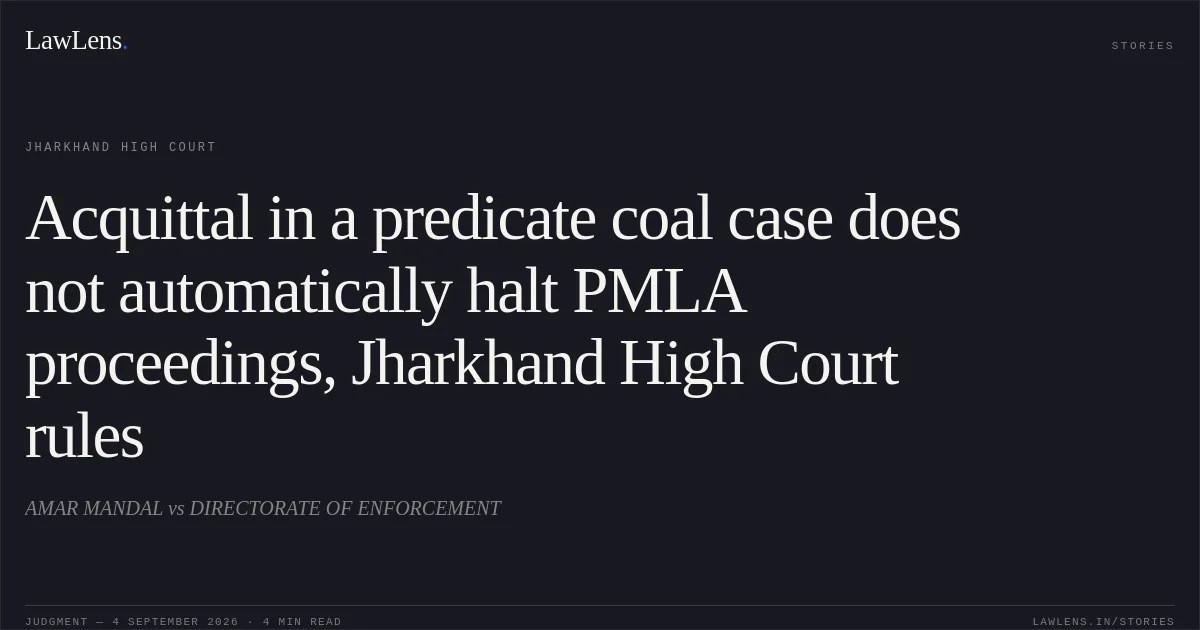
The Court held that the ECIR could not be quashed at the present stage because it was an internal ED document, the petitioner’s acquittal was not yet a final absolution, and the seized assets raised independent factual issues pending before the Adjudicating Authority.
Source reference: para. 145–150The interim stay granted on 13 May 2026 was vacated.
Source reference: para. 151The petitioner was left at liberty to pursue his remedies before the Adjudicating Authority and other competent authorities, including placing the acquittal judgment on record; the concerned authority was directed to decide the matter in accordance with law.
Source reference: para. 152–154Original Court PDF
AMAR MANDALvsDIRECTORATE OF ENFORCEMENT
Click to open original judgment
Original judgment, available to read, download and summarize on LawLens.in