Facts
The Appellant was convicted under Section 302 of the IPC for the murder of Lala alias Suleshwar and sentenced to life imprisonment
Source reference: p. 1-2On 07.03.2019, the deceased was found injured in a pit; before dying, he claimed to have been assaulted by four unknown persons at a picnic
Source reference: p. 2The prosecution alleged that the Appellant assaulted the deceased and his own wife (PW-3) because he found them chatting
Source reference: p. 4, 10The prosecution relied on the recovery of a cot leg and a bamboo club based on the Appellant's memorandum statement, and an FSL report showing human blood on these items
Source reference: p. 4During the trial, the injured eye-witness (PW-3), the complainant (PW-1), and the Appellant’s family members (PW-2, PW-4, PW-5) all turned hostile
Source reference: p. 5-9Issues
1. Whether the prosecution established a complete chain of circumstantial evidence sufficient to prove the Appellant's guilt beyond a reasonable doubt in light of the hostile witnesses
Source reference: p. 5 / para. 7, 112. Whether the recovery of weapons and the presence of human blood in the FSL report constitute sufficient evidence for conviction when the eyewitnesses have recanted
Source reference: p. 6 / para. 7Law Applied
Section 302 of the IPC regarding the punishment for murder
Source reference: p. 1The "Panchsheel" principles of circumstantial evidence established in Sharad Birdhichand Sarda v. State of Maharashtra, which requires that circumstances must be "conclusive" and exclude every hypothesis except the guilt of the accused
Source reference: p. 13-15The principle that the chain of evidence must be so complete as to leave no reasonable ground for a conclusion consistent with innocence, as emphasized in Hanumant v. State of Madhya Pradesh and Surendra Kumar v. State of Uttar Pradesh
Source reference: p. 13-14The principle from Digambar Vaishnav v. State of Chhattisgarh that if two views are possible, the view favourable to the accused must be adopted
Source reference: p. 16Reasoning
The Court observed that the prosecution’s case disintegrated as the star witness—the injured eye-witness PW-3—turned hostile and denied the incident entirely
Source reference: para. 11The complainant (PW-1) testified that the deceased attributed the assault to four unknown picnic-goers, creating a conflicting narrative
Source reference: para. 12, 27The High Court found the recovery of the murder weapons suspicious, noting that witnesses (PW-13, PW-14) admitted to signing documents at the police station in the Appellant's absence
Source reference: para. 22, 27The Court held that the memorandum statement made to the police was inadmissible as substantive evidence
Source reference: para. 27Since the recovery itself was doubtful and the blood group was not matched to the deceased, this single link of human blood on items could not replace a complete chain of evidence
Source reference: para. 27, 31The Court highlighted that the deceased’s failure to name the Appellant—whom he supposedly knew—while he was still conscious and speaking, created significant doubt
Source reference: para. 27Holding
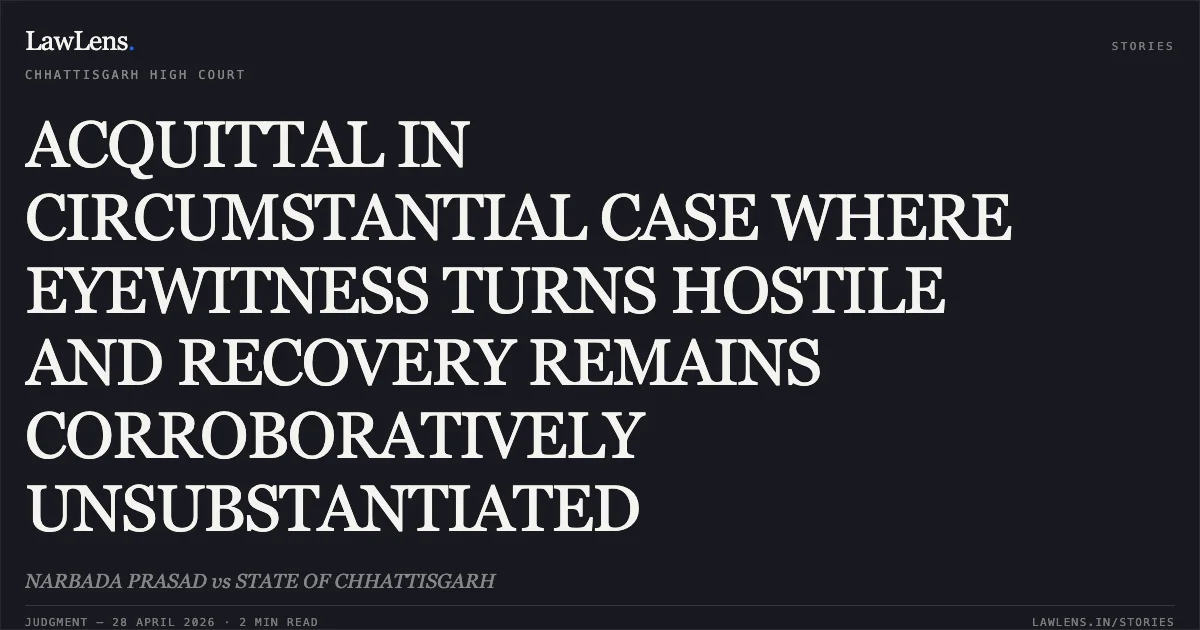
The Court answered the issues in the negative, holding that the prosecution failed to establish a complete chain of circumstantial evidence
The High Court allowed the appeal, set aside the conviction and life sentence, and acquitted the Appellant by granting him the benefit of the doubt
Source reference: para. 32The Court ordered the Appellant’s immediate release from jail and directed him to furnish a personal bond under Section 481 of the Bharatiya Nagarik Suraksha Sanhita, 2023
Source reference: para. 33-34Acts & Sections Cited
3 provisions across 2 statutes referred to in this judgment. Each provision opens on LawLens.
Indian Penal Code, 18602
Bharatiya Nagarik Suraksha Sanhita, 20231
Original Court PDF
NARBADA PRASADvsSTATE OF CHHATTISGARH
Click to open original judgment
Original judgment, available to read, download and summarize on LawLens.in