01Facts
The deceased (55 years old) died due to fatal injuries sustained on July 8, 2009, when his motorcycle was hit by a TSR (DL-1RJ-3421) driven rashly
p. 1The Motor Accident Claims Tribunal (MACT) awarded Rs. 25,21,536 with 9% interest, granting the Insurance Company "pay and recover" rights due to policy breach
pp. 1-2The Insurance Company appealed challenging negligence (noting the driver's criminal acquittal) and the computation of compensation regarding dependency and conventional heads
pp. 2-302Issues
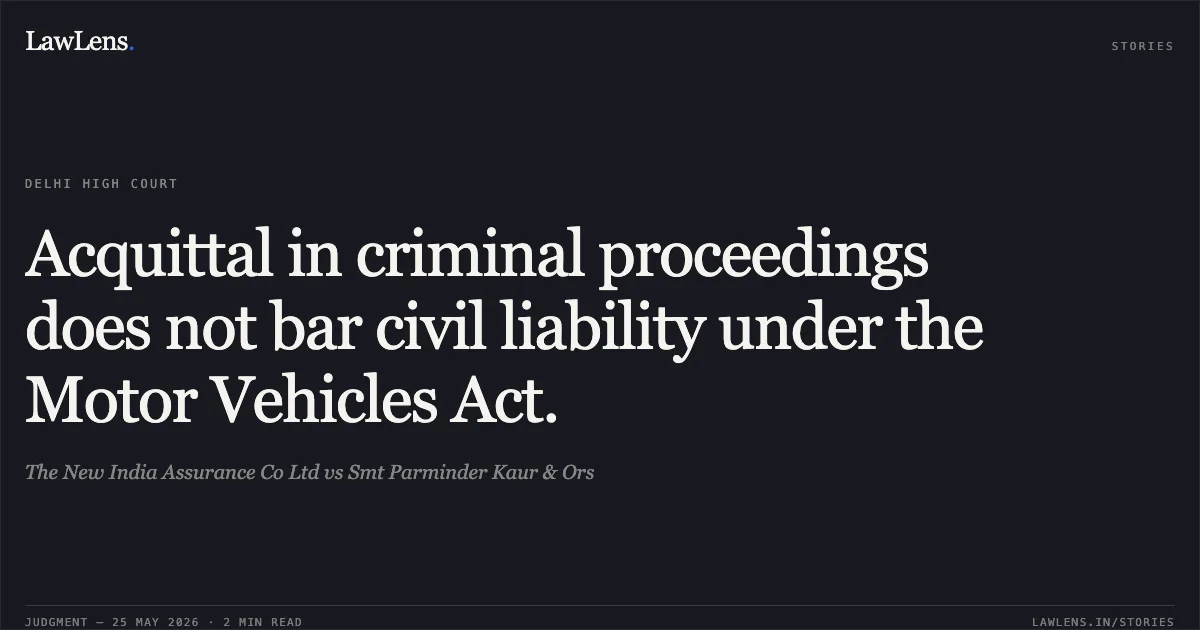
i.1. Whether an acquittal in criminal proceedings bars civil liability for negligence under the Motor Vehicles Act
p. 2ii.2. Whether the major, earning children of the deceased should be considered dependents for the purpose of calculating personal expense deductions
p. 3iii.3. Whether the claimants are entitled to future prospects and revised conventional heads under the Pranay Sethi guidelines
pp. 4-503Law Applied
Criminal acquittal does not bar civil liability because the standard of proof (preponderance of probabilities) is lower than the criminal requirement of "beyond reasonable doubt" as established in N.K.V. Bros. (P) Ltd. v. M. Karumai Ammal
p. 2, 8The doctrine of res ipsa loquitur for negligence
p. 7Regarding compensation, the court followed Sarla Verma v. DTC and National Insurance Co. Ltd. v. Pranay Sethi for multipliers, personal deductions, and conventional heads
p. 5The court's duty to award "just compensation" even in the absence of a cross-appeal by claimants as per Surekha Ors. v. Santosh Ors. and Ningamma v. United India Insurance Co. Ltd.
pp. 9-10Provisions in the judgment · 2 · Linked ones open on LawLens
Indian Penal Code, 1860 Section 279
Motor Vehicles Act, 1988 Section 166
04Reasoning
The Court held that even though the driver was acquitted in criminal court, the circumstantial evidence and the Mechanical Inspection Report showing fresh damage to the TSR justified an inference of negligence under res ipsa loquitur, especially since the driver failed to testify
pp. 7-8The Court found that since the daughter was married and the son was an earning adult abroad, they were not financial dependents; thus, the deduction for personal expenses was increased from 1/4th to 1/3rd (for the remaining two dependents: wife and mother)
pp. 4-5The Court maintained a multiplier of 11 because the deceased had not yet turned 56
p. 5Following Pranay Sethi, the Court adjusted conventional heads (reducing funeral expenses, deleting "care and guidance") but exercised its power to grant 25% future prospects and parental/spousal consortium to ensure "just compensation," despite the insurer being the sole appellant
pp. 9-1105Holding
The Court upheld the finding of negligence but modified the compensation amount, enhancing it from Rs. 25,21,536 to Rs. 27,41,824
p. 11The Court ordered the Insurance Company to deposit the enhanced amount with 9% interest and maintained the "pay and recover" rights
p. 11, 2Original Court PDF
The New India Assurance Co LtdvsSmt Parminder Kaur & Ors
Click to open original judgment
Original judgment, available to read, download and summarize on LawLens.in