Facts
The appellant, a police constable, was served with a departmental charge-sheet alleging he assaulted an unarmed fellow constable with a stick and misbehaved with a Treasury Officer while intoxicated.
Source reference: para. 1Concurrent to the departmental inquiry, three FIRs were registered against him: one under the Prohibition Act, one for escaping from custody while at the pretext of answering a nature's call, and a third resulting in a conviction that was later overturned on appeal.
Source reference: para. 2, 8While the appellant was eventually acquitted in all criminal proceedings, the departmental inquiry found the charges proven.
Source reference: para. 3, 8The Disciplinary Authority imposed the punishment of removal from service, which was upheld by the Appellate Authority, the Revisional Authority, and subsequently by a Single Judge of the High Court.
Source reference: para. 4-7Issues
1. Whether an acquittal in a criminal prosecution automatically exonerates a delinquent employee from departmental proceedings and the resulting punishment.
Source reference: para. 9-102. Whether the gravity of the misconduct (assaulting a colleague and public intoxication) justifies the punishment of removal from service for a member of the police force.
Source reference: para. 11-12Law Applied
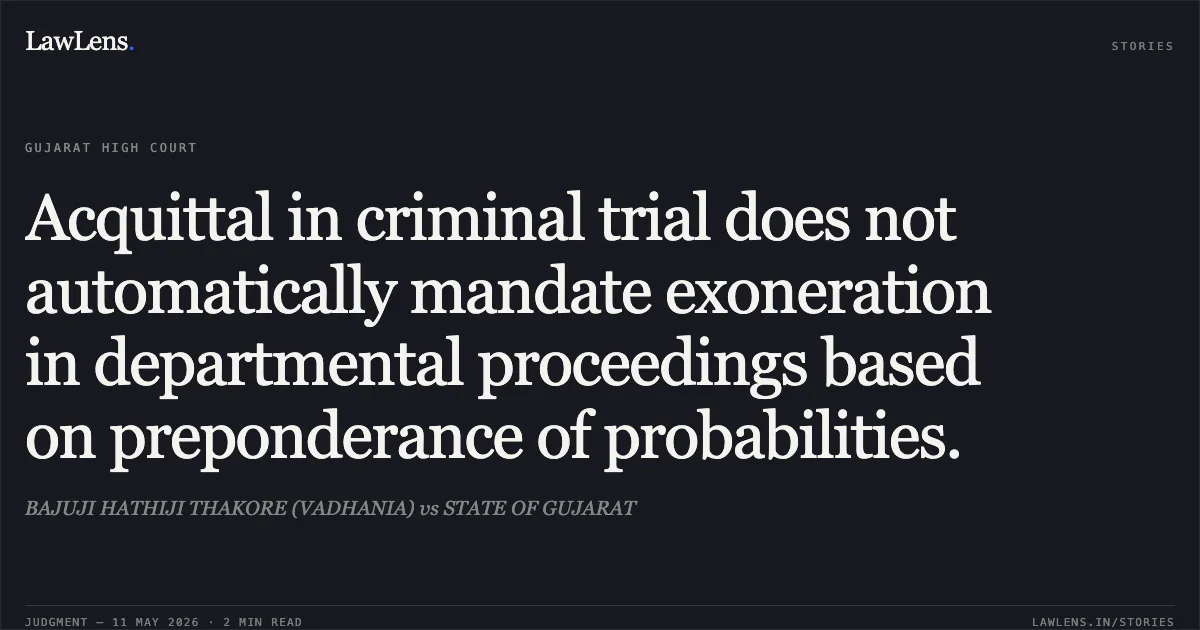
The Court applied the settled legal principle that departmental proceedings and criminal prosecutions operate in distinct fields with different standards of proof.
Source reference: para. 10Departmental inquiries are governed by the principle of "preponderance of probabilities," whereas criminal trials require "proof beyond all reasonable doubt".
Source reference: para. 10An acquittal in a criminal case does not mandate an exoneration in departmental proceedings.
Source reference: para. 10The court emphasized the professional standards of conduct expected of the police force, where maintaining law and order is a fundamental duty.
Source reference: para. 12Reasoning
The Court reasoned that the Single Judge correctly distinguished between the standards of proof required for conviction versus departmental discipline.
Source reference: para. 10It held that even if the criminal court found insufficient evidence for a conviction beyond reasonable doubt, the material before the inquiry officer was sufficient to establish guilt on a preponderance of probabilities.
Source reference: para. 10Regarding the merits, the Court found that the appellant’s conduct—assaulting a fellow officer and intoxication—was antithetical to the duties of a police constable.
Source reference: para. 12The act of escaping from custody further demonstrated that his continuance in the force was "undesirable".
Source reference: para. 13The Court concluded that the disciplinary action was proportionate to the gravity of the misconduct, as a constable must be instrumental in maintaining, rather than violating, law and order.
Source reference: para. 12-13Holding
The Court answered the issues in the negative and affirmative respectively, holding that the acquittal in criminal cases did not invalidate the departmental punishment.
The Division Bench affirmed the Single Judge's order, finding no merit in the appeal; the Letters Patent Appeal was dismissed, and the punishment of removal from service was upheld.
Source reference: para. 13-14Original Court PDF
BAJUJI HATHIJI THAKORE (VADHANIA)vsSTATE OF GUJARAT
Click to open original judgment
Original judgment, available to read, download and summarize on LawLens.in


![Subsequent exoneration does not retrospectively invalidate a finalized promotion select list.. UNNIKRISHNAN M vs M/o Environment And Forests. CAT - ['Ernakulam']. LawLens](/stories/thumbnails/subsequent-exoneration-does-not-retrospectively-invalidate-a-finalized-promotion-select-li-ce80a0e84f2f4887857271e8b4341c42.webp)