Facts
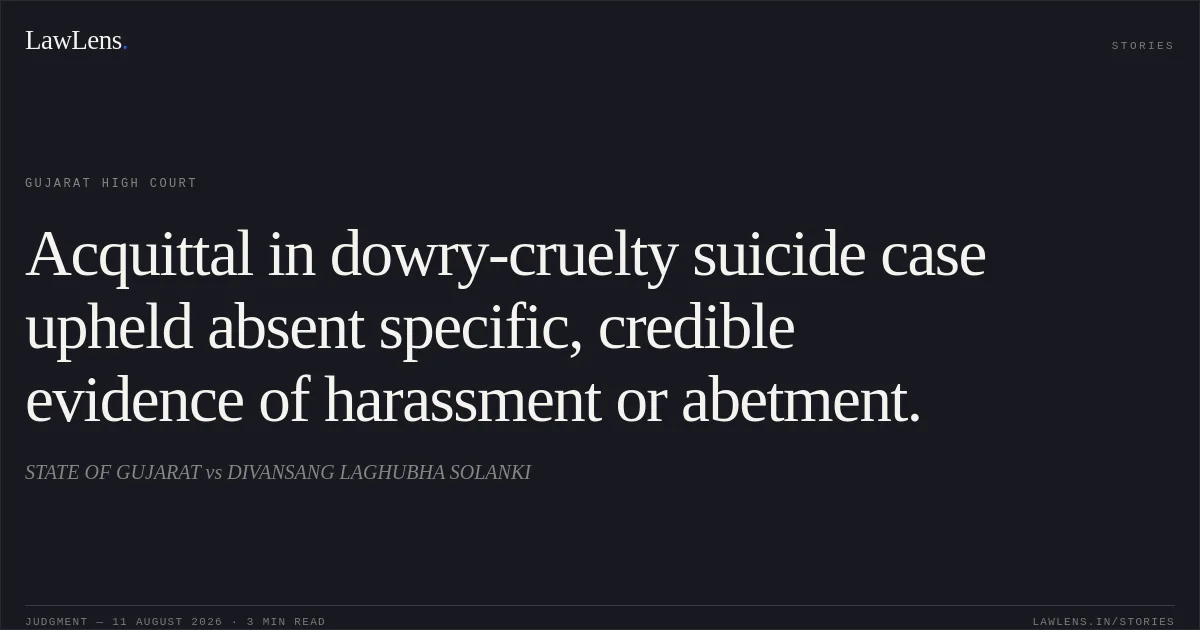
The deceased, Manharba, married accused No. 3 approximately one and a half years before the incident and resided in a joint family with the accused at Sadatpura, Viramgam.
Source reference: pp. 1–2, paras. 1–2Her parental relatives alleged that she had repeatedly complained of mental and physical cruelty, harassment, and demands for additional dowry by her husband and in-laws.
Source reference: pp. 1–2, paras. 1–2On 13 March 2009, she allegedly poured kerosene on herself and committed suicide. An FIR was registered at Detroj Police Station for offences under Sections 306, 498A and 114 of the Indian Penal Code and Sections 3 and 7 of the Dowry Prohibition Act.
Source reference: pp. 1–2, paras. 1–2After investigation, a charge-sheet was filed and the accused were tried in Sessions Case No. 4 of 2009. The trial court acquitted all the accused by judgment dated 11 August 2009.
Source reference: pp. 2–3, paras. 2.1–6During the pendency of the State’s appeal, accused No. 1 died, and the appeal against him abated.
Source reference: p. 1, para. 1Issues
1. Whether the trial court was justified in acquitting the accused of offences under Sections 306, 498A and 114 IPC and Sections 3 and 7 of the Dowry Prohibition Act?
Source reference: p. 5, para. 10(1)2. Whether the trial court properly appreciated the oral and documentary evidence led by the prosecution?
Source reference: p. 5, para. 10(2)3. Whether the acquittal judgment suffered from any illegality, irregularity, or perversity warranting appellate interference?
Source reference: p. 5, para. 10(3)Law Applied
The Court considered Sections 306, 498A and 114 of the IPC and Sections 3 and 7 of the Dowry Prohibition Act.
Source reference: pp. 7–9, paras. 12.1–13For abetment of suicide under Section 306 IPC, the prosecution must establish beyond reasonable doubt a proximate act of instigation, intentional aid, or abetment which led the deceased to commit suicide.
Source reference: pp. 7–9, paras. 12.1–13Section 113A of the Indian Evidence Act permits—but does not mandate—a presumption of abetment of suicide by a married woman within seven years of marriage where cruelty by the husband or his relative is first shown; Section 113B creates a mandatory presumption of dowry death only where cruelty or harassment for, or in connection with, dowry demand is shown to have occurred soon before death.
Source reference: pp. 7–9, para. 12.2The Court relied on Ramesh Kumar v. State of Chhattisgarh, (2001) 9 SCC 618, and Ram Pyarey v. State of Uttar Pradesh, (2025) 6 SCC 820, concerning the requirement of proof of cruelty and abetment.
Source reference: pp. 7–9, paras. 12–13In an appeal against acquittal, the appellate court may fully reappreciate the evidence, but must account for the double presumption of innocence; where two reasonable views are possible, the acquittal should not be disturbed.
Source reference: pp. 9–12, paras. 14–17These principles were drawn from Chandrappa v. State of Karnataka, (2007) 4 SCC 415, Rajesh Prasad v. State of Bihar, (2022) 3 SCC 471, Babu Sahebagouda Rudragoudar v. State of Karnataka, (2024) 8 SCC 149, and Ramesh v. State of Karnataka, (2024) 9 SCC 169.
Source reference: pp. 9–12, paras. 14–17Reasoning
The High Court found that only three prosecution witnesses—two brothers and the mother of the deceased—substantially supported the prosecution, while the remaining witnesses did not support the case.
Source reference: p. 6, para. 11Even the supporting witnesses did not give specific particulars of the alleged dowry demand, such as the money, articles, or property demanded, nor did they describe with sufficient precision the acts constituting cruelty or harassment.
Source reference: p. 6, para. 11The Investigating Officer specifically stated that no allegations of any particular dowry demand or specific acts of harassment had been disclosed during investigation.
Source reference: p. 6, para. 11Although the death occurred within seven years of marriage, the statutory presumptions could arise only after the foundational facts of cruelty, harassment, and—where relevant—dowry-related conduct were proved.
Source reference: pp. 7–9, paras. 12–13Those foundational facts were not established beyond reasonable doubt.
Source reference: pp. 7–9, paras. 12–13The Court also noted that the prosecution had not examined the doctors who conducted the post-mortem examination.
Source reference: p. 9, para. 13Applying the restrictive principles governing appeals against acquittal, the Court held that the trial court’s view was a reasonable view of the evidence and was neither perverse nor manifestly illegal.
Source reference: pp. 9–12, paras. 14–19Holding
The High Court answered the issues against the State.
It held that the prosecution failed to prove beyond reasonable doubt that the accused had subjected the deceased to legally cognizable cruelty or dowry-related harassment, or had abetted her suicide.
Source reference: pp. 12–13, paras. 18–20Finding no illegality, irregularity, or perversity in the trial court’s acquittal, the Court dismissed Criminal Appeal No. 2445 of 2009 and confirmed the judgment of acquittal.
Source reference: pp. 12–13, paras. 18–20The bail bonds were cancelled and the record was directed to be returned to the trial court. Criminal Revision Application No. 588 of 2009 was also dismissed accordingly.
Source reference: p. 13, paras. 20–21Acts & Sections Cited
7 provisions across 3 statutes referred to in this judgment. Each provision opens on LawLens.
Code of Criminal Procedure, 19732
Indian Penal Code, 18603
Original Court PDF
STATE OF GUJARATvsDIVANSANG LAGHUBHA SOLANKI
Click to open original judgment
Original judgment, available to read, download and summarize on LawLens.in