Facts
On 4 March 2008, officers of the Gujarat/Vadodara electricity distribution authorities inspected the electricity connection associated with the accused’s father at Village Padla, Taluka Sami, District Patan.
Source reference: p.2, para.2The prosecution alleged that the accused had illegally connected a neutral wire and used electricity through artificial means, consuming approximately 915 watts, thereby committing theft of electricity under Section 135(1)(a) of the Electricity Act, 2003.
Source reference: p.2, para.2A complaint was registered on 12 March 2008 as II-C.R. No. 214 of 2008, followed by investigation and filing of a chargesheet.
Source reference: p.2, para.2.2The prosecution examined seven witnesses and produced ten documents.
Source reference: p.2, para.2.3The trial court acquitted the accused in Special (Electricity) Case No. 13 of 2008 by judgment dated 15 October 2012.
Source reference: no citationThe State challenged the acquittal under Section 378(1) and (3) of the Code of Criminal Procedure, 1973.
Source reference: p.1, para.1Issues
Whether the trial court was justified in acquitting the accused of the offence under Section 135(1)(a) of the Electricity Act, 2003?
Source reference: p.4, para.9(1)Whether the trial court properly appreciated the oral and documentary evidence led by the prosecution?
Source reference: p.4, para.9(2)Whether the acquittal suffered from any illegality, irregularity, perversity, or other infirmity warranting appellate interference?
Source reference: p.4, para.9(3)Law Applied
The Court applied Section 135(1)(a) of the Electricity Act, 2003, which criminalises dishonest abstraction, consumption, or use of electricity through artificial means or unauthorised arrangements; the prosecution was required to establish the charge through cogent and material evidence.
Source reference: pp.1, 6–7, paras.1, 12The appeal against acquittal was governed by Section 378 of the Code of Criminal Procedure, 1973.
Source reference: p.1, para.1Relying on Chandrappa v. State of Karnataka, (2007) 4 SCC 415, as reaffirmed in Rajesh Prasad v. State of Bihar, (2022) 3 SCC 471, Babu Sahebagouda Rudragoudar v. State of Karnataka, (2024) 8 SCC 149, and Ramesh v. State of Karnataka, (2024) 9 SCC 169, the Court held that an appellate court may reappreciate evidence in an appeal against acquittal, but must recognise the accused’s double presumption of innocence; where two reasonable views are possible, the acquittal should not be disturbed.
Source reference: pp.8–10, paras.15–16The Court also relied on State of Gujarat v. Kersan Chakubhai Parmar, Criminal Appeal No. 969 of 2009, for the requirement of cogent and material proof in a prosecution under Section 135 of the Electricity Act.
Source reference: p.7, para.12Reasoning
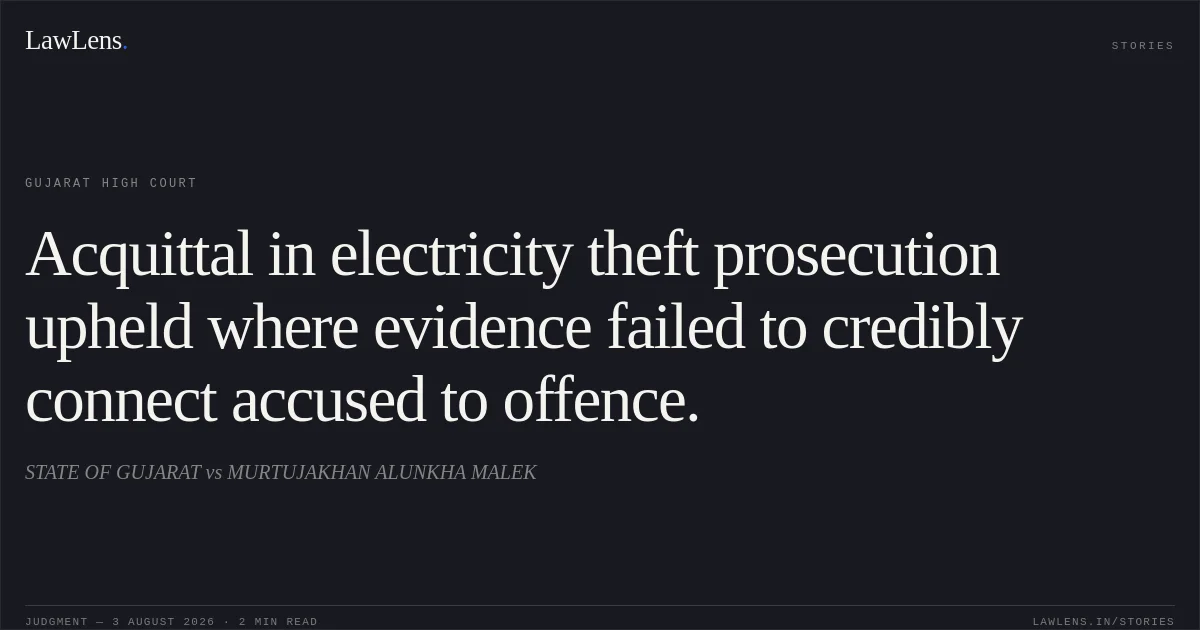
The Court found that the prosecution evidence did not reliably connect the accused with dishonest abstraction of electricity.
Source reference: no citationAlthough the inspection team alleged the use of cables and other apparatus, the Investigating Officer admitted that no seizure panchnama was prepared; the alleged electrical articles were neither collected during investigation, produced before the trial court, nor sent for forensic examination.
Source reference: p.5, para.10The testimony of PW-3 and PW-4 regarding the presence of a mob, assault, threats, and the accused’s alleged display of a firearm was materially inconsistent and was not supported by the FIR, the Investigating Officer, or the police personnel allegedly present during inspection.
Source reference: pp.5–7, paras.11–12The absence of any separate criminal-intimidation complaint further weakened that version.
Source reference: p.7, para.12In light of these evidentiary deficiencies and the heightened presumption in favour of an accused already acquitted, the trial court’s view was held to be a reasonable one and not perverse or manifestly illegal.
Source reference: pp.7–10, paras.13–18Holding
The High Court answered all issues against the State.
It held that the prosecution failed to prove beyond reasonable doubt that the accused had committed the offence under Section 135(1)(a) of the Electricity Act, 2003, and that the trial court had committed no error, illegality, perversity, or infirmity in recording the acquittal.
Source reference: pp.10–11, paras.17–18The State’s appeal was dismissed, the trial court’s judgment of acquittal dated 15 October 2012 was confirmed, the accused’s bail bond was cancelled, and the record and proceedings were directed to be returned to the trial court.
Source reference: p.11, para.19Acts & Sections Cited
4 provisions across 3 statutes referred to in this judgment. Each provision opens on LawLens.
Code of Criminal Procedure, 19732
Electricity Act, 20031
Indian Penal Code, 18601
Original Court PDF
STATE OF GUJARATvsMURTUJAKHAN ALUNKHA MALEK
Click to open original judgment
Original judgment, available to read, download and summarize on LawLens.in