Facts
The appellant, the deceased’s wife, challenged the acquittal of five accused charged with offences including murder under Sections 302 and 149 of the Indian Penal Code, arising from an alleged assault on her husband on 12 September 2016; he died two days later
Source reference: para. 3–7, 17–19At trial, only one prosecution witness was examined. The trial court acquitted the accused without the remaining charge-sheet witnesses being examined
Source reference: para. 21, 26–28The appellant argued that the prosecution had not been given a fair opportunity to secure and examine its witnesses
Source reference: para. 11–12Issues
1. Whether the trial court’s acquittal, entered without recording the evidence of the remaining charge-sheet witnesses and without adequately securing their attendance, was arbitrary, erroneous and illegal
Source reference: para. 16(i)2. Whether the acquittal should be set aside and the case remitted for further trial
Source reference: para. 33–36Law Applied
The appeal was brought under Section 372 of the Code of Criminal Procedure, 1973, corresponding to Section 413 of the Bharatiya Nagarik Suraksha Sanhita, 2023
Source reference: para. 8A criminal trial must be fair to the accused, the victim and society; failure to hear material witnesses may deny a fair trial. The Court relied on Zahira Habibullah M. Sheikh v. State of Gujarat, (2004) 4 SCC 158, for these principles
Source reference: para. 29It also relied on Machander Son of Pandurang v. State of Hyderabad, AIR 1955 SC 792, for the principle that courts must balance the need to ensure that the guilty do not escape with the need to avoid undue delay and harassment of the accused
Source reference: para. 31It also relied on State of Karnataka v. Ramesh Lakshmana Katti, Criminal Appeal No. 100499 of 2021, for remitting a case where remaining charge-sheet witnesses had not been examined
Source reference: para. 30Reasoning
The order sheet showed that summons and non-bailable warrants had been issued for several witnesses, but did not establish that the warrants had been executed; the trial court had also not issued summons to other official witnesses
Source reference: para. 22–26, 28Despite these gaps, the court closed the prosecution evidence and acquitted the accused, relying on directions to dispose of the case expeditiously
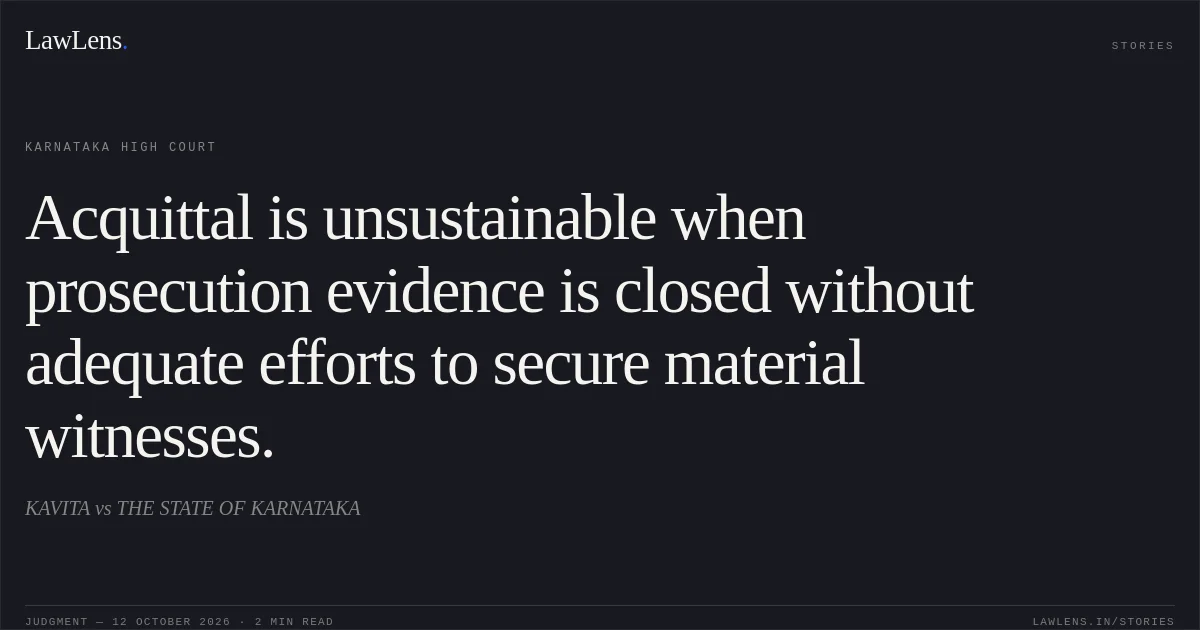
Source reference: para. 26–28The High Court held that expedition did not justify concluding the trial without taking appropriate steps to secure the witnesses and afford the prosecution an opportunity to present its intended evidence. Given the seriousness of the charges, the premature closure of evidence resulted in a miscarriage of justice
Source reference: para. 27–34Holding
The High Court answered the first issue in the affirmative and allowed the appeal
It set aside the acquittal and remitted the case to the trial court to record the evidence of the remaining charge-sheet witnesses whom the prosecution intended to examine. The trial court was directed to secure the accused’s presence and proceed according to law; the parties were directed to cooperate in the early disposal of the case
Source reference: para. 36Acts & Sections Cited
16 provisions across 3 statutes referred to in this judgment. Each provision opens on LawLens.
Code of Criminal Procedure, 19733
Bharatiya Nagarik Suraksha Sanhita, 20232
Original Court PDF
KAVITAvsTHE STATE OF KARNATAKA
Click to open original judgment
Original judgment, available to read, download and summarize on LawLens.in
![Competent authority must reconsider transfer-waiting-list priority through a reasoned order.. Prabhat Kumar Srivastwa vs NORTH CENTRAL RAILWAY. CAT - ['Allahabad']. LawLens](/stories/thumbnails/competent-authority-must-reconsider-transfer-waiting-list-priority-through-a-reasoned-orde-e23ccd4eaf154e82b09ea183b25e32fb.webp)
![Excess-pay recovery from retired Group C employees is impermissible absent fraud or misrepresentation.. SATYA NAND YADAV vs NORTH EASTERN RAILWAY. CAT - ['Allahabad']. LawLens](/stories/thumbnails/excess-pay-recovery-from-retired-group-c-employees-is-impermissible-absent-fraud-or-misrep-c357cbdd195c44d68331385eea2a3c9a.webp)