Facts
On 8 July 1997, the prosecution alleged that the accused formed an unlawful assembly at Village Ranakpur and assaulted Ganpatsing Kusubha Vaghela with knives and sticks, allegedly because of his relationship with the daughter of accused No. 1.
Source reference: pp. 2–4Ganpatsing subsequently died from his injuries.
Source reference: pp. 2–4The complainant claimed that his sons, Ishubha and Navubha, informed him about the incident, following which an FIR was registered on 9 July 1997 and the accused were arrested.
Source reference: pp. 2–4The prosecution relied on the testimony of eleven witnesses, including the alleged eyewitnesses, the medical officer, panch witnesses and the investigating officer, together with documentary evidence such as the FIR, inquest panchnama, post-mortem report, scene-of-offence panchnama and weapon-recovery panchnamas.
Source reference: pp. 2–4The Sessions Court, Banaskantha at Palanpur, acquitted all the accused in Sessions Case No. 4 of 1998 by judgment dated 21 September 1998.
Source reference: p. 2The State preferred an appeal against acquittal under Section 378(1) and (3) of the Code of Criminal Procedure, 1973.
Source reference: p. 2Issues
1. Whether the trial court had rightly acquitted the accused after appreciating the prosecution evidence.
Source reference: p. 9, para. 112. Whether the trial court had correctly appreciated the oral and documentary evidence and its reasons for acquittal.
Source reference: p. 9, para. 113. Whether the judgment of acquittal suffered from any illegality, irregularity or perversity warranting appellate interference.
Source reference: p. 9, para. 11Law Applied
The prosecution was required to establish beyond reasonable doubt the offences alleged under Sections 147, 148, 149, 306(2) and 34 of the Indian Penal Code and Section 135 of the Bombay Police Act.
Source reference: p. 2In an appeal against acquittal, the appellate court possesses full power to reappreciate the evidence, but must bear in mind the double presumption of innocence in favour of the accused.
Source reference: pp. 17–19, paras. 19–20Where two reasonable views are possible, the acquittal should ordinarily not be disturbed unless the trial court’s approach is manifestly illegal or its conclusions are perverse.
Source reference: pp. 17–19, paras. 19–20The Court relied on Chandrappa v. State of Karnataka, (2007) 4 SCC 415; Rajesh Prasad v. State of Bihar, (2022) 3 SCC 471; Babu Sahebagouda Rudragoudar v. State of Karnataka, (2024) 8 SCC 149; and Ramesh v. State of Karnataka, (2024) 9 SCC 169, for these principles governing appeals against acquittal.
Source reference: pp. 17–19, paras. 19–20Reasoning
The High Court found that the prosecution evidence was materially inconsistent and was not corroborated by the medical evidence.
Source reference: p. 10, para. 12The alleged eyewitnesses, Ishubha and Navubha, were the deceased’s brothers, yet their conduct in allegedly witnessing a group assault, failing to raise an alarm or seek immediate assistance, and instead informing their father at another village several hours later created serious doubt about their presence at the scene.
Source reference: p. 10, para. 12The injuries described by the eyewitnesses did not correspond with the injuries recorded in the inquest panchnama and post-mortem report.
Source reference: pp. 11–13, paras. 13–13.2Although the medical evidence recorded serious head and neck injuries, the prosecution’s specific allegation regarding knife blows was undermined by the doctor’s evidence and cross-examination concerning the absence or inconsistency of incised or punctured wounds and alterations in the description of Injury No. 7.
Source reference: pp. 11–13, paras. 13–13.2The timing of death and the medical evidence concerning the deceased’s last meal also did not satisfactorily accord with the prosecution version.
Source reference: pp. 12–13Several panch witnesses turned hostile, the alleged recoveries were not reliably connected with the offence, and the investigating officer admitted that no evidence substantiated the alleged relationship between the deceased and the minor daughter of accused No. 1.
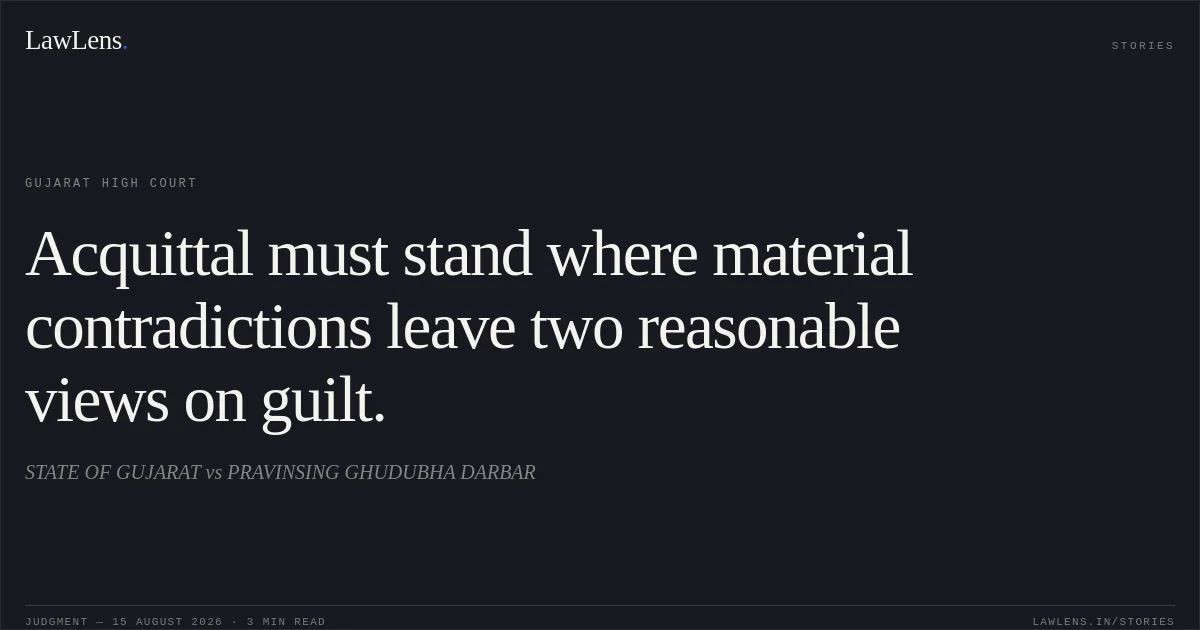
Source reference: pp. 13–15In these circumstances, the trial court’s view that the prosecution had failed to prove the charges beyond reasonable doubt was considered a reasonable view, not a perverse or legally unsustainable one.
Source reference: pp. 15–16, paras. 16–18Holding
The High Court answered the issues in favour of the accused and held that the trial court had committed no error of fact or law in acquitting them.
The prosecution had failed to produce credible and reliable evidence connecting the accused with the alleged crime or proving their guilt beyond reasonable doubt.
Source reference: pp. 19–20, paras. 21–22The State’s appeal was therefore dismissed, the judgment and order of acquittal dated 21 September 1998 were confirmed, the bail bonds were cancelled, and the record and proceedings were directed to be returned to the trial court.
Source reference: p. 20, para. 23Acts & Sections Cited
7 provisions across 2 statutes referred to in this judgment. Each provision opens on LawLens.
Code of Criminal Procedure, 19732
Indian Penal Code, 18605
Original Court PDF
STATE OF GUJARATvsPRAVINSING GHUDUBHA DARBAR
Click to open original judgment
Original judgment, available to read, download and summarize on LawLens.in