Facts
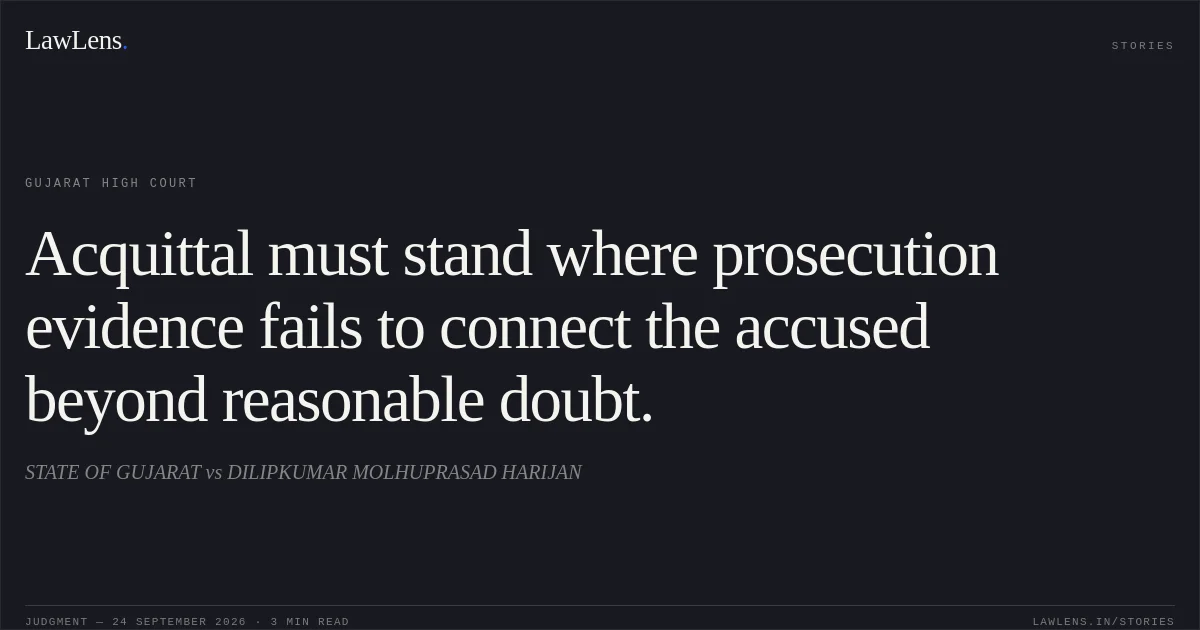
The State of Gujarat filed an appeal under Sections 378(1) and 378(3) of the Code of Criminal Procedure, 1973, challenging the acquittal dated 14 October 2009 passed by the Special Judge and 2nd Additional Sessions Judge, Bharuch, in Special (Electricity) Case No. 32 of 2008.
Source reference: p.1, para.1The prosecution alleged that an electricity transformer/coil belonging to D.G.V.C.L. had been damaged and stolen near Village Mandva, causing loss of approximately Rs.12,000–13,800.
Source reference: pp.2, 6, paras.2, 12An FIR was registered for offences under Sections 136(1)(a), 150 and 137 of the Electricity Act, 2003. After investigation, a charge-sheet was filed and the matter was committed to the Special Court.
Source reference: pp.2–3, paras.2.2–2.6The prosecution examined twelve witnesses, including the complainant, departmental officials, police personnel and panch witnesses.
Source reference: p.3, para.3The trial Court acquitted them, holding that the prosecution had failed to establish their connection with the alleged theft and damage.
Source reference: p.4, paras.5–7Issues
Whether the trial Court was justified in acquitting the respondents of offences under Sections 136(1)(a), 150 and 137 of the Electricity Act, 2003?
Source reference: p.6, para.11(1)Whether the trial Court properly appreciated the oral and documentary evidence led by the prosecution?
Source reference: p.6, para.11(2)Whether the impugned acquittal suffered from illegality, irregularity, perversity or any other infirmity warranting appellate interference?
Source reference: p.6, para.11(3)Law Applied
The Court applied Sections 136(1)(a), 150 and 137 of the Electricity Act, 2003, which required the prosecution to establish the alleged theft, damage and the accused persons’ participation or connection with the stolen electrical property.
Source reference: no citationThe appeal was governed by Section 378 CrPC concerning appellate scrutiny of an acquittal.
Source reference: p.1, para.1The Court reiterated that an appellate court has full power to review and reappreciate evidence in an appeal against acquittal, but must bear in mind the accused’s double presumption of innocence; where two reasonable views are possible, the acquittal should not be disturbed.
Source reference: pp.9–11, paras.16–19These principles were drawn from Chandrappa v. State of Karnataka, (2007) 4 SCC 415; Rajesh Prasad v. State of Bihar, (2022) 3 SCC 471; Babu Sahebagouda Rudragoudar v. State of Karnataka, (2024) 8 SCC 149; and Ramesh v. State of Karnataka, (2024) 9 SCC 169.
Source reference: paras.18–19Reasoning
The High Court found that the prosecution proved, at most, that the transformer had been damaged or removed; it did not prove who committed the theft or how either respondent was connected with it.
Source reference: pp.6–8, paras.12–15The prosecution did not examine any villager who had allegedly reported the incident, did not produce the written complaint from the residents of Mandva, and did not examine its signatories.
Source reference: p.8, para.14Although the place was regularly used by villagers and was situated near the National Highway, no person who could have witnessed or noticed the removal of the transformer was examined.
Source reference: p.7, para.13The panch witnesses also did not provide material connecting evidence, and there was no direct or circumstantial evidence establishing the respondents’ involvement or possession of stolen property.
Source reference: p.8, para.15The Court therefore held that the prosecution had failed to prove the essential ingredients of the offences beyond reasonable doubt.
Source reference: no citationApplying the enhanced standard of restraint applicable to an appeal against acquittal, it found no perversity, manifest illegality or unreasonable appreciation of evidence by the trial Court.
Source reference: pp.8–12, paras.15–21Holding
The High Court answered the issues in favour of the respondents.
It held that the prosecution had failed to establish beyond reasonable doubt that the respondents committed the theft, damaged the transformer, or possessed the stolen electrical property.
Source reference: pp.8, 12, paras.15, 20–21The State’s appeal was dismissed, the trial Court’s judgment of acquittal was confirmed, the bail bond was cancelled, and the record and proceedings were directed to be returned to the trial Court.
Source reference: p.12, para.22Acts & Sections Cited
6 provisions across 2 statutes referred to in this judgment. Each provision opens on LawLens.
Code of Criminal Procedure, 19733
Electricity Act, 20033
Original Court PDF
STATE OF GUJARATvsDILIPKUMAR MOLHUPRASAD HARIJAN
Click to open original judgment
Original judgment, available to read, download and summarize on LawLens.in