01Facts
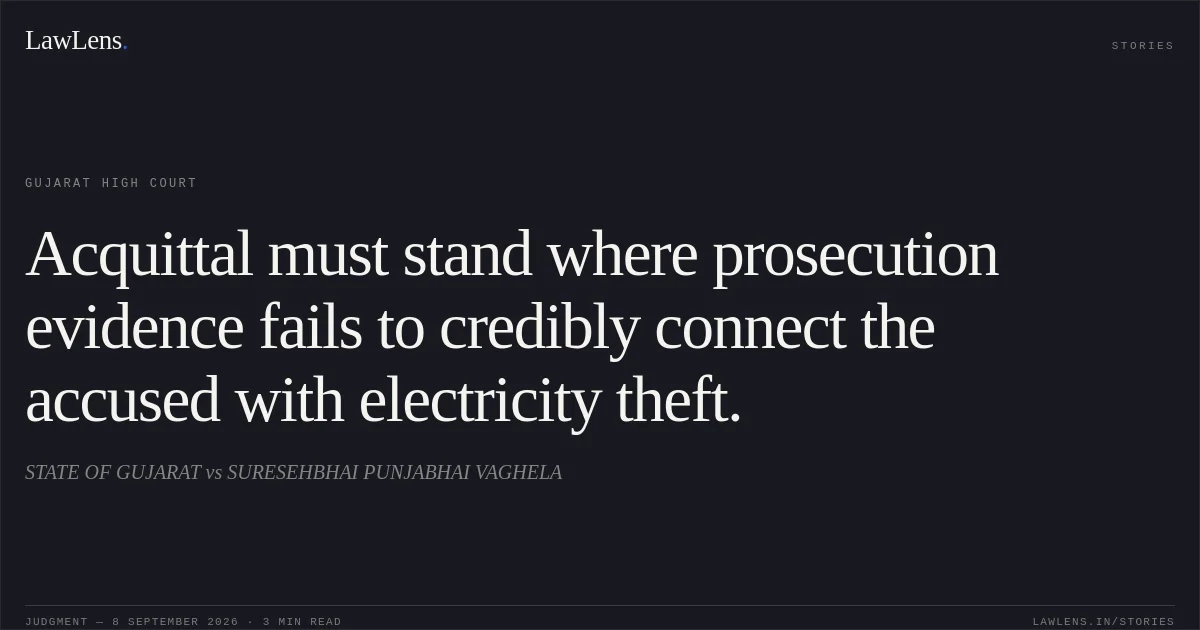
On 20 January 2006, a GEB checking squad allegedly found an unauthorised electricity connection at a residence in Bhanvad, involving abstraction of 1,370 watts of electricity and alleged loss of ₹57,580.88.
p. 2 · ¶ 2–2.3The prosecution alleged that the respondent had illegally connected a private cable to the GEB line and thereby committed theft of electricity under Section 135 of the Electricity Act, 2003.
p. 2 · ¶ 2–2.3A complaint was registered as II-C.R. No. 1092 of 2006, and the respondent was prosecuted in Special (GEB) Case No. 57 of 2008.
p. 2 · ¶ 2.2–2.4The trial court acquitted him.
p. 2 · ¶ 2.2–2.4The State challenged the acquittal under Section 378(1)(3) of the Code of Criminal Procedure, 1973.
p. 1 · ¶ 1The High Court noted that the complaint and departmental documents named Bhiniben Nazabhai Vaghela, rather than the respondent, and that the prosecution produced no reliable evidence establishing the respondent’s ownership, occupation, or connection with the premises.
p. 7 · ¶ 1502Issues
i.Whether the trial court was justified in acquitting the respondent of the offence under Section 135 of the Electricity Act, 2003?
p. 5 · ¶ 9(1)ii.Whether the trial court properly appreciated the oral and documentary evidence led by the prosecution?
p. 5 · ¶ 9(2)iii.Whether the acquittal suffered from any illegality, irregularity, or perversity warranting appellate interference?
p. 5 · ¶ 9(3)03Law Applied
The Court applied Section 135 of the Electricity Act, 2003, which criminalises dishonest abstraction, consumption, or use of electricity.
It also considered Section 151 of the Act concerning the authority competent to institute a complaint, noting the complainant’s admission that he lacked the requisite authorisation.
p. 6 · ¶ 12The State’s appeal was governed by Section 378 of the Code of Criminal Procedure, 1973.
On appellate review of acquittals, the Court relied on Chandrappa v. State of Karnataka, (2007) 4 SCC 415; Rajesh Prasad v. State of Bihar, (2022) 3 SCC 471; Babu Sahebagouda Rudragoudar v. State of Karnataka, (2024) 8 SCC 149; and Ramesh v. State of Karnataka, (2024) 9 SCC 169.
pp. 9–11 · ¶ 17–20These authorities establish that an appellate court may reappraise the evidence, but an acquitted accused enjoys a strengthened or “double” presumption of innocence; where two reasonable views are possible, the acquittal should not be disturbed unless the trial court’s conclusion is manifestly illegal or perverse.
pp. 9–11 · ¶ 17–20Provisions in the judgment · 4 · Linked ones open on LawLens
Code of Criminal Procedure, 1973 Section 378Section 313
Electricity Act, 2003 Section 135Section 151
04Reasoning
The High Court found that the prosecution evidence did not establish the respondent’s involvement beyond reasonable doubt.
The complainant admitted that he was not authorised by the Vigilance Department or Electrical Inspector to lodge the complaint and that the complaint had been prepared by a subordinate officer.
p. 6 · ¶ 12The checking-squad witness admitted that no photographs, spot panchnama, independent witnesses, or prior written authorisation were obtained, and that his statement was recorded approximately fifteen months after the inspection.
p. 7 · ¶ 13The Investigating Officer likewise admitted that no independent witness statements, panchnama, or seized material were produced.
p. 7 · ¶ 14Most significantly, the checking sheet, supplementary bill, and FIR referred to Bhiniben Nazabhai Vaghela, not the respondent, and the prosecution failed to explain how the respondent was implicated or prove that he owned or occupied the premises.
p. 7 · ¶ 15In light of these evidentiary deficiencies and the strengthened presumption arising from the acquittal, the trial court’s conclusion was found to be a reasonable view and not perverse or legally infirm.
pp. 8–12 · ¶ 16–2205Holding
The High Court held that the prosecution failed to prove the respondent’s connection with the alleged unauthorised use of electricity or establish the offence under Section 135 of the Electricity Act beyond reasonable doubt.
pp. 11–12 · ¶ 21–22The trial court’s acquittal was neither illegal nor perverse and did not warrant appellate interference.
pp. 11–12 · ¶ 21–22The State’s appeal was therefore dismissed, the order of acquittal was confirmed, the bail bond was cancelled, and the record and proceedings were directed to be returned to the trial court.
p. 12 · ¶ 23Original Court PDF
STATE OF GUJARATvsSURESEHBHAI PUNJABHAI VAGHELA
Click to open original judgment
Original judgment, available to read, download and summarize on LawLens.in