Facts
On 6 August 2009, the complainant, Mansukhbhai Kalabhai Dafda, alleged that Respondent No. 1 threw a stick at his child, assaulted the complainant’s wife with the stick, and thereafter assaulted the complainant when he intervened.
Source reference: p. 2, para. 2Respondent No. 2 allegedly abused and assaulted the complainant’s wife.
Source reference: p. 2, para. 2The accused were further alleged to have threatened the complainant and intentionally insulted him and his wife by referring to their caste.
Source reference: p. 2, para. 2Following investigation, a charge-sheet was filed for offences under Sections 325, 323, 504, 506(2) and 114 of the IPC, Section 135 of the Bombay Police Act, and Section 3(1)(x) of the Scheduled Castes and Scheduled Tribes (Prevention of Atrocities) Act, 1989.
Source reference: p. 2, para. 2.1–2.2The Trial Court examined 17 prosecution witnesses and admitted 19 documentary exhibits, but acquitted all the accused on 31 July 2012.
Source reference: p. 2, para. 2.1–2.2The State preferred the present appeal against acquittal under Section 378(1) and (3) of the CrPC.
Source reference: p. 1, para. 1Issues
1. Whether the Trial Court committed an error of law or fact in acquitting the respondents-accused.
Source reference: p. 6, para. 82. Whether the Trial Court improperly appreciated the oral and documentary evidence led by the prosecution.
Source reference: p. 6, para. 83. Whether the acquittal suffered from illegality, perversity, or any other infirmity warranting appellate interference.
Source reference: p. 6, para. 84. Whether the prosecution proved beyond reasonable doubt the offences under Sections 325, 323, 504, 506(2) and 114 of the IPC and Section 135 of the Bombay Police Act.
Source reference: pp. 8–10, paras. 13–15, 225. Whether the prosecution established the essential ingredients of the offence under Section 3(1)(x) of the SC/ST Act, including caste-based intentional insult or humiliation in a legally relevant public setting.
Source reference: pp. 10–15, paras. 16–20Law Applied
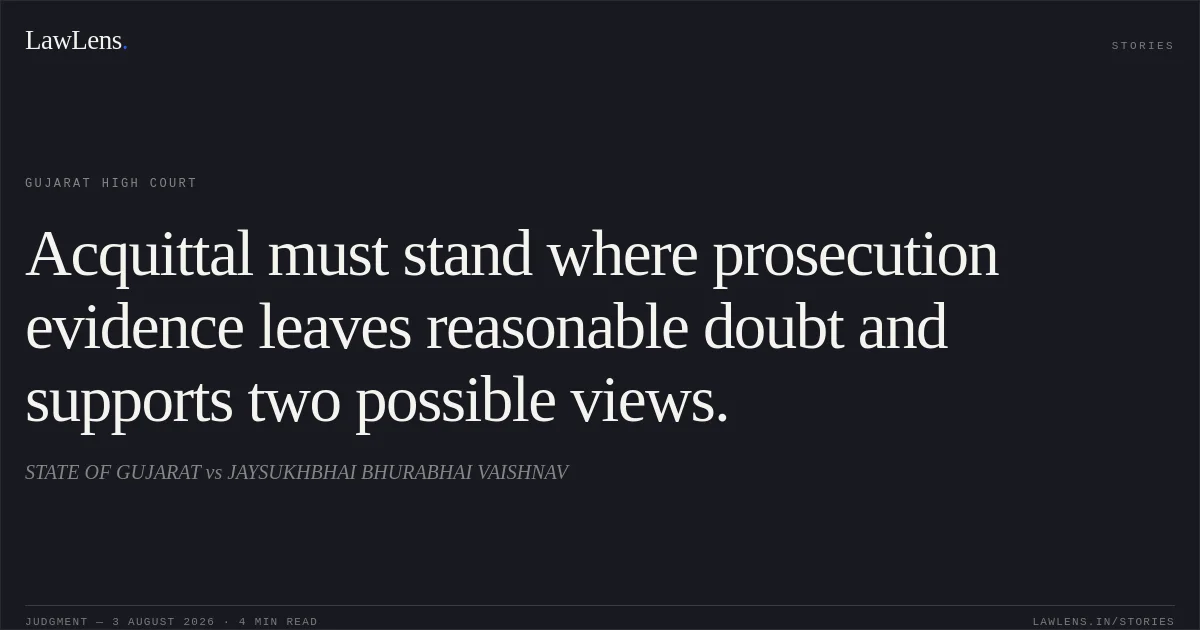
The Court applied Section 378 CrPC governing appeals against acquittal and reaffirmed that an appellate court may reappreciate the evidence but must respect the double presumption of innocence in favour of an acquitted accused; where two reasonable views are possible, the acquittal should not be disturbed unless the Trial Court’s conclusion is manifestly illegal or perverse.
Source reference: pp. 17–19, paras. 25–28It applied Sections 323, 325, 504, 506(2) and 114 IPC and Section 135 of the Bombay Police Act, requiring the prosecution to establish the charged acts beyond reasonable doubt.
Source reference: no citationIn relation to Section 3(1)(x) of the SC/ST Act, the Court relied on Shajan Skaria v. State of Kerala, holding that intentional insult must be connected with the victim’s caste identity and aimed at caste-based humiliation, not merely arise from the victim’s membership of an SC/ST community.
Source reference: pp. 10–13, paras. 17–18It also relied on Sohanvir @ Sohanvir Dhama v. State of U.P., Karuppudayar v. State, and related authorities for the requirement that caste-based abuse under the Act must occur in a place within public view.
Source reference: pp. 13–15, paras. 18–19The principles governing appellate review of acquittals were drawn principally from Chandrappa v. State of Karnataka, Rajesh Prasad v. State of Bihar, Babu Sahebagouda Rudragoudar v. State of Karnataka, and Ramesh v. State of Karnataka.
Source reference: pp. 17–19, paras. 25–28Reasoning
The High Court found material discrepancies between the complainant’s testimony and the FIR, and noted that PW-3 and PW-4 were close relatives while independent witnesses did not support the prosecution case.
Source reference: p. 7, paras. 11–12The prosecution failed to examine the Dhari PHC doctor or produce the primary medical records, leaving the nature of the initial injuries and the history given by the injured persons unproved.
Source reference: pp. 8–9, paras. 13–15The Civil Hospital medical certificate did not identify the assailants, and the examining doctor accepted that the injuries could have resulted from a fall.
Source reference: p. 8, para. 14The Court also noted inconsistencies concerning an injury to the complainant’s right hand.
Source reference: p. 9, para. 15Regarding the SC/ST Act charge, the investigating witnesses stated that the investigation did not disclose the statutory ingredients of the offence, and the prosecution failed to establish caste-based intentional humiliation satisfying the applicable legal requirements.
Source reference: pp. 10–15, paras. 16–20Since the evidence did not prove the assault, threats, insults, or caste-based offence beyond reasonable doubt, the Trial Court’s view was considered reasonable and not perverse.
Source reference: pp. 16–19, paras. 24–28The double presumption in favour of the acquitted accused therefore precluded appellate interference.
Source reference: pp. 16–19, paras. 24–28Holding
The High Court answered the issues against the State and held that the prosecution had failed to prove the charged offences beyond reasonable doubt.
The Trial Court’s acquittal was supported by cogent reasons and disclosed no error of law, perversity, or illegality warranting interference.
Source reference: pp. 16–17, paras. 23–30The State’s appeal was dismissed, the judgment and order of acquittal dated 31 July 2012 were confirmed, the bail bonds were cancelled, and the record and proceedings were directed to be returned to the Trial Court.
Source reference: p. 20, para. 31Acts & Sections Cited
15 provisions across 4 statutes referred to in this judgment. Each provision opens on LawLens.
Code of Criminal Procedure, 19736
Indian Penal Code, 18606
Scheduled Castes and the Scheduled Tribes (Prevention of Atrocities) Act, 19892
Protection of Civil Rights Act, 19551
Original Court PDF
STATE OF GUJARATvsJAYSUKHBHAI BHURABHAI VAISHNAV
Click to open original judgment
Original judgment, available to read, download and summarize on LawLens.in