Facts
The petitioner, a Constable in the Madhya Pradesh Police, was caught during a raid by the Crime Branch on June 30, 2010, for allegedly participating in gambling near Durga Mandir, Bhopal.
Source reference: para. 2Following an FIR under Section 13 of the Public Gambling Act, the department initiated an inquiry. On February 10, 2011, the Inquiry Officer found all charges proved.
Source reference: para. 2Consequently, the disciplinary authority imposed the punishment of compulsory retirement on February 28, 2011.
Source reference: para. 2Subsequently, on April 11, 2011, a Criminal Court (JMFC) acquitted the petitioner of the criminal charges as witnesses turned hostile.
Source reference: para. 2, 7The petitioner’s departmental appeals and mercy petitions were dismissed between 2011 and 2016, leading to this writ petition.
Source reference: para. 2The petitioner’s service record included seven minor and two major penalties prior to this incident.
Source reference: para. 4, 10Issues
1. Whether the subsequent acquittal by a criminal court automatically entitles a delinquent employee to reinstatement and the setting aside of departmental punishment.
Source reference: para. 8, 92. Whether the punishment of compulsory retirement was disproportionate to the gravity of the misconduct, considering the petitioner’s past service record.
Source reference: para. 11, 12Law Applied
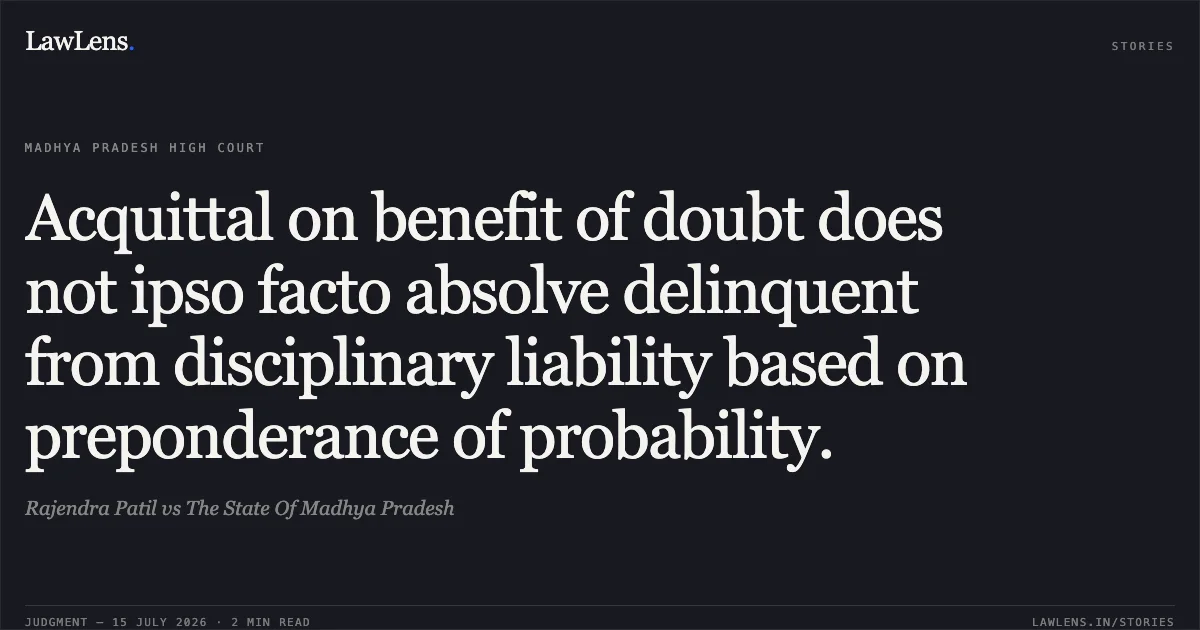
criminal and departmental proceedings operate in different fields with different objectives and standards of proof; the former requires proof "beyond reasonable doubt," while the latter relies on "preponderance of probability".
Source reference: para. 8acquittal does not ipso facto absolve a delinquent from liability in disciplinary proceedings.
Source reference: Shashi Bhushan Prasad v. CISF (2019), para. 8judicial review is restricted to cases where the punishment "shocks the conscience of the court" or is an "outrageous defiance of logic".
Source reference: S.R. Tewari v. Union of India (2013), para. 11Reasoning
The court reasoned that the departmental inquiry was concluded based on evidence and eyewitness accounts before the criminal acquittal occurred.
Source reference: para. 4, 7It noted that the JMFC's acquittal was not a "clean acquittal" but was based on a "benefit of doubt" due to witnesses turning hostile.
Source reference: para. 7The court emphasized that a member of a disciplined force is expected to maintain public order, and involvement in gambling is detrimental to the force's reputation.
Source reference: para. 4, 6Furthermore, the court scrutinized the petitioner’s antecedents, noting a history of similar gambling offenses in 2003 and 2009 and a total of nine previous penalties.
Source reference: para. 6, 10It concluded that the petitioner’s failure to improve his conduct after major penalties justified the department's decision that his continued service was not in the public interest.
Source reference: para. 6Holding
The court answered the issues in the negative, holding that the acquittal did not mandate reinstatement and the punishment was not disproportionate.
The court ruled that the punishment of compulsory retirement was just and proper given the petitioner’s repeated misconduct and the high standard of discipline required in the police force.
Source reference: para. 12Consequently, the High Court declined to interfere under Article 226 and dismissed the writ petition.
Source reference: para. 13Acts & Sections Cited
1 provisions across 1 statute referred to in this judgment. Linked provisions open on LawLens.
Madhya Pradesh Public Gambling Act1
Original Court PDF
Rajendra PatilvsThe State Of Madhya Pradesh
Click to open original judgment
Original judgment, available to read, download and summarize on LawLens.in


