01Facts
The petitioner instituted a writ petition challenging the constitutional validity of Explanation (1) to Rule 2(f) of the Special Rules for the Tamil Nadu Jail Subordinate Services.
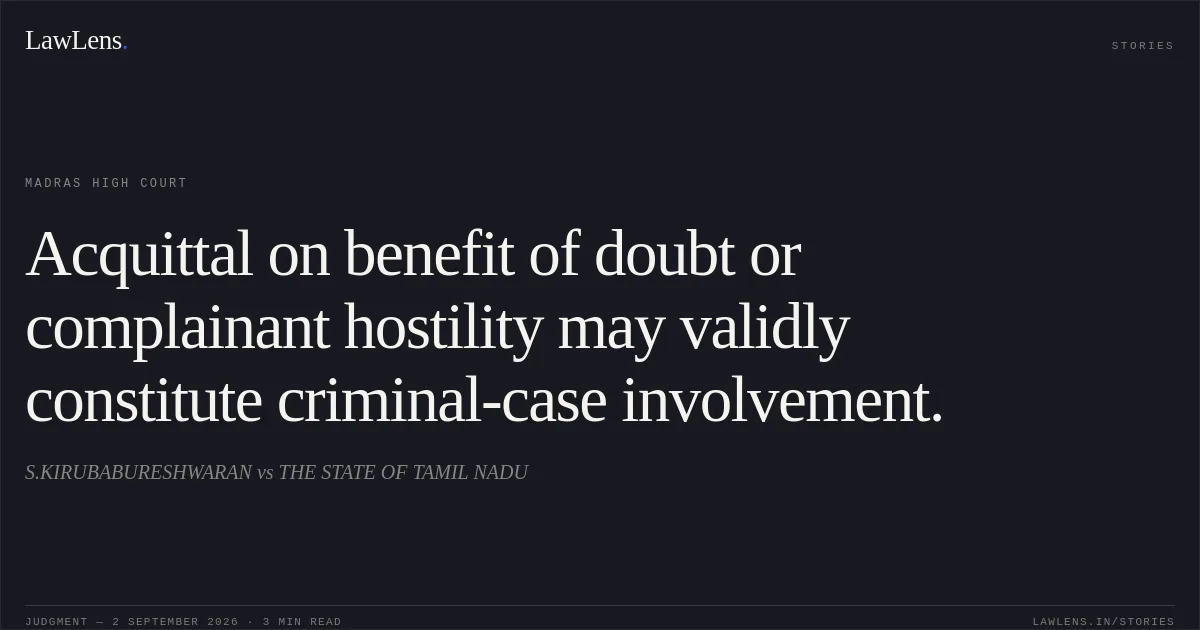
p. 1 · ¶ 1The Explanation provides that a person acquitted or discharged on benefit of doubt, or because the complainant turned hostile, shall nevertheless be treated as a person involved in a criminal case.
p. 1 · ¶ 1Rule 2(f) requires that a candidate must not have been involved in any criminal case before police verification.
p. 2 · ¶ 3The petitioner specifically sought invalidation of the Explanation insofar as it covers acquittals resulting from the complainant turning hostile.
p. 1The respondents opposed the challenge, and the Court considered the analogous provision under the Tamil Nadu Special Police Subordinate Service Rules, 1978.
pp. 2–3 · ¶ 5–602Issues
i.Whether Explanation (1) to Rule 2(f) of the Special Rules for the Tamil Nadu Jail Subordinate Services is unconstitutional insofar as it treats a person acquitted because the complainant turned hostile as a person involved in a criminal case.
p. 1 · ¶ 1–4ii.Whether an acquittal or discharge on benefit of doubt, or due to the complainant turning hostile, prevents the competent authority from considering the candidate’s prior involvement in a criminal case while assessing suitability for appointment.
pp. 3–4 · ¶ 703Law Applied
The Court applied Rule 2(f) and Explanation (1) of the Special Rules for the Tamil Nadu Jail Subordinate Services, under which a candidate must not have been involved in any criminal case before police verification, and a person acquitted or discharged on benefit of doubt or because the complainant turned hostile is still treated as having been involved in a criminal case.
p. 2 · ¶ 2–4The Court relied on the analogous Explanation to Rule 14(b) of the Tamil Nadu Special Police Subordinate Service Rules, 1978, which had been considered by a Larger Bench in J. Alex Ponseelan v. The Director General of Police, Tamil Nadu, 2014 (2) CTC 337.
p. 3 · ¶ 6The principle derived from Alex Ponseelan is that the Explanation identifies instances evidencing involvement in a criminal case and does not prevent the Government from appropriately framing or amending suitability criteria.
p. 3 · ¶ 6The Court further treated “involvement” as participation in a criminal case, for which registration of an FIR may be sufficient; the nature of the acquittal remains relevant to the competent authority’s suitability assessment.
p. 4 · ¶ 704Reasoning
The Court found that the impugned Explanation merely clarifies the meaning of “involved” in Rule 2(f).
p. 2 · ¶ 3–4Since the provision expressly covers acquittals on benefit of doubt and acquittals resulting from the complainant turning hostile, the petitioner could not claim that such an acquittal retrospectively erased the candidate’s involvement in the criminal case.
p. 2 · ¶ 3–4The Court considered the substantially identical provision in the Police Subordinate Service Rules and held that the Larger Bench decision in Alex Ponseelan had already addressed and upheld the relevant legal position.
p. 3 · ¶ 6It further reasoned that registration of an FIR constitutes participation or involvement in a criminal case, while the fact and circumstances of the subsequent acquittal are matters for the competent authority when determining the candidate’s suitability for public employment.
p. 4 · ¶ 7Accordingly, no independent constitutional invalidity was established.
p. 4 · ¶ 705Holding
The Court rejected the challenge to Explanation (1) to Rule 2(f) of the Special Rules for the Tamil Nadu Jail Subordinate Services and held that a person acquitted because the complainant turned hostile may still be treated as having been involved in a criminal case.
p. 4 · ¶ 7The competent authority may consider the circumstances of the acquittal while assessing suitability for appointment.
p. 4 · ¶ 7The writ petition was dismissed without costs, and the connected miscellaneous petition was closed.
p. 4Original Court PDF
S.KIRUBABURESHWARANvsTHE STATE OF TAMIL NADU
Click to open original judgment
Original judgment, available to read, download and summarize on LawLens.in