Facts
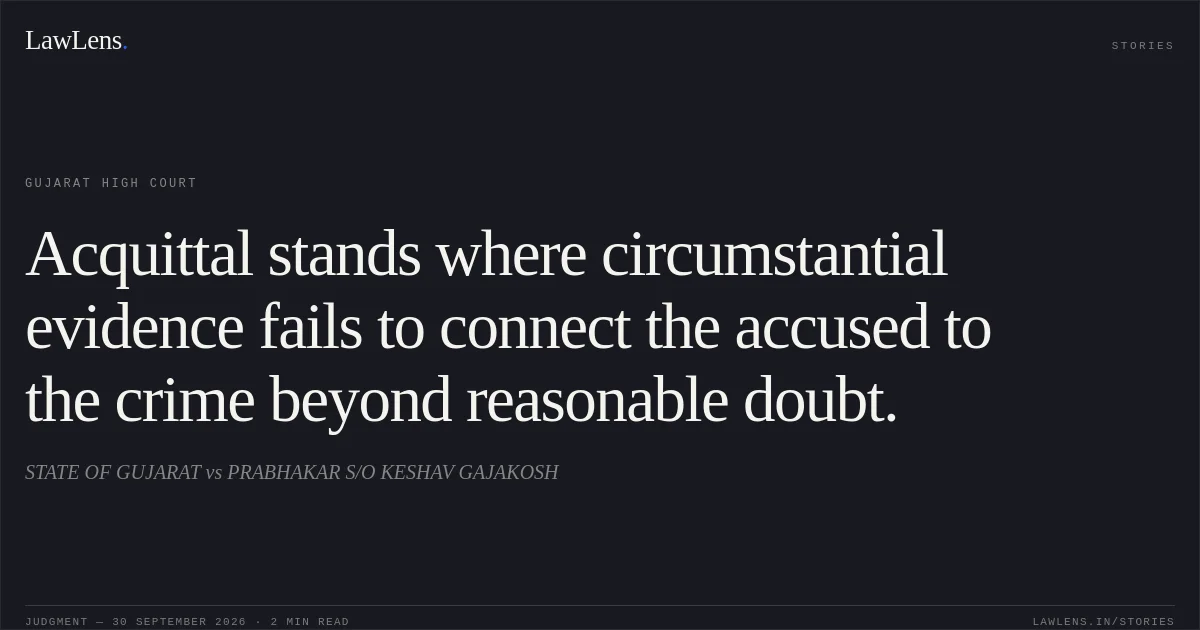
The respondent was convicted by the Chief Judicial Magistrate for offences including Sections 429 and 120-B of the Indian Penal Code and provisions of the Wildlife (Protection) Act, 1972, in a prosecution concerning the poaching of lions.
Source reference: para. 2.3–2.4, 11He was not originally named in the FIR; his alleged involvement was based principally on a chit bearing his telephone numbers, reportedly recovered from a cloth bundle, and a lie-detection report.
Source reference: para. 12–13The Additional Sessions Judge allowed his appeal and acquitted him on 20 August 2009, while dismissing appeals brought by other accused.
Source reference: para. 5, 11.1The State appealed against his acquittal under Section 378 of the Code of Criminal Procedure, 1973.
Source reference: para. 1Issues
1. Whether the appellate court’s acquittal of the respondent was erroneous or perverse so as to warrant interference in the State’s appeal.
Source reference: para. 14–172. Whether the prosecution evidence, particularly the telephone-number chit and lie-detection report, proved the respondent’s involvement in the alleged offences beyond reasonable doubt.
Source reference: para. 12–15, 20–21Law Applied
The Court considered the State’s appeal under Section 378(1) and (3) of the Code of Criminal Procedure, 1973.
Source reference: para. 1It applied the principles governing appeals against acquittal stated in Chandrappa v. State of Karnataka, (2007) 4 SCC 415, and reiterated in Rajesh Prasad v. State of Bihar, (2022) 3 SCC 471, Babu Sahebagouda Rudragoudar v. State of Karnataka, (2024) 8 SCC 149, and Ramesh v. State of Karnataka, (2024) 9 SCC 169: an appellate court may reappraise the evidence, but an acquittal carries a reinforced presumption of innocence, and where two reasonable views are possible, the acquittal should not be disturbed.
Source reference: para. 16–19The prosecution was required to establish the respondent’s guilt beyond reasonable doubt.
Source reference: para. 9, 20Reasoning
The Court found no reliable evidence connecting the respondent to the poaching. The lie-detection report could not be relied upon as the officer who conducted the test was not examined; the panch witness also failed satisfactorily to explain the recovery of the chit containing the telephone numbers.
Source reference: para. 13The appellate court had given cogent reasons for finding the circumstantial evidence insufficient, and the trial court’s conviction rested on circumstances that did not establish guilt beyond reasonable doubt.
Source reference: para. 12.1, 14–15Applying the reinforced presumption of innocence and the limits on interference with an acquittal, the High Court found no manifest error or perversity warranting reversal.
Source reference: para. 16–21Holding
The Court held that the prosecution had failed to prove the respondent’s involvement beyond reasonable doubt and that the appellate court had committed no error of fact or law in acquitting him.
The State’s appeal was dismissed, the acquittal was confirmed, the bail bond was cancelled, and the record and proceedings were directed to be returned to the concerned trial court.
Source reference: para. 22Acts & Sections Cited
12 provisions across 3 statutes referred to in this judgment. Each provision opens on LawLens.
Code of Criminal Procedure, 19732
Wild Life (Protection) Act, 1972
Indian Penal Code, 18601
Original Court PDF
STATE OF GUJARATvsPRABHAKAR S/O KESHAV GAJAKOSH
Click to open original judgment
Original judgment, available to read, download and summarize on LawLens.in