Facts
The State appealed a trial court judgment dated February 24, 2022, which acquitted the respondent of charges under the Narcotic Drugs and Psychotropic Substances (NDPS) Act.
Source reference: para. 1The prosecution alleged that in August 2017, police acting on a tip-off intercepted the respondent near a railway gate and recovered 1.4 kg of cannabis (Ganja) from a bag in his possession.
Source reference: para. 2After the trial court found the evidence insufficient for conviction, the State sought leave to appeal. There was an initial procedural delay of 155 days in filing the appeal, which the High Court condoned before reviewing the merits of the acquittal.
Source reference: Assessment of I.A. No. 22574/2022Issues
1. Whether the search and seizure procedures complied with the mandatory statutory requirements under Section 50 of the NDPS Act.
Source reference: para. 92. Whether the testimony of official witnesses alone, in the absence of corroborated independent witness testimony, was sufficient to overturn an acquittal.
Source reference: para. 8, 143. Whether the failure to exhibit the Forensic Science Laboratory (FSL) report or question the accused on it during his examination created a fatal gap in the prosecution's case.
Source reference: para. 13Law Applied
Section 50 of the NDPS Act, which mandates strictly informing an accused of their right to be searched before a Gazetted Officer or Magistrate.
Source reference: para. 9Principles of appellate review for acquittals under Section 378 of the CrPC, as clarified in H.D. Sundara v. State of Karnataka (2023) and Mallappa v. State of Karnataka (2024), which establish that an appellate court should not interfere with a "legally plausible" trial court view unless it is perverse or suffers from patent illegality.
Source reference: para. 15, 17Reasoning
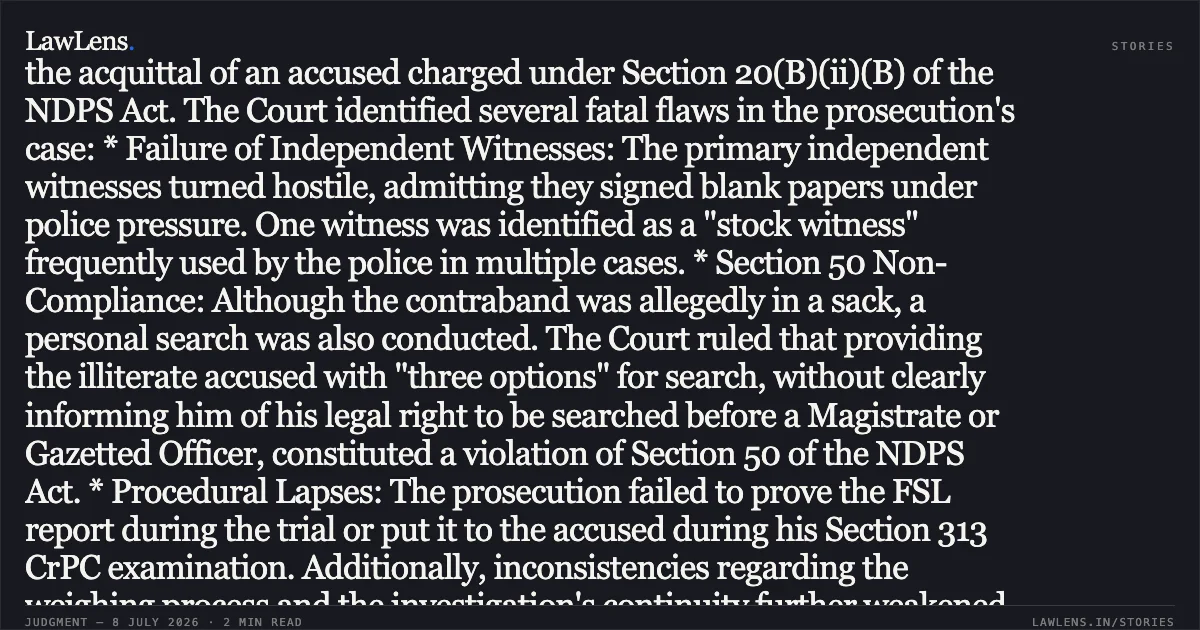
The High Court found several critical failures in the prosecution's case. First, the independent witnesses either turned hostile or appeared to be "stock witnesses" regularly used by the police in multiple other cases, undermining the credibility of the seizure.
Source reference: para. 8, 10Second, the court noted a significant procedural breach of Section 50 of the NDPS Act; the accused was given confusing options for the search rather than a clear communication of his legal rights, which is mandatory for personal searches.
Source reference: para. 9Third, the court highlighted that the FSL report—essential for proving the seized substance was actually contraband—was never properly exhibited or put to the accused during his Section 313 CrPC examination.
Source reference: para. 13These inconsistencies and omissions supported the trial court’s decision to grant the benefit of the doubt to the accused.
Source reference: para. 14, 18Holding
The High Court held that the trial court's acquittal was a plausible view based on the evidence and did not suffer from perversity.
The court dismissed the application for leave to appeal and the appeal itself, affirming the respondent's acquittal.
Source reference: para. 18-19Acts & Sections Cited
6 provisions across 2 statutes referred to in this judgment. Each provision opens on LawLens.
Code of Criminal Procedure, 19732
Narcotic Drugs and Psychotropic Substances Act, 19854
Original Court PDF
The State Of Madhya PradeshvsAshok Gupta @ Banta
Click to open original judgment
Original judgment, available to read, download and summarize on LawLens.in


