Facts
The State appealed against a judgment dated November 23, 2022, where the Special Judge (POCSO Act), Umaria, acquitted the respondent of charges involving criminal trespass, sexual harassment, and criminal intimidation under Sections 452, 354, 506 Part-II of the IPC and Section 7/8 of the POCSO Act.
Source reference: para. 1The prosecution alleged that on July 19, 2020, the accused entered the victim's home while she was alone and made non-consensual physical contact.
Source reference: para. 2The FIR was lodged five days later on July 24, 2020.
Source reference: para. 8The trial court acquitted the accused citing a lack of credible evidence and procedural inconsistencies.
Source reference: para. 5Issues
1. Whether the trial court’s judgment of acquittal was perverse or based on a misreading of material evidence, warranting interference by the appellate court.
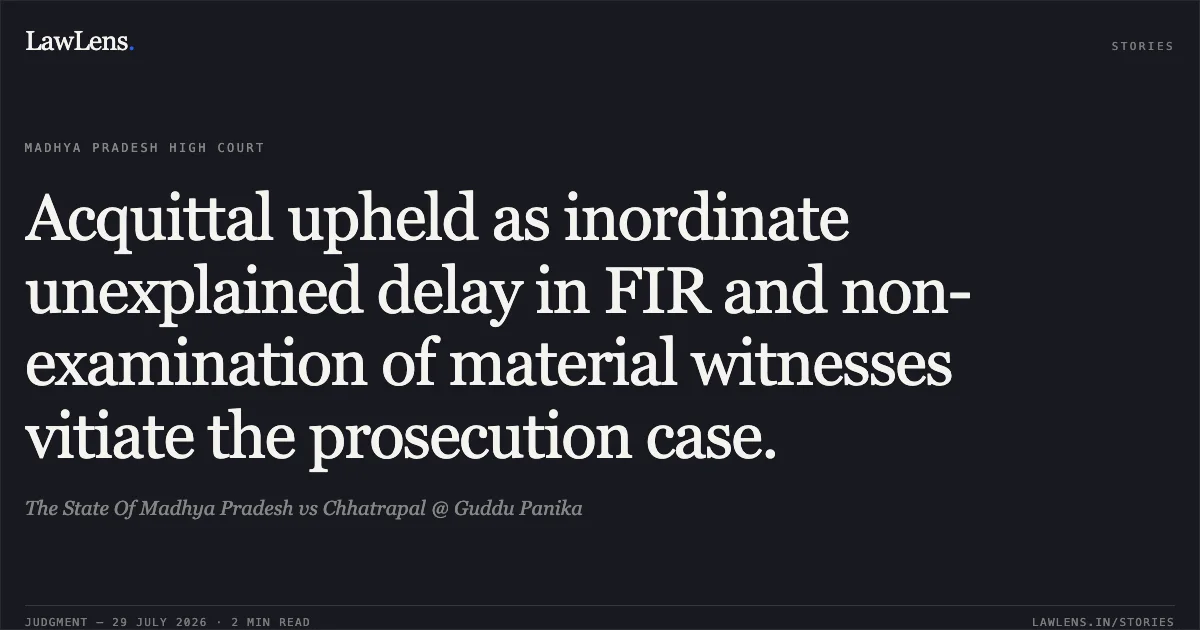
Source reference: para. 12-142. Whether the delay in lodging the FIR and the non-examination of material witnesses proved fatal to the prosecution's case.
Source reference: para. 8-11Law Applied
The court applied Section 378 of the Code of Criminal Procedure regarding appeals against acquittal.
Source reference: para. 1It relied on established judicial principles from H.D. Sundara v. State of Karnataka (2023), which dictate that an appellate court should not overturn an acquittal if the trial court’s view is a "possible view" based on the evidence.
Source reference: para. 13The court further cited Babu Sahebagouda Rudragoudar v. State of Karnataka (2024) and Mallappa v. State of Karnataka (2024) regarding the high threshold for reversing acquittals, requiring a finding of patent perversity, selective appreciation of evidence, or manifest error of law.
Source reference: para. 14-15Reasoning
The High Court found that the prosecution failed to provide a satisfactory explanation for the five-day delay in filing the FIR.
Source reference: para. 8The court noted significant contradictions in the victim's testimony regarding the preparation of the written report and her movements following the incident.
Source reference: para. 8-10Crucially, the prosecution failed to examine the victim’s sister, who was present during the alleged incident, and other family members who were reportedly at the home, despite their status as material witnesses.
Source reference: para. 9-10No independent witnesses were presented, and testimony regarding a neighbor’s mobile phone was never verified.
Source reference: para. 11The court determined that the trial judge's skepticism regarding witness credibility was a legally plausible interpretation of the record.
Source reference: para. 12Holding
The High Court held that the trial court's findings were neither perverse nor unreasonable, and the acquittal strengthened the presumption of the accused's innocence.
The court refused to interfere with the lower court's decision as the prosecution failed to prove guilt beyond a reasonable doubt.
Source reference: para. 16Consequently, the application for leave to appeal was dismissed and the appeal was formally dismissed.
Source reference: para. 17Acts & Sections Cited
7 provisions across 3 statutes referred to in this judgment. Each provision opens on LawLens.
Code of Criminal Procedure, 19732
Indian Penal Code, 18603
Original Court PDF
The State Of Madhya PradeshvsChhatrapal @ Guddu Panika
Click to open original judgment
Original judgment, available to read, download and summarize on LawLens.in


