Facts
The Appellant (ESIC) filed a complaint against M/s. Hotel Navjivan and its partner (Respondents) under Sections 85(e) and 85(g) of the ESI Act, 1948. The allegation was the non-submission of statutory returns (Form-6) and contribution challans for the period September 1995 to March 1996
Source reference: p. 2The ESI Inspector claimed that during a 1993 inspection, the hotel employed more than 10 persons, bringing it under the Act’s purview, despite the hotel's attendance register showing only six employees
Source reference: p. 2, 9The Trial Court (Metropolitan Magistrate, Ahmedabad) acquitted the respondents on October 13, 2000, questioning the Inspector's jurisdiction and the Act's applicability
Source reference: p. 1, 9Issues
1. Whether the ESI Act, 1948, was applicable to the respondent establishment based on the number of employees found during inspection
Source reference: p. 92. Whether the Inspector who conducted the search had the requisite territorial jurisdiction and authorization under Section 45 of the Act
Source reference: p. 93. Whether the prosecution was barred by limitation and initiated with valid sanction
Source reference: p. 8, 10Law Applied
The court applied Section 85(e) and (g) of the ESI Act, 1948, which penalizes the failure to submit returns or non-compliance with regulations
Source reference: p. 8It considered Section 45 regarding the appointment and powers of Inspectors, and Section 86 regarding the procedure for prosecution
Source reference: p. 9The court further relied on the appellate standards for reviewing acquittals established in Chandrappa v. State of Karnataka, emphasizing the "double presumption of innocence"
Source reference: p. 12Rajesh Prasad v. State of Bihar, which requires "weighty grounds" to overturn a trial court's acquittal
Source reference: p. 12-13Reasoning
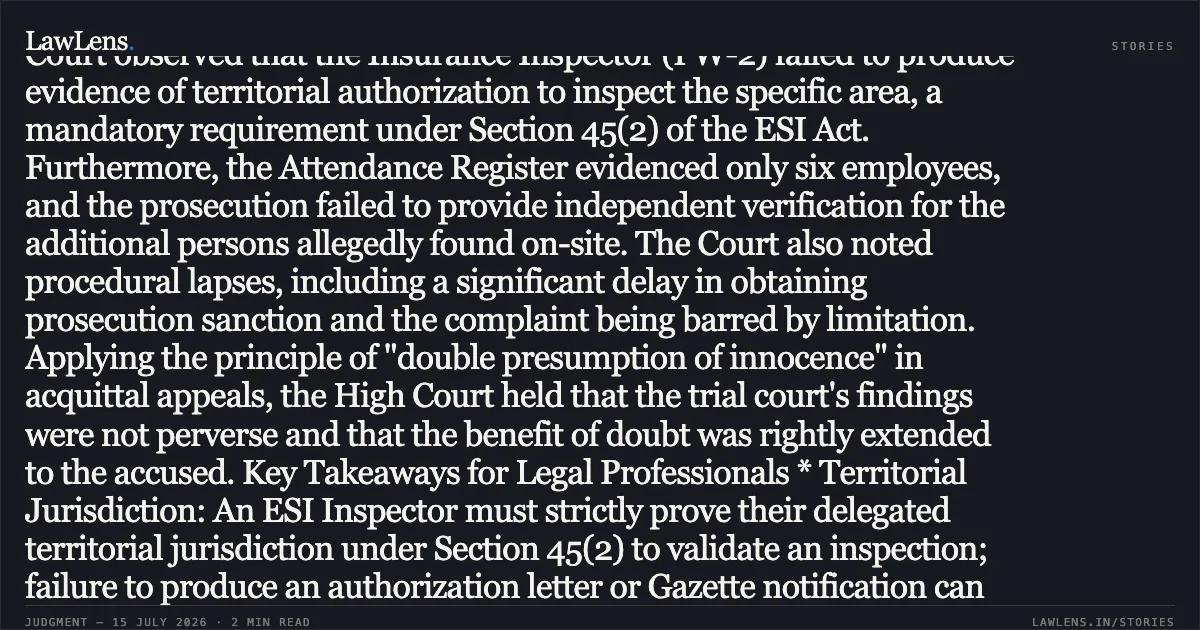
The prosecution failed to prove the establishment met the statutory threshold of 10 employees for ESI coverage. While the Inspector claimed more than ten workers were present, the official Attendance Register reflected only six
Source reference: p. 9Crucially, the Inspector (PW-2) admitted he could not produce documents, Gazette notifications, or authorization letters proving he had territorial jurisdiction over the specific area where the hotel was located
Source reference: p. 9PW-2 also conceded he had not personally verified the submission of Form No. 1 or the specifics of the code allotment
Source reference: p. 9The Court noted a significant delay in obtaining prosecution sanction (six months) and found the complaint to be instituted at a belated stage, potentially barred by limitation
Source reference: p. 8-10Consequently, the Court found the Trial Court's view—that the Act did not apply due to insufficient employee numbers—to be a reasonable conclusion derived from the evidence.
Source reference: p. 9Holding
The High Court held that the prosecution failed to establish the foundational facts regarding the number of employees and the Inspector’s jurisdiction beyond a reasonable doubt
The High Court dismissed the appeal and confirmed the judgment of acquittal. It further ordered that all bail bonds were cancelled
Source reference: p. 14Acts & Sections Cited
3 provisions across 2 statutes referred to in this judgment. Each provision opens on LawLens.
Code of Criminal Procedure, 19732
Indian Penal Code, 18601
Original Court PDF
THE REGIONAL DIRECTOR EMPLOYEES STATE INSURANCEvsSTATE OF GUJARAT
Click to open original judgment
Original judgment, available to read, download and summarize on LawLens.in


![Subsequent exoneration does not retrospectively invalidate a finalized promotion select list.. UNNIKRISHNAN M vs M/o Environment And Forests. CAT - ['Ernakulam']. LawLens](/stories/thumbnails/subsequent-exoneration-does-not-retrospectively-invalidate-a-finalized-promotion-select-li-ce80a0e84f2f4887857271e8b4341c42.webp)