Facts
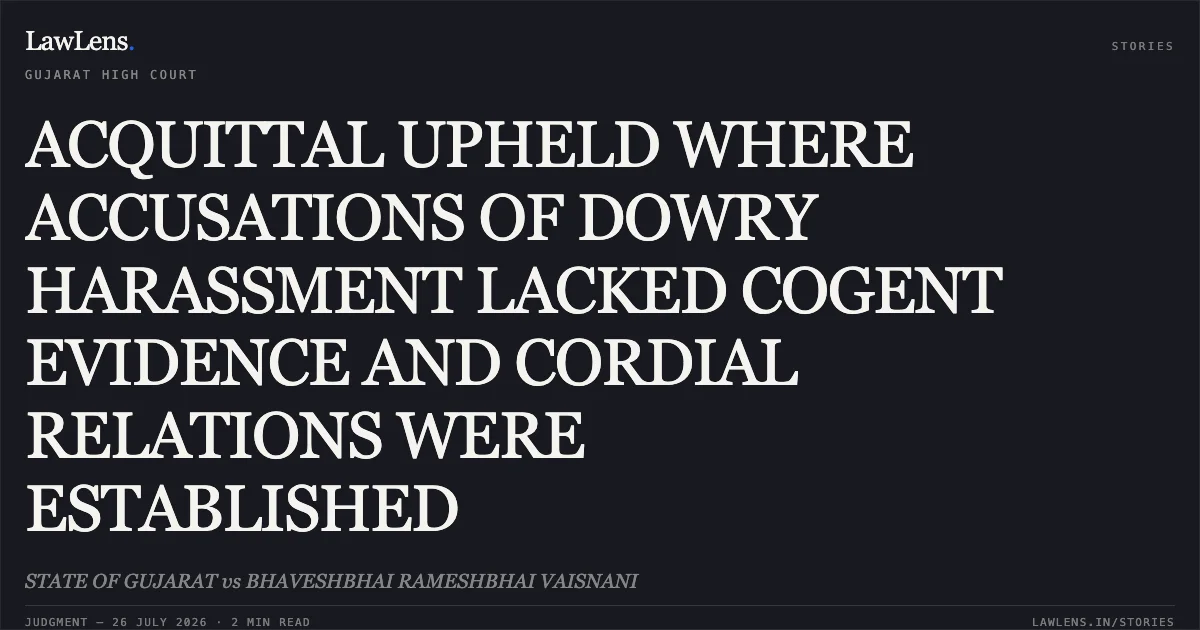
The State appealed against the acquittal of the respondents (the deceased’s husband, brother-in-law, and sister-in-law) for offences under Sections 306, 498(A), and 114 of the IPC, and Sections 3 and 5 of the Dowry Prohibition Act
Source reference: p. 1The deceased, Sejalben, married Respondent No. 1 in April 2007 and allegedly committed suicide by consuming poison on September 18, 2008
Source reference: p. 2-3The complainant (the deceased's father) alleged she was harassed for cooking mistakes and a demand of Rs. 1,00,000 for furniture
Source reference: p. 2However, the initial accidental death entry and statements recorded by the police immediately after the incident contained no allegations of harassment
Source reference: p. 7Crucially, after the death, the respondents voluntarily returned all dowry articles and stridhan via a legal agreement
Source reference: p. 8Issues
1. Whether the trial court was justified in passing the judgment and order of acquittal based on the evidence presented
Source reference: p. 62. Whether the prosecution proved the ingredients of Sections 498A and 306 of the IPC and the Dowry Prohibition Act beyond reasonable doubt
Source reference: p. 103. Whether there is any manifest illegality or perversity in the trial court’s appreciation of evidence
Source reference: p. 6Law Applied
The court applied Section 498A (cruelty) and Section 306 (abetment of suicide) of the IPC, and Sections 3 and 5 of the Dowry Prohibition Act. It relied on the principle that to sustain a conviction under Section 306, there must be clear evidence of active abetment or instigation
Source reference: p. 10Regarding the powers of the Appellate Court against acquittal, the court followed the principles laid down in Chandrappa v. State of Karnataka, Rajesh Prasad v. State of Bihar, and Babu Sahebagouda Rudragoudar v. State of Karnataka, emphasizing the "double presumption of innocence" in favor of an acquitted accused
Source reference: p. 11-12It further noted the requirement from Rajendra Prasad v. State of Bihar that the High Court must find it "well-nigh impossible" for the Trial Court to have rejected certain testimony before reversing an acquittal
Source reference: p. 13Reasoning
The Court found that the prosecution's narrative was inconsistent with the material evidence. While the complainant alleged a demand for furniture money, the home panchnama and photographs proved the house was already fully furnished before the incident
Source reference: p. 9Testimony from the deceased’s sister, Jalpaben, revealed she had vacationed with the couple shortly before the incident and noticed no ill-treatment
Source reference: p. 9The Court observed that the complainant’s conduct—such as denying he had instructed a lawyer to issue a notice for the return of stridhan—undermined his credibility
Source reference: p. 8Since the respondents voluntarily returned the dowry articles, the Court inferred a lack of dowry-related animus
Source reference: p. 10The Court reasoned that the essential ingredients of Section 306 (abetment) and Section 498A (legal cruelty) were missing, and the trial court's view was a "possible" and "reasonable" one that did not warrant interference
Source reference: p. 10, 14Holding
The High Court dismissed the appeal and confirmed the trial court's judgment of acquittal. It held that the prosecution failed to prove the charges beyond a reasonable doubt and that there was no perversity in the trial court’s findings
The bail bonds were cancelled, and the sureties discharged
Source reference: p. 14Acts & Sections Cited
6 provisions across 3 statutes referred to in this judgment. Each provision opens on LawLens.
Code of Criminal Procedure, 19732
Indian Penal Code, 18602
Original Court PDF
STATE OF GUJARATvsBHAVESHBHAI RAMESHBHAI VAISNANI
Click to open original judgment
Original judgment, available to read, download and summarize on LawLens.in