Facts
On September 15, 2005, a Food Inspector visited the accused's grocery firm and collected samples of "Gaay Brand agmarked Soji" (Batch No. 5, packed 08/2005)
Source reference: p. 2The samples were sent to the Public Analyst, Rajkot, who declared the sample adulterated due to the presence of living and dead larvae insects
Source reference: p. 2-4The trial Court acquitted the accused on February 8, 2018, noting a delay of one month and thirteen days in sending the sample for analysis and finding no mention of insects in the original panchnama
Source reference: p. 3-4The State appealed this acquittal, arguing that mandatory requirements were met and the Public Analyst’s report proved adulteration
Source reference: p. 4-5Issues
1. Whether the trial Court was justified in passing the judgment and order of acquittal based on the appreciation of evidence
Source reference: p. 12 / para. 102. Whether there was a breach of mandatory provisions under the PFA Act and Rules, specifically regarding the packing process and the timing of the analysis
Source reference: p. 12 / para. 103. Whether the prosecution proved that the accused were the owners of the firm at the time of the sample collection
Source reference: p. 14 / para. 14Law Applied
The court applied Section 2(1)(a)(f) and Section 16(1)(a)(i) of the Prevention of Food Adulteration (PFA) Act regarding the sale of insect-infested food
Source reference: p. 2It strictly relied on Rule 16(b) and (c) of the PFA Rules, which mandate a double-safeguard packing procedure (wrapping in thick paper with adhesive followed by twine and sealing) to prevent tampering
Source reference: p. 8-10The court followed the principle from Jethalal Lallubhai v. Baroda Municipal Corporation, holding Rule 16 to be mandatory and its breach sufficient for acquittal
Source reference: p. 8-10It also emphasized Rule 13(2) regarding the accused's right to have the sample tested by the Central Food Laboratory, and the presumption of innocence in acquittal appeals as established in Chandrappa v. State of Karnataka
Source reference: p. 15-16Reasoning
The High Court found the prosecution's case fundamentally flawed due to procedural lapses and evidentiary gaps. First, although the Public Analyst found insects, the Food Inspector admitted in cross-examination that no insects were visible when the sample was originally drawn
Source reference: p. 13Second, the sample reached the analyst 43 days after collection, and the prosecution failed to provide evidence regarding the storage conditions during this interval to rule out natural infestation
Source reference: p. 13-14Third, the Food Inspector's testimony failed to prove compliance with the distinct two-step packing process required by Rule 16(b), which is a mandatory safeguard
Source reference: p. 10-12Finally, since the complaint was lodged nine months after the report was received, the accused's right under Section 13(2) was prejudiced as the "best before" date had lapsed, rendering a second analysis futile
Source reference: p. 10-11The court also noted that the prosecution failed to prove the ownership of the firm by Respondent No. 1
Source reference: p. 14Holding
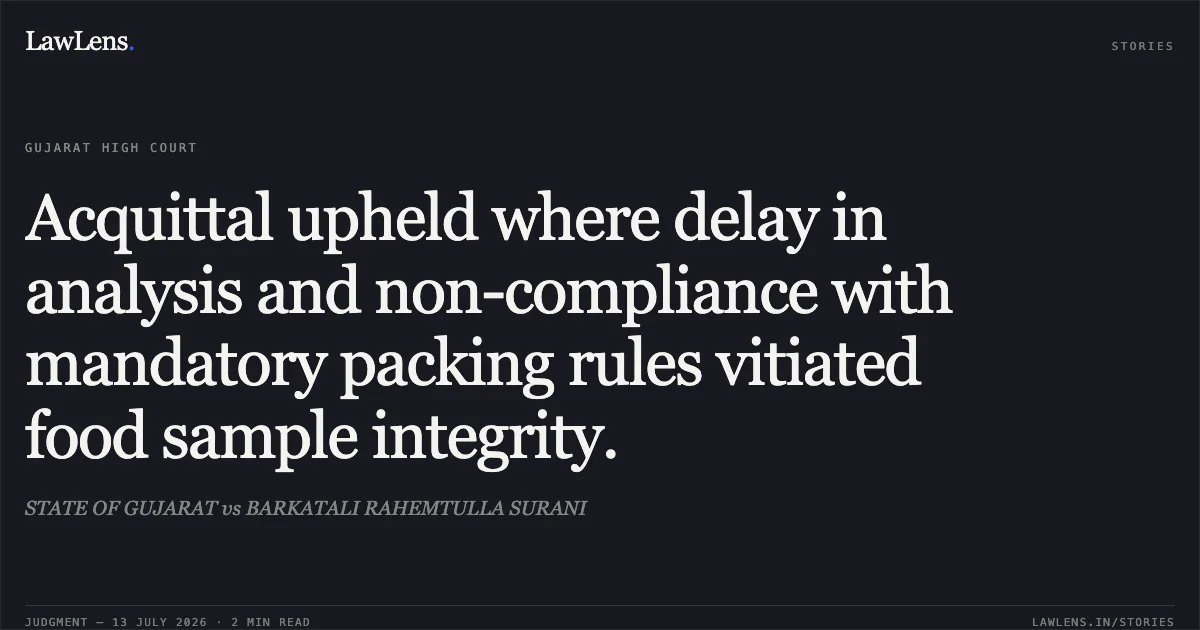
The Court held that the prosecution miserably failed to prove the charges beyond a reasonable doubt due to the breach of mandatory packing rules (Rule 16) and the violation of the accused’s right to independent analysis under Section 13(2)
The High Court dismissed the appeal and confirmed the trial Court's order of acquittal. All bail bonds were cancelled, and the record was ordered back to the Trial Court
Source reference: p. 18Acts & Sections Cited
2 provisions across 1 statute referred to in this judgment. Each provision opens on LawLens.
Code of Criminal Procedure, 19732
Original Court PDF
STATE OF GUJARATvsBARKATALI RAHEMTULLA SURANI
Click to open original judgment
Original judgment, available to read, download and summarize on LawLens.in