Facts
The deceased, Vilasben, was married to Respondent No. 1 (husband) and lived with Respondent No. 2 (mother-in-law). On 09.01.2002, the deceased suffered fatal burn injuries.
Source reference: p. 2The prosecution alleged that after a quarrel the previous evening, the husband poured kerosene and the mother-in-law provided a matchbox to set her on fire.
Source reference: p. 4A dying declaration was recorded by an Executive Magistrate (PW-8).
Source reference: p. 5A neighbor (PW-6) testified that the husband (Respondent No. 1) attempted to douse the fire and save the deceased.
Source reference: p. 4The Trial Court acquitted the accused of charges under Sections 498A, 114, 323, and 302 of the IPC.
Source reference: p. 1-2Issues
1. Whether the dying declaration recorded by the Executive Magistrate was reliable and sufficient to sustain a conviction despite procedural lapses and contradictions.
Source reference: p. 62. Whether the prosecution proved the charges of cruelty and murder beyond a reasonable doubt given the conduct of the accused and the testimony of independent witnesses.
Source reference: p. 8-9Law Applied
Indian Penal Code, 1860, specifically Section 302 (Murder), Section 498A (Cruelty), and Section 114 (Abettor present when offense committed).
Source reference: p. 2For a dying declaration to form the sole basis of conviction, it must be recorded following due procedure and inspire "absolute confidence," typically requiring a medical certificate of the declarant's "fit state of mind".
Source reference: p. 6-7Reasoning
The High Court found the dying declaration (Exh. 33) unreliable due to several factors: the Executive Magistrate (PW-8) admitted to interpolations regarding the date and age, failed to obtain a medical opinion on the deceased's consciousness, and recorded the statement in an operation theater without following standard procedures.
Source reference: p. 6-7Independent witness PW-6 (a neighbor) testified that the husband actively tried to save the deceased and sustained burn injuries himself—conduct inconsistent with homicidal intent.
Source reference: p. 4, 8The father of the deceased (PW-7) admitted in cross-examination that the matrimonial relations were generally smooth.
Source reference: p. 5The Court also noted the prosecution's failure to examine other family members living in the same house or produce reliable seizure panchnamas for the mudammal; consequently, the "chain of circumstances" remained incomplete.
Source reference: p. 8Holding
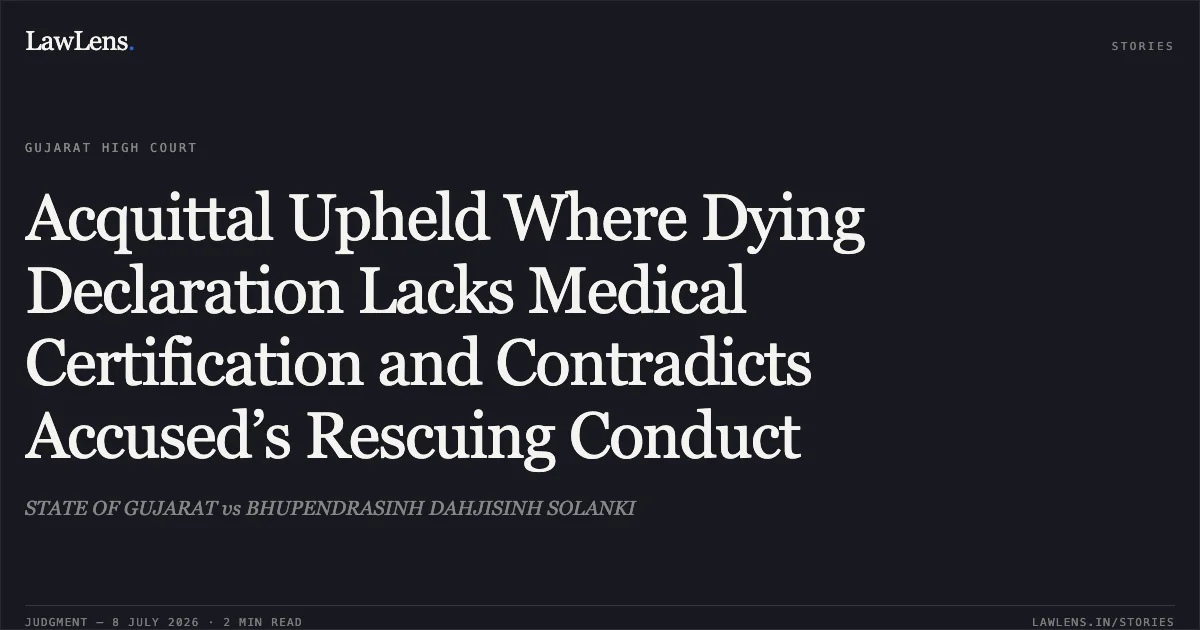
The dying declaration was deemed untrustworthy due to procedural lapses, and the evidence regarding the husband’s attempts to save the deceased created significant doubt regarding the prosecution's narrative.
The High Court dismissed the appeal and upheld the acquittal, holding that the prosecution failed to prove the offenses under Sections 498A, 323, or 302 IPC beyond a reasonable doubt.
Source reference: p. 9Acts & Sections Cited
4 provisions across 2 statutes referred to in this judgment. Each provision opens on LawLens.
Indian Penal Code, 18603
Code of Criminal Procedure, 19731
Original Court PDF
STATE OF GUJARATvsBHUPENDRASINH DAHJISINH SOLANKI
Click to open original judgment
Original judgment, available to read, download and summarize on LawLens.in