Facts
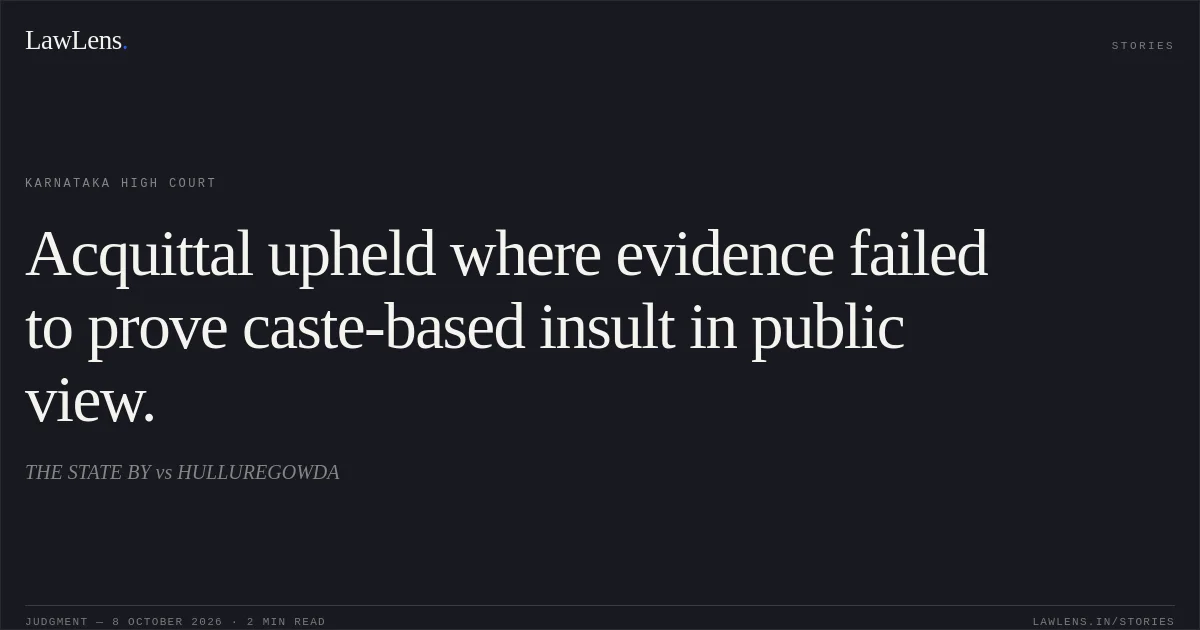
The State appealed the acquittal of four accused by the I Additional District and Sessions Judge, Ramanagara, in a case alleging wrongful restraint, assault, attempted outraging of a woman’s modesty, criminal intimidation and caste-based abuse.
Source reference: pp. 2–4, paras. 1, 3–5The prosecution alleged that, on 13 March 2013, the accused quarrelled with Gowramma over a pathway across land in Survey No. 162, assaulted her and abused her by reference to her caste.
Source reference: p. 3, para. 4At trial, the court heard the complainant and other witnesses, received documentary and medical evidence, and acquitted the accused.
Source reference: pp. 4–5, para. 5The State challenged that acquittal, arguing that the trial court had failed to properly assess the evidence.
Source reference: pp. 4–5, paras. 6–7Issues
Whether the State had established grounds for the High Court to interfere with the trial court’s acquittal.
Source reference: p. 6, paras. 9–10Whether the evidence sufficiently established the alleged offences, including the caste-based offences under Sections 3(1)(x) and 3(1)(xi) of the SC/ST Act.
Source reference: pp. 10–11, para. 21Law Applied
The prosecution relied on Sections 341, 323, 354 and 506 read with Section 34 of the Indian Penal Code, and Sections 3(1)(x) and 3(1)(xi) of the Scheduled Castes and Scheduled Tribes (Prevention of Atrocities) Act, 1989.
Source reference: pp. 2–4, paras. 3–5The High Court assessed whether the record contained cogent and reliable evidence supporting the charges and whether the acquittal disclosed a legal or factual error warranting appellate interference.
Source reference: p. 11, para. 21It cited Constable 907 Surendra Singh v. State of Uttarakhand, Babu Sahebgouda Rudragoudar v. State of Karnataka, Chandrappa v. State of Karnataka and H.D. Sundara v. State of Karnataka in considering the State’s appeal against acquittal.
Source reference: pp. 11–12, para. 21Reasoning
The High Court found that the alleged incident arose from a civil dispute concerning an easementary pathway, and noted that the investigating officer had not produced the land records for Survey No. 162.
Source reference: pp. 9–10, paras. 19–21The medical certificate recorded only simple injuries, which the court considered inconsistent with the alleged assault using the material object.
Source reference: p. 10, para. 21It also found insufficient evidence that the accused intentionally insulted or humiliated the complainant by reference to caste in public view, and concluded that the prosecution evidence was not cogent, consistent or trustworthy enough to sustain the charges.
Source reference: p. 11, para. 21On its review of the record, the Court found no legal or factual error in the acquittal.
Source reference: p. 11, para. 21Holding
The High Court answered the question of interference in the negative.
The High Court dismissed the State’s appeal, leaving the acquittal undisturbed.
Source reference: p. 12, para. 22Acts & Sections Cited
9 provisions across 3 statutes referred to in this judgment. Each provision opens on LawLens.
Code of Criminal Procedure, 19732
Indian Penal Code, 18606
Scheduled Castes and the Scheduled Tribes (Prevention of Atrocities) Act, 19891
Original Court PDF
THE STATE BYvsHULLUREGOWDA
Click to open original judgment
Original judgment, available to read, download and summarize on LawLens.in