Facts
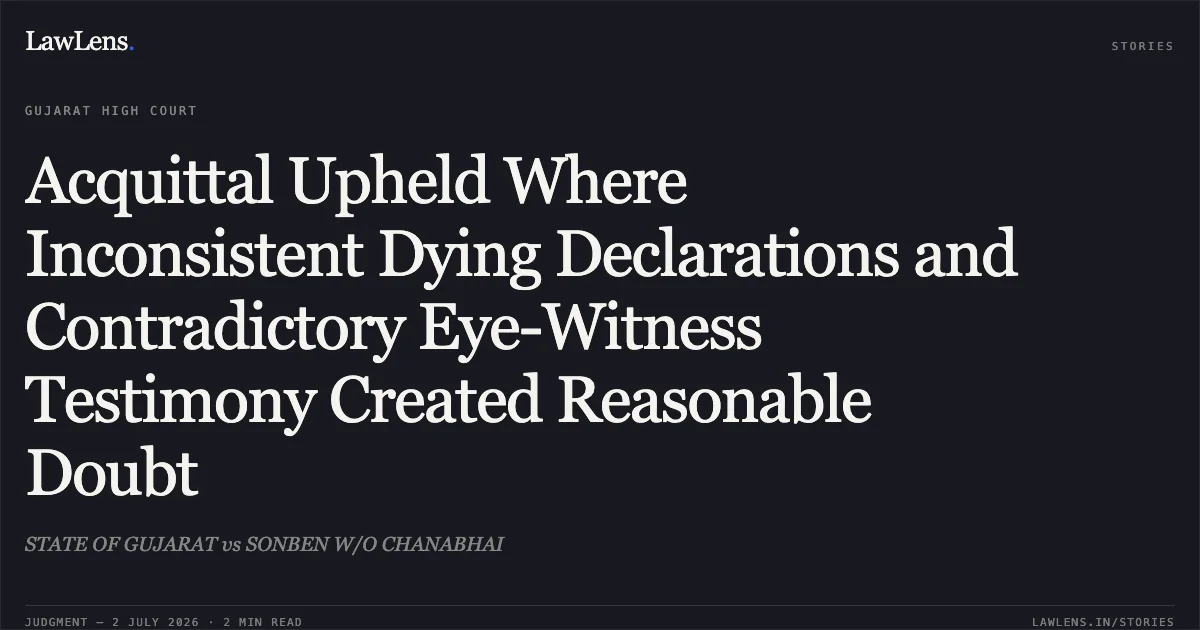
The State appealed against a judgment dated 25.01.2002 by the Additional Sessions Judge, Gondal, which acquitted the accused of charges under Sections 302, 323, 324, 504 r/w 114 of the IPC and the Bombay Police Act.
Source reference: p. 1-2The prosecution alleged that on 22.12.1999, following an altercation regarding children playing, Accused No. 3 (respondent herein) poured kerosene on the deceased (Manjuben) and set her on fire.
Source reference: p. 10The husband (P.W. 2) and another relative (P.W. 3) sustained burn injuries while allegedly attempting rescue.
Source reference: p. 18-19The Trial Court acquitted all accused; the High Court previously confirmed the acquittal of Respondents 1, 2, and 4, restricting this appeal solely to the role of Accused No. 3.
Source reference: p. 11Issues
1. Whether the oral testimony of P.W. 2 (husband) and the dying declarations (Exhs. 44 and 67) were reliable enough to reverse an order of acquittal?
Source reference: p. 25-262. Whether the dying declarations met the legal requirement of proving the declarant was in a "fit state of mind" at the time of recording?
Source reference: p. 29-303. Whether the High Court should interfere with the Trial Court’s findings if two reasonable views are possible?
Source reference: p. 15Law Applied
The Court applied the principles of appellate review of acquittal, noting a "double presumption" of innocence in favor of the accused.
Source reference: p. 11-12It relied on State of Rajasthan v. Ram Niwas and Chandrappa v. State of Karnataka, which mandate that an appellate court should not disturb an acquittal unless the Trial Court's view is perverse or defies logic.
Source reference: p. 12-16Regarding dying declarations, the Court applied Section 32 of the Indian Evidence Act and the principles in Smt. Laxmi v. Om Prakash, emphasizing that a medical certificate must not merely state "consciousness" but must certify a "fit state of mind" to narrate facts coherently.
Source reference: p. 22-23Reasoning
The Court found significant contradictions in the evidence. While P.W. 2 claimed to be a witness, the deceased’s dying declaration (Exh. 44) stated her husband was not home during the incident.
Source reference: p. 20P.W. 2 also failed to name the accused to medical officers initially, and his medical records (Exh. 50) indicated the injuries resulted from a stove blast, not an assault.
Source reference: p. 8, 28Regarding the dying declarations, the Court noted that Exh. 44 Bore a doctor’s note saying "conscious" but lacked certification of "fit state of mind," especially since subsequent Junagadh hospital records described the patient as "confused".
Source reference: p. 24, 29-30Furthermore, the recording times of the Executive Magistrate’s declaration (Exh. 44) and the police statement (Exh. 67) overlapped, casting doubt on their authenticity.
Source reference: p. 30P.W. 3’s testimony further undermined the prosecution by suggesting the deceased immolated herself after losing her temper.
Source reference: p. 19Holding
The High Court held that the prosecution failed to prove the charges beyond a reasonable doubt as the evidence of P.W. 2 was untrustworthy and the dying declarations were tainted by procedural irregularities and medical contradictions.
The Court concluded that the Trial Court’s findings were not perverse and adopted a view favorable to the accused. The appeal was dismissed, and the acquittal of Accused No. 3 was confirmed.
Source reference: p. 31Acts & Sections Cited
6 provisions across 2 statutes referred to in this judgment. Each provision opens on LawLens.
Indian Penal Code, 18605
Code of Criminal Procedure, 19731
Original Court PDF
STATE OF GUJARATvsSONBEN W/O CHANABHAI
Click to open original judgment
Original judgment, available to read, download and summarize on LawLens.in