Facts
The State alleged that on 6 June 2009, the accused formed an unlawful assembly in Bommanahalli, assaulted members of a Scheduled Caste community, and damaged a community-hall signboard and a photograph of Dr. B.R. Ambedkar
Source reference: para. 3, p. 5The accused faced charges under Sections 143, 147, 148, 341, 323, 324, 506, 427 and 295A of the IPC and Sections 3(1)(x) and 3(1)(xi) of the SC/ST (Prevention of Atrocities) Act, 1989
Source reference: p. 4The Sessions Court acquitted accused 1, 3–12, 14–24 and 26–29; accused 2 was dealt with in a separate case, and proceedings against accused 25 had abated on his death
Source reference: paras. 4, 6, pp. 6–7The State appealed under Section 378 CrPC, contending that the trial court had improperly rejected the prosecution evidence
Source reference: paras. 7–8, pp. 7–8Issues
Whether the trial court erred in assessing the prosecution evidence and acquitting the respondents
Source reference: paras. 7, 11–12, pp. 7–10Whether the evidence was sufficient to establish the respondents’ guilt beyond reasonable doubt and warrant reversal of the acquittal
Source reference: paras. 11–12, pp. 9–10Law Applied
The appeal was brought under Section 378(1) and (3) of the Code of Criminal Procedure
Source reference: p. 4The charged offences were under the identified provisions of the IPC and the SC/ST (Prevention of Atrocities) Act, 1989
Source reference: p. 4The Court applied the criminal standard of proof beyond reasonable doubt and the corresponding principle that unresolved doubt benefits the accused, as reflected in its adoption of the trial court’s reasoning
Source reference: para. 11, pp. 9–10Reasoning
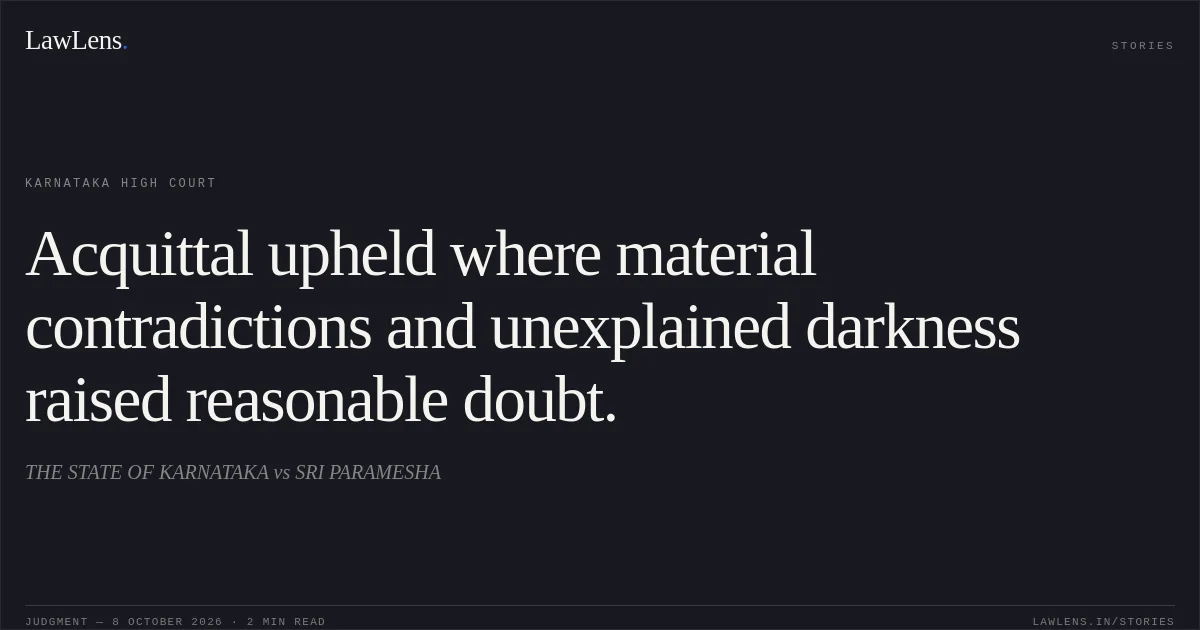
The High Court found no legal or factual error in the trial court’s assessment.
Source reference: para. 12, p. 10The trial court had noted that the witnesses described darkness and a village-wide power outage from about 6:45 p.m., but did not explain how they could observe the incident or identify the assailants
Source reference: para. 11, pp. 9–10It also relied on material contradictions in the eyewitness evidence; PW4 had turned hostile and PW7 had partly turned hostile
Source reference: para. 11, p. 9On re-examination of the record, the High Court saw no basis to disturb the resulting reasonable doubt
Source reference: para. 12, p. 10Holding
The Court answered the challenge to the acquittal against the State, finding no legal or factual error in the trial court’s decision
It dismissed the appeal, leaving the acquittal undisturbed
Source reference: p. 10Acts & Sections Cited
11 provisions across 3 statutes referred to in this judgment. Each provision opens on LawLens.
Code of Criminal Procedure, 19732
Indian Penal Code, 18608
Scheduled Castes and the Scheduled Tribes (Prevention of Atrocities) Act, 19891
Original Court PDF
THE STATE OF KARNATAKAvsSRI PARAMESHA
Click to open original judgment
Original judgment, available to read, download and summarize on LawLens.in