Facts
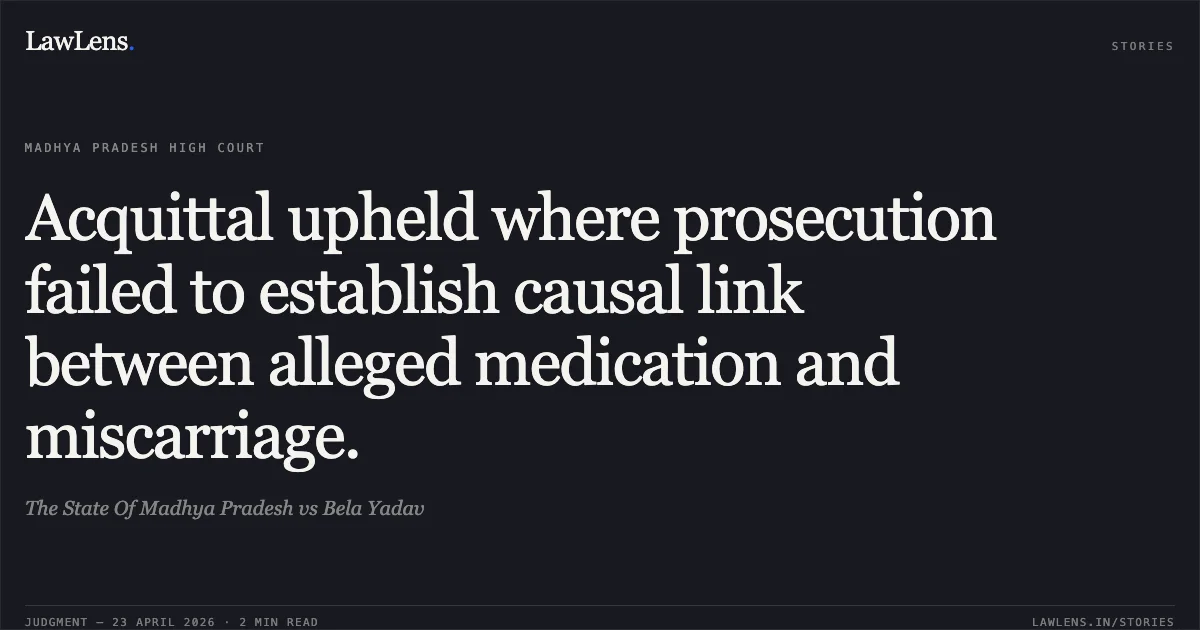
The State of Madhya Pradesh appealed against the judgment dated 17.05.2022 passed in S.T. No. 106/2016, which acquitted the respondent, Bela Yadav, of charges under Section 316 of the IPC.
Source reference: para. 1The prosecution alleged that the prosecutrix (PW-3) was impregnated by her cousin, Pawan Yadav. Upon informing the respondent (Pawan’s sister), the respondent allegedly provided a pill to the prosecutrix to induce an abortion.
Source reference: para. 2The prosecutrix claimed she consumed the pill, suffered stomach pain, and subsequently miscarried.
Source reference: para. 2The prosecutrix was declared hostile after providing contradictory testimony regarding the timeline and circumstances of the abortion.
Source reference: para. 11-12Issues
1. Whether the prosecution established a direct causal link between the medicine allegedly provided by the respondent and the subsequent miscarriage of the prosecutrix to satisfy the ingredients of Section 316 IPC.
Source reference: para. 9 & 142. Whether the evidence on record was sufficient to overturn the trial court’s order of acquittal.
Source reference: para. 16-18Law Applied
Section 316 of the Indian Penal Code (IPC) regarding causing the death of a quick unborn child by an act amounting to culpable homicide.
Source reference: para. 1Evidentiary standard that the prosecution must prove guilt beyond all reasonable doubt, as affirmed in State of Gujarat v. Jayrajbhai Punjabhai Varu (2016).
Source reference: para. 16Appellate principles established in Nikhil Chandra Mondal v. State of W.B. (2023) and Mallappa & others v. State of Karnataka (2024), which mandate that if two views are possible, the view favorable to the accused must be adopted, and an acquittal should only be reversed if the trial court’s finding is perverse or illegal.
Source reference: para. 16-17Reasoning
The Court found the prosecution's case fundamentally lacked corroborative physical evidence. No tablet wrapper, medical bills, or testimony from a chemist were produced to prove the respondent purchased or provided the abortifacient.
Source reference: para. 9The prosecution failed to examine an expert witness to explain the chemical nature of the alleged tablet or its physiological impact.
Source reference: para. 9The Court noted significant contradictions: while the FIR mentioned one tablet, the prosecutrix testified to five; furthermore, the prosecutrix admitted the abortion occurred 8-9 days after consumption and after she had already approached the police, creating a gap in the chain of causality.
Source reference: para. 11The medical testimony of Dr. Sunita (PW-9) confirmed the abortion but failed to link it to the consumption of any specific drug.
Source reference: para. 14Since the prosecutrix admitted the intercourse was consensual and expressed a personal desire to abort, the Court found the trial court's view of "reasonable doubt" to be legally plausible.
Source reference: para. 12-15Holding
The prosecution failed to establish a direct link between the respondent's actions and the abortion with cogent and reliable evidence.
Following the ratio in Mallappa v. State of Karnataka, the Court concluded there was no perversity or error of law in the trial court's judgment that warranted appellate interference.
Source reference: para. 17-18The High Court dismissed the appeal and affirmed the acquittal.
Source reference: para. 19Acts & Sections Cited
3 provisions across 2 statutes referred to in this judgment. Each provision opens on LawLens.
Code of Criminal Procedure, 19732
Indian Penal Code, 18601
Original Court PDF
The State Of Madhya PradeshvsBela Yadav
Click to open original judgment
Original judgment, available to read, download and summarize on LawLens.in