Facts
On 20 June 2008, the Food Inspector of the Ahmedabad Municipal Corporation visited the respondent’s Harsh Dairy in Ahmedabad and purchased 1,500 ml of cow’s milk for Rs.27 in the presence of a panch witness and the complainant’s peon.
Source reference: p.2The milk was stirred, divided into three samples, preserved with formalin, sealed, and one sample was sent for analysis.
Source reference: p.2The Public Analyst reported that the milk solids-not-fat content was below the prescribed standard for cow’s milk under the Prevention of Food Adulteration Rules, 1955, and the respondent was prosecuted under Section 7, punishable under Section 16 of the Prevention of Food Adulteration Act, 1954.
Source reference: p.2The trial Court acquitted the accused in Criminal Case No.5457 of 2008 by judgment dated 28 February 2012.
Source reference: p.1The Ahmedabad Municipal Corporation preferred an appeal under Section 378 of the Code of Criminal Procedure, 1973, challenging the acquittal.
Source reference: p.1Issues
Whether the trial Court was justified in acquitting the respondent-accused of the offence under Section 7 read with Section 16 of the Prevention of Food Adulteration Act, 1954?
Source reference: para.12Whether the trial Court properly appreciated the prosecution evidence and whether its findings suffered from illegality, irregularity, or perversity warranting appellate interference?
Source reference: para.12Whether the prosecution proved compliance with the prescribed sampling and analytical requirements, particularly Rules 4(4) and 14 of the Prevention of Food Adulteration Rules, 1955, and established adulteration beyond reasonable doubt?
Source reference: pp.7–12; paras.14, 19–20Law Applied
The Court applied Sections 7 and 16 of the Prevention of Food Adulteration Act, 1954, concerning the prohibition and punishment of sale of adulterated food, along with Section 13(2) regarding the accused’s right to have the sample examined by the Central Food Laboratory.
Source reference: p.11It considered Rules 4(4) and 14 of the Prevention of Food Adulteration Rules, 1955, which require compliance with prescribed procedures for analysis, sampling, and the use of clean and dry containers; the prosecution must prove such compliance through cogent evidence.
Source reference: pp.7–10, 12The Court relied on State of Gujarat v. Kiritbhai Khusalbhai Patel, [2007] 2 FAC 306, concerning the effect of delay and deficiencies in sampling and preservation; Corporation of the City of Nagpur v. Neetam Manikrao Kature, [1998] SCC (Cri.) 564, concerning the reliability of the analytical method; and State of Gujarat v. Narottambhai Chaganbhai Thakkar, [2007] 1 FAC 465, concerning strict proof of compliance with Rule 14.
Source reference: pp.8–10On appellate review of acquittal, the Court applied Chandrappa v. State of Karnataka, (2007) 4 SCC 415, as reaffirmed in Rajesh Prasad v. State of Bihar, (2022) 3 SCC 471, Babu Sahebagouda Rudragoudar v. State of Karnataka, (2024) 8 SCC 149, and Ramesh v. State of Karnataka, (2024) 9 SCC 169: although an appellate court may reappreciate the evidence, an acquittal carries a double presumption of innocence and should not be disturbed where two reasonable views are possible.
Source reference: paras.15–18Reasoning
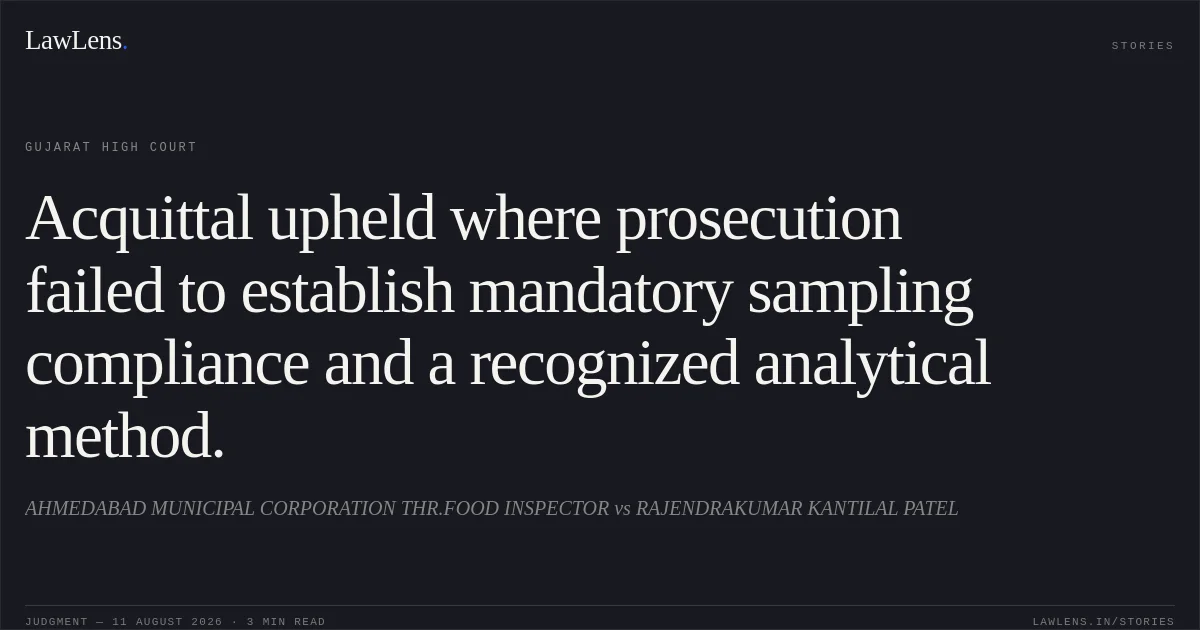
The High Court found that the prosecution failed to establish the reliability of the milk analysis and strict compliance with the mandatory sampling safeguards.
Source reference: para.14The trial Court had correctly concluded that the analytical method recorded by the Public Analyst, namely IS:1224:1977, was not shown to be a recognized or acceptable method for establishing adulteration in the circumstances of the case.
Source reference: para.14The prosecution also failed to satisfactorily prove compliance with Rules 4(4) and 14, including the use and condition of clean and dry bottles and the prescribed sampling procedure.
Source reference: pp.7–10, 12Although the prosecution relied on the analyst’s report and the Central Food Laboratory material, the High Court held that the evidence did not convincingly establish that the sample retained its original character or that the test results could safely support a conviction.
Source reference: paras.14, 19–20In light of these evidentiary deficiencies, the prosecution had not proved the offence beyond reasonable doubt.
Source reference: paras.14, 19–20Since the trial Court’s view was a reasonable one and was not perverse or manifestly illegal, the double presumption in favour of the acquitted accused barred appellate interference.
Source reference: paras.15–18Holding
The High Court answered the issues in favour of the respondent-accused.
It held that the trial Court had properly appreciated the evidence and had committed no illegality, irregularity, or perversity in acquitting him.
Source reference: paras.19–20The criminal appeal was dismissed, the judgment and order of acquittal dated 28 February 2012 were confirmed, the bail bond was cancelled, and the record and proceedings were directed to be returned to the trial Court.
Source reference: para.21Acts & Sections Cited
2 provisions across 1 statute referred to in this judgment. Each provision opens on LawLens.
Code of Criminal Procedure, 19732
Original Court PDF
AHMEDABAD MUNICIPAL CORPORATION THR.FOOD INSPECTORvsRAJENDRAKUMAR KANTILAL PATEL
Click to open original judgment
Original judgment, available to read, download and summarize on LawLens.in