Facts
On 31 March 2020, Police Station Basantpur allegedly received secret information that Ramswaroop Tiwari was transporting intoxicating cough syrup in a Hyundai Eon car. The police intercepted the vehicle and allegedly recovered 420 bottles of Onerex/codeine cough syrup packed in four cartons. The respondent was arrested and charged under Section 21(B) of the Narcotic Drugs and Psychotropic Substances Act, 1985 (“NDPS Act”).
Source reference: paras. 1–3Eight bottles were first sent to the Drug Inspector, who reported the presence of chlorpheniramine maleate and codeine phosphate, but admitted that he had not chemically examined the contents. The samples were subsequently sent to the Forensic Science Laboratory on 18 May 2020. The prosecution did not establish where the seized articles were kept between 1 April and 18 May 2020, and neither the malkhana register nor the malkhana officer was produced or examined.
Source reference: paras. 2, 4, 9, 11, 14The independent witnesses turned hostile. The Investigating Officer was also the informant and admitted several procedural deficiencies, including failure to prove the custody of the seized articles, absence of the specimen seal on the relevant document, and failure to specify where in the vehicle the syrup was found. The trial court acquitted the respondent, holding that the prosecution had failed to prove the charge beyond reasonable doubt. The State preferred an appeal under Section 378(1) of the Code of Criminal Procedure.
Source reference: paras. 1, 3, 8–10Issues
Whether the prosecution proved beyond reasonable doubt that the seized cough syrup was a prohibited narcotic substance and that the respondent was in conscious possession of it, so as to sustain conviction under Section 21(B) of the NDPS Act?
Source reference: paras. 9–14, 17Whether the trial court’s order of acquittal was perverse or legally unsustainable so as to warrant interference in an appeal under Section 378(1) CrPC?
Source reference: paras. 15–17Law Applied
The Court applied Section 21(B) of the NDPS Act, which criminalises possession, sale, purchase, or transport of manufactured drugs or preparations containing substances covered by the provision, and Section 378(1) CrPC governing appeals against acquittal.
Source reference: paras. 1, 3The prosecution was required to establish the identity of the contraband, its safe custody and chain of possession, and the accused’s conscious possession beyond reasonable doubt.
Source reference: paras. 9–14, 17Relying on State of Rajasthan v. Kistoora Ram, 2022 SCC OnLine SC 984, the Court held that an appellate court should not interfere with an acquittal where the trial court’s view is possible or plausible, unless it is impossible or perverse.
Source reference: para. 15It further relied on Jafarudheen v. State of Kerala, (2022) 8 SCC 440, which recognises that an acquittal reinforces the presumption of innocence and may be disturbed only after thorough scrutiny on settled legal principles.
Source reference: para. 16Reasoning
The Court found material gaps in the prosecution case. The Drug Inspector had not chemically examined the contents of the bottles, and the prosecution failed to prove the safe custody of the seized material during the period preceding its FSL examination.
Source reference: paras. 9, 11, 14The absence of the malkhana register and non-examination of the malkhana officer left open the possibility of tampering and weakened the evidentiary value of the chemical report.
Source reference: paras. 9, 11, 14The independent witnesses did not support the seizure, while the prosecution evidence contained inconsistencies regarding whether the syrup was seized from the respondent or merely from the vehicle, the precise location of the bottles, and the seizure documentation.
Source reference: paras. 9–13These deficiencies created reasonable doubt both as to the identity and integrity of the alleged contraband and as to the respondent’s conscious possession.
Source reference: paras. 14–17Since the trial court’s conclusion was a plausible view of the evidence, the heightened presumption of innocence applicable in an appeal against acquittal prevented the High Court from substituting another possible view merely because the State considered conviction more probable.
Source reference: paras. 14–17Holding
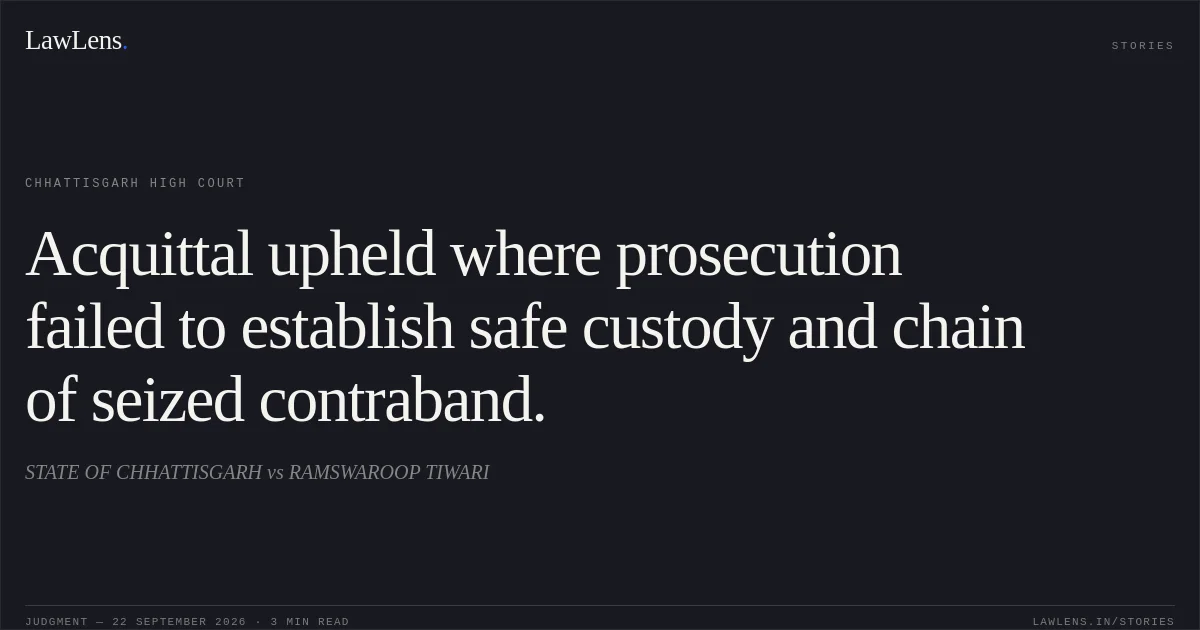
The High Court held that the prosecution failed to prove the respondent’s conscious possession of prohibited contraband and failed to establish an unimpeachable chain of custody.
The trial court’s acquittal was a possible and plausible view supported by the evidence and was neither perverse nor illegal.
Source reference: para. 17Accordingly, the State’s acquittal appeal was dismissed, and the respondent’s acquittal under Section 21(B) of the NDPS Act was affirmed.
Source reference: para. 18Acts & Sections Cited
5 provisions across 2 statutes referred to in this judgment. Each provision opens on LawLens.
Code of Criminal Procedure, 19733
Narcotic Drugs and Psychotropic Substances Act, 19852
Original Court PDF
STATE OF CHHATTISGARHvsRAMSWAROOP TIWARI
Click to open original judgment
Original judgment, available to read, download and summarize on LawLens.in