Facts
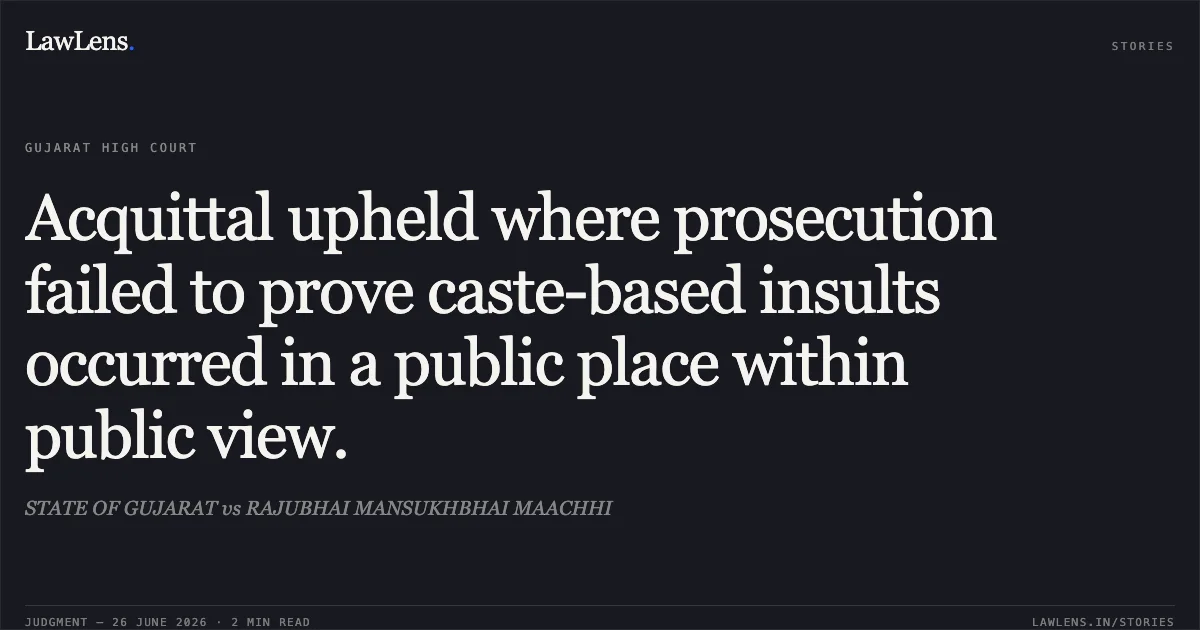
The State of Gujarat appealed an acquittal order regarding a 2008 incident where a primary school teacher, belonging to a Scheduled Caste, alleged he and his family were assaulted and verbally abused by neighbors
Source reference: p.1-2The complainant claimed the respondents attacked him with sticks to prevent him from attending a court hearing for a previous dispute
Source reference: p.2Procedurally, the Trial Court acquitted the accused after finding the prosecution failed to prove the charges beyond reasonable doubt
Source reference: p.6During the pendency of the appeal, both the original complainant and Respondent No. 4 passed away, leading to the abatement of the appeal against Respondent No. 4
Source reference: p.6Issues
1. Whether the Trial Court committed a manifest error or perversity in its appreciation of evidence while acquitting the respondents
Source reference: p.8-92. Whether the alleged verbal abuse occurred in a "public place within public view" so as to attract the specialized penal provisions of the Atrocity Act
Source reference: p.10-11Law Applied
The Court applied Sections 323 (voluntarily causing hurt), 504 (intentional insult), 506(2) (criminal intimidation), and 114 (abettorship) of the Indian Penal Code
Source reference: p.9Section 3(1)(10) of the Scheduled Castes and Scheduled Tribes (Prevention of Atrocities) Act, 1989
Source reference: p.10The Court relied on Chandrappa v. State of Karnataka regarding the double presumption of innocence in appeals against acquittal
Source reference: p.12The Court further cited Shajan Skaria v. State of Kerala and Gunjan @ Girija Kumari v. State (NCT of Delhi) to clarify that for an offence under the Atrocity Act to be made out, the insult must occur in a public place within public view with the intent to humiliate based on community
Source reference: p.10-11Reasoning
The High Court found that the prosecution's narrative was inconsistent with the medical evidence provided by the examining physician, who did not support the version of events provided by the complainant's family
Source reference: p.10The Court observed that the incident allegedly took place at the complainant's doorstep, which did not satisfy the "public view" requirement established by the Supreme Court for Atrocity Act violations
Source reference: p.10-11Evidence emerged suggesting a history of the complainant filing multiple similar cases to obtain government compensation, casting doubt on the credibility of the testimony
Source reference: p.10-11The Court reasoned that since the Trial Court's view was a plausible interpretation of the evidence, there were no "substantial or compelling reasons" to overturn the acquittal
Source reference: p.12-14Holding
The Court held that the prosecution failed to prove the charges beyond a reasonable doubt and that the misuse of specialized legislation for personal disputes could not be sustained
The High Court dismissed the State's appeal and confirmed the Trial Court's judgment of acquittal. All bail bonds were ordered cancelled
Source reference: p.16Acts & Sections Cited
8 provisions across 3 statutes referred to in this judgment. Each provision opens on LawLens.
Code of Criminal Procedure, 19733
Indian Penal Code, 18604
Scheduled Castes and the Scheduled Tribes (Prevention of Atrocities) Act, 19891
Original Court PDF
STATE OF GUJARATvsRAJUBHAI MANSUKHBHAI MAACHHI
Click to open original judgment
Original judgment, available to read, download and summarize on LawLens.in